
Showing posts with label 1860. Show all posts
Showing posts with label 1860. Show all posts
Tuesday, June 11, 2013

Saturday, June 8, 2013
Pointless Presidential Pfacts #41 - "Moving On Up"
What happened to the first vice president of the United States after his second term ended in 1797? Oh, that's right, he became the president of the United States.

John Adams. Massachusetts. 2nd POTUS. 1797-1800. Federalist. 1st VPOTUS. 1789-1797. President Washington.
What happened to the second VPOTUS? Well he, too, became the POTUS four years later in 1801 after the only Presidential Election pitting the sitting VPOTUS versus the sitting POTUS.
Okay, now there's a little break in the vice presidents going right to the top job. The Secretary of States get the attention for awhile, while the 12th Amendment, separate votes for president and vice president, diminished the quality of men for the poorly created second-in-command of the United States Government. USA! USA! USA! The 3rd VPOTUS, Aaron Burr, after nearly becoming the 3rd POTUS when the 1800 election didn't produce a majority in the Electoral College, but rather a tie. Burr went on to murder Alexander Hamilton in a duel in 1804 which helped to ruin his reputation as well as some treasonous actions in the West.
Burr's successors in the vice presidency, George Clinton, Jefferson's second VPOTUS and Madison's first VPOTUS, and Elbridge Gerry, Madison's second vice president, died in office. The 6th VPOTUS, Daniel D. Tompkins, was only the second vice president to be elected to two terms and serve the full 8 years after John Adams, the 1st VPOTUS. It wouldn't be until 1912, when Thomas R. Marshall was elected the 28th VPOTUS and served two terms and eight years. However, unlike Vice President Adams or even Vice President Jefferson, Vice President Tompkins would not run for the presidency and would end up dying just months after leaving office in 1825.
John C. Calhoun would be safely elected vice president in the crazy, but interesting, 1824 Presidential Election. Calhoun was the vice presidential nominee for both Andrew Jackson and John Quincy Adams. While the presidential race was chaos with four candidates from the same party, since the Federalists were finished as a national political party after the success of the War of 1812. The factions that made up the Democratic-Republicans, had four candidates for the top of the ticket and three for the bottom. While Jackson would win a plurality of both popular votes (not all States votes were counted at this point, but those that were Jackson had the most) and the Electoral College, but not a majority. Calhoun however did receive a majority of Electoral Votes and became the 7th VPOTUS and had to wait to see who his president would be. Vice President Calhoun would be the second and, so far, last vice president to serve two different presidents.

John C. Calhoun. South Carolina. 7th VPOTUS. 1825-1832. Presidents Adams 6 and Jackson. Democratic-Republican (1825-1829). Democratic (1829-1832).
When the House of Representatives elected John Quincy Adams the 6th POTUS, Jackson essentially campaigned against Adams 6 for the next four years. Jackson's supporters, calling themselves Democrats, helped put Jackson in the Executive Mansion in 1829 with Calhoun reelected to a second term, but with a new president. Calhoun would be the last reelected vice president until Vice President Marshall wins with Woodrow Wilson in 1916 for a second term. However, Calhoun would not finish his second term. He would resign the vice presidency in the Presidential Election year of 1832, so he could be elected Senator from South Carolina. He was a thorn in President Jackson's side, probably just as ruckus as the Adams 2/Jefferson administration from 1797-1801.
It is with Vice President Calhoun's successor and President Jackson's second vice president, Martin Van Buren, where the sitting vice president has a chance for the top job. The one term vice president would be elected to one term and kicked out of office thanks to bad economic times.

Martin Van Buren. New York. 8th POTUS. 1837-1841. 8th VPOTUS. 1833-1837. Democratic.
After Van Buren's jump right from the vice presidency to the presidency, it would be some time before anyone attempted it or do what Adams 2, Jefferson and Van Buren had accomplished. Van Buren's own vice president, Richard M. Johnson, who needed the Senate to be elected vice president since he was a few votes shy of a majority in the Electoral College thanks to his relations with a slave, did not run for the presidency and is part of that great pantheon of unknown 19th Century vice presidents. From 1841 to 1965, there would be vice presidents that become president through death, natural or assassinated, like John Tyler, Millard Fillmore, Andrew Johnson, Chester A. Arthur, Theodore Roosevelt, Calvin Coolidge, Harry S. Truman, and Lyndon B. Johnson. Of that group, Tyler through Arthur never faced the People at the top of the ballot, Fillmore did as a third party candidate in 1856 for the Know-Nothing Party and won Electoral Votes. Not that late 20th Century/early 21st Century third party placing $#!t. The remainder of that list won reelection to the presidency in their own right after serving out the term of the fallen president. The 1860 Presidential Election had the incumbent Vice President John C. Breckinridge, the youngest VPOTUS to serve at 36 in 1857 with President James Buchanan, ran against the GOP's second presidential candidate, Abraham Lincoln and the Democratic Party's Stephen Douglas. While Lincoln came in first in both popular and Electoral Votes, Breckinridge came in second in the Electoral College and third in popular votes after Douglas. Breckinridge of course carried the South, as he ran as the candidate for the Southern Democratic Party. Breckinridge, like all incumbent vice presidents, had to read the winner of the Electoral College during a Joint-Session of Congress, announcing his loss and his opponent's victory. Unlike Vice President Breckinridge, Vice Presidents Adams, Jefferson, and Van Buren announced their victories as Commander-in-Chief.

John C. Breckinridge. Kentucky. 14th VPOTUS. Democratic. 1857-1861. President Buchanan. 1860 Southern Democratic Presidential Candidate. Youngest man elected vice president at 36 in 1856.
100 years after Vice President Breckinridge's loss, Vice President Richard M. Nixon would have to announce his defeat in the close 1960 Presidential Election with Senator John F. Kennedy. Nixon was the first incumbent vice president to run for the presidency since Breckinridge. Eight years later in 1968, Hubert Humphrey would follow in Nixon's footsteps as the next eligible incumbent vice president to try for the top of the ticket. Like Nixon's 1960 close election, the incumbent vice president lost in a SUPER close race, this time however Nixon was on the winning side of the election, becoming the first former vice president to win the presidency.

Richard Nixon. California. 37th POTUS. 1969-1974. Republican. 36th VPOTUS. 1953-1961. 1960 Republican Presidential Candidate.
Nixon in 1960.
From there the next eligible V.P. would be George Bush in 1988. Nixon's vice president, Spiro Agnew, would resign, becoming the second to do so and be replaced by first-appointed vice president under the 25th Amendment, Gerald Ford. Ford would of course go on to be POTUS, the first to never run for the office or the vice presidency. Jimmy Carter and his running-mate, Walter Mondale, would lose a second term to Ronald Reagan and George Bush in 1980, but as if he served 8 years, Mondale tries his turn at the top of the ticket in 1984 and did worse than when he was on the bottom four years prior. So with Reagan and Bush's reelection in '84 and the 22nd Amendment limiting Reagan to two terms, Bush was next as the incumbent vice president for the top of the Republican Party's ticket in '88.

George Herbert Walker Bush. Texas. 41st POTUS. 1989-1993. Republican. 43rd VPOTUS. 1981-1989. President Reagan.
Vice President Bush accepting the GOP nomination in 1988.
Bush 41 would be the first sitting vice president to run since Humphrey ran 20 years prior, but unlike the 1968 Democratic Candidate, Bush 41 was more like the Democratic Vice President in 1836, Martin Van Buren, the last incumbent to win the presidency. So for the first time in the 20th Century and since Van Buren in 1837, the vice president of the United States announced his win in the Electoral College making him the next president of the United States. Had Bush 41 won reelection in 1992 (some say he would have had Ross Perot not been in the race, since as a third party candidate Perot siphoned) and served out his second term until 1997, he would've been the first person to have served two terms as vice president and two as POTUS, just it would have been for another presidential father, Adams 2 in 1800. Jefferson served one term as VPOTUS and two as POTUS. MVB served one term as both the VP and POTUS. Nixon has been elected twice to both the presidency and vice presidency, but he did not complete his second term. There's a record to be broken, that's four out of five national elections. The 5th election was the super-close 1960 Presidential Election where JFK defeated the incumbent Vice President Nixon.

Al Gore. Tennessee. 45th VPOTUS. 1993-2001. Democratic. 2000 Democratic Presidential Candidate and winner of the Popular Vote in the 2000 Presidential Election.
The screen capture is of his concession speech on December 13, 2000 after 36 days of recounts and legal battles.
Al Gore would come very very close to the presidency with a win in the popular vote in 2000 but not in the Electoral College thanks to the U.S. Supreme Court's ruling in Bush v. Gore, which ended the recounts in Florida which then gave the State's votes to Bush 43. Eight years later in 2008, Vice President Richard Cheney would not run for the presidency. The chances of the current Vice President Joe Biden running in 2016 are slim. He will be 74 and while 74 is the new 64, he faces popular challengers from his own party and the GOP. So only time will tell if a future vice president will be a Bush 41 (winner), a Gore (super close), a Humphrey (close enough), a Mondale (loser, electorally), or a Nixon (all of the above).

Former Vice President Richard Nixon campaigning in 1968 as the GOP's Presidential Nominee, for a second time.
Friday, April 19, 2013
Pointless Presidential Pfacts #35 - "Lincoln, Kennedy and Monroe"
There are many coincidences throughout history and even within a country's own history, like the United States. Now the internets have been passing misinformation around big time, including on the legend of the connections between Abraham Lincoln and John F. Kennedy. The inaccuracies forced me to write this piece based off of simple coinkydinks that occurred during the Lincoln and Kennedy presidencies, starting with some accurate non-coinkydinks events in presidential history.
Abraham Lincoln was born on February 12, 1809 and John F. Kennedy was born on May 29, 1917. No similarity there between the two. Lincoln was elected the 16th POTUS while Kennedy became the 35th POTUS. Still nothing coincidental about those facts.

Abraham Lincoln. 16th POTUS. Illinois. Republican.
Lincoln was elected to Congress in 1846 and JFK was elected in 1946. Exactly (well in years) one hundred years apart Lincoln and Kennedy were elected to the House of Representatives. Representative Lincoln served only one term in the House after being a part of the Whig Party's opposition to President James K. Polk and the Democratic Party's war win against Mexico, making the United States a continental power. Representative Kennedy on the other hand went on to win reelection to his House seat two more times and then in 1952 wins the race for Massachusetts' open senate seat in the U.S. Senate, the other house of Congress.

John F. Kennedy. 35th POTUS. Massachusetts. Democrat.
Senator Kennedy went from the Senate to the White House in 1960, whereas Lincoln won the presidential election of 1860 without having served in elected politics since he left the House in 1849, when Polk was leaving office and Zachary Taylor was entering office. One hundred years apart both became president of the United States. They were both challenged by an incumbent, and youthful, vice president in the General Election, John C. Breckinridge in 1860 and Richard M. Nixon in 1960, both would announce their loss to Lincoln and Kennedy, respectively, to a Joint-Session of Congress.
President Lincoln had to deal with States in rebellion from the start of his term and his goal was first and foremost to preserve the Union of States before the Civil War took on the responsibility of freeing the enslaved blacks in the South. He was president during the Civil War, while JFK was a president that served during the Cold War, another "C"-"W" initialed event. His hundred year counterpart would become associated with Civil Rights as well and his death would help push Civil Rights legislation through the Congress by his successor one hundred years after the Civil War ended. Essentially the Civil Rights that Lincoln began fighting for don't come to until almost one hundred years after his death.
As president, they both had young children in the White House, or during Lincoln's time, the Executive Mansion. Their wives also lost a child while living in the presidential mansion. Mary Todd Lincoln, and the president, lost their youngest William to an illness at the age of 11, where Jack and Jackie Kennedy lost their child, Patrick, two days after being born. The two died one hundred and one years apart.
Both presidents had secretaries named after the other. President Lincoln had a secretary named Kennedy and President Kennedy had a secretary named Lincoln.
But there's more connections.

John Wilkes Booth shoots President Lincoln while he, his wife and the Rathbones (such a 19th Century-sounding name) watch "Our American Cousin" from box seats at Ford's Theater. Why the sketch artist just sketched and didn't help is one of history's greatest unsolved mysteries so says the ghost of Robert Stack.
Lincoln was assassinated in 1865 and Kennedy was assassinated in 1963, almost one hundred years. Almost. But they were both shot on a Friday while sitting next to their wives. Both were shot in the head. They were with another couple. The Lincolns went to Ford's Theater with the Rathbones and the Kennedys rode with the Connallys in an automobile named Lincoln. Both males that were with the president when they were shot were both injured and survived the attacks. The presidents were shot by men from the South. One was born in 1838 and the other born in 1939. The assassins were known by their full name, three names made up of 15 letters, John Wilkes Booth and Lee Harvey Oswald. Booth fled a theater for an abandoned warehouse, whereas Oswald did the opposite, he went from a warehouse to a theater. Both Booth and Oswald were shot and killed before their trial.

"Oswald!" yelled Jack Ruby as he shot Lee Harvey Oswald on LIVE television.
Both presidents were succeeded by Southerners who were their vice presidents. Both vice presidents were named Johnson and born one hundred years apart, 1808 and 1908 Tennessee's Andrew Johnson was loyal to the Union and put on the Union Party ticket with President Lincoln in 1864, a ticket made up of a Republican and a Democrat. Johnson became the 17th POTUS the day after Lincoln was shot and three hours after he died. Texas' Lyndon Johnson ran with Kennedy in 1960 and was sworn in as the 36th POTUS the day JFK was shot and killed in Dallas. Johnson-17 would go on to become the first impeached POTUS but survived the trial in the Senate by one vote in a battle to control Reconstruction of the South. His impeachment would weaken the executive branch, which was strong during Lincoln's terms, for the rest of the 19th Century. Johnson-36 would go on to win a landslide election of his own in 1964 but while he had success with Civil Rights and hoped for a great society, Johnson-36 eventually lost favor with the American people and his party as reelection in 1968 seemed impossible thanks to the longevity of the Vietnam War and his mishandling of the Cold War's proxy hot war.
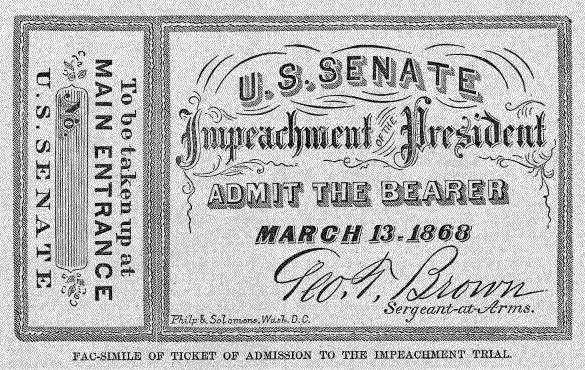
A ticket to the Impeachment Trial of President Andrew Johnson in the Senate in 1868.

Lyndon B. Johnson. 36th POTUS. 37th VPOTUS. Texas. Democrat.
The punchline of the fact sheet from the pre-Internet days ends with Lincoln being in Monroe, Maryland a week before his assassination setting up Kennedy to be in Marilyn Monroe a week before his. There is no Monroe, Maryland and Marilyn Monroe died in 1962...all according to Google.
All of this is nothing but historical coincidences. Nothing more. These comparisons between the two American presidents has been going on since the mid-1960s, more than likely.
Thursday, February 12, 2009
Today in POTUStory
Today in 1809 the myth, the legend, and the man...well just the man was born. The myth and the legend would come on April 15, 1865.
200 years ago our nation's 16th president of the United States was born in Kentucky. He and his family then moved to Indiana before settling down in his home state he has become associated with Illinois.

The 16th President of the United States
Lincoln would go on to become a lawyer traveling the judicial circuit of Illinois. As a lawyer he honed his skills which would help him become the great writer and speaker of his later years.
From 1847-1849, Lincoln served one term in the United States House of Representatives during the Mexican-US War in which he strongly opposed. While he would go on to become a founding member of the Republican Party, he served in the House as a member of the Whigs, a political party which would contribute to the founding of the Grand Old Party.
Lincoln would rise to national prominence in the most famous senate race in U.S. history. In 1858 Lincoln would debate his Democratic opponent Stephen Douglas and utter the famous "house divide" lines in terms of the nation existing half slave and half free. Although not competing in a directly elected senate contest since this took place prior to 1913, the Democrats won the majority in the State legislature and thus elected Douglas to the U.S. Senate. Lincoln may have lost but he became a national figure.

The Lincoln-Douglas Debates
In 1860 the New York Republican Party invited Lincoln to speak at Cooper Union. His speech elevated his status within the Republican Party. That year Lincoln would take on the big names of the Republican Party for the party's presidential nomination. Men like William Seward of New York, Salmon P. Chase of Ohio, and Edward Bates of Missouri. Lincoln, the one term Representative from Illinois, would be the victor in the contest against the heavy weights.

Lincoln's chief rival for the Republican nomination and his pick for Secretary of State, William Seward
By November Lincoln would face three other opponents for the presidency: the incumbent vice president John Breckinridge, John Bell, and his former opponent for the U.S. senate, Stephen Douglas. Lincoln won.
With Lincoln's election, or the election of a Republican, the South protested in form of succeeding from the Union. Lincoln would be inaugurated as president without a complete Union of States.

Seal of the Confederate States of America
Those that left the Union feared Lincoln would abolish their way of life or violate their States' Right. Lincoln made it clear he had no intention of doing such a thing. But that did not stop the southern States from leaving the Union and rebelling.
Lincoln's term would become defined by war like no other president in U.S. history. While Lincoln struggled with the war he thought would be over quickly, he also tried to maintain the status of the Union by continuing construction on the dome of the Capitol or building the transcontinental railroad connecting east and west.
The war between the States (or the Civil War or The War against Northern Aggression) was not fought on the issue of slavery. For Lincoln the war was fought to preserve the idea of the Union which was established in 1776. The war took on the notion of ending slavery by January of 1863 when the Emancipation Proclamation took effect, freeing the slaves within the States in rebellion. With that new cause taken by President Lincoln, the war was not only fought to preserve the Union and free the slaves but to essentially fight for a new definition of what the United States was truly about.
All the way up until 1864, Lincoln thought he would be a one term president. But as successes came in by Generals Ulysses S. Grant and William Sherman, Lincoln's election became clear. Instead of running as a Republican, he ran on the Union Party ticket with Democrat Andrew Johnson, the only senator from the South to remain loyal to the Union. The Union Party won and Lincoln was reelected.
Lincoln was determined to not punish the South and he made it clear in his Second Inaugural Address as he declared "With malice toward none, with charity for all."

Lincoln's Second Inaugural on the east front of the Capitol
Lincoln would be shot by southern sympathizer, Confederate spy, and well known actor John Wilkes Booth on Good Friday, April 14, 1865, creating the myth and the legend of the man.

John Wilkes Booth
After his death Abraham Lincoln became a secular saint to some Americans and a war criminal to others. Historians rank him as the best or second best president (George Washington and Lincoln duke it out for the top two spots), while others claim him to be a tyrant and should be removed from Mount Rushmore.
No matter what you believe about Abraham Lincoln, savior of the Union or aggressor toward southerners, he now belongs to the ages.
200 years ago our nation's 16th president of the United States was born in Kentucky. He and his family then moved to Indiana before settling down in his home state he has become associated with Illinois.
The 16th President of the United States
Lincoln would go on to become a lawyer traveling the judicial circuit of Illinois. As a lawyer he honed his skills which would help him become the great writer and speaker of his later years.
From 1847-1849, Lincoln served one term in the United States House of Representatives during the Mexican-US War in which he strongly opposed. While he would go on to become a founding member of the Republican Party, he served in the House as a member of the Whigs, a political party which would contribute to the founding of the Grand Old Party.
Lincoln would rise to national prominence in the most famous senate race in U.S. history. In 1858 Lincoln would debate his Democratic opponent Stephen Douglas and utter the famous "house divide" lines in terms of the nation existing half slave and half free. Although not competing in a directly elected senate contest since this took place prior to 1913, the Democrats won the majority in the State legislature and thus elected Douglas to the U.S. Senate. Lincoln may have lost but he became a national figure.
The Lincoln-Douglas Debates
In 1860 the New York Republican Party invited Lincoln to speak at Cooper Union. His speech elevated his status within the Republican Party. That year Lincoln would take on the big names of the Republican Party for the party's presidential nomination. Men like William Seward of New York, Salmon P. Chase of Ohio, and Edward Bates of Missouri. Lincoln, the one term Representative from Illinois, would be the victor in the contest against the heavy weights.
Lincoln's chief rival for the Republican nomination and his pick for Secretary of State, William Seward
By November Lincoln would face three other opponents for the presidency: the incumbent vice president John Breckinridge, John Bell, and his former opponent for the U.S. senate, Stephen Douglas. Lincoln won.
With Lincoln's election, or the election of a Republican, the South protested in form of succeeding from the Union. Lincoln would be inaugurated as president without a complete Union of States.
Seal of the Confederate States of America
Those that left the Union feared Lincoln would abolish their way of life or violate their States' Right. Lincoln made it clear he had no intention of doing such a thing. But that did not stop the southern States from leaving the Union and rebelling.
Lincoln's term would become defined by war like no other president in U.S. history. While Lincoln struggled with the war he thought would be over quickly, he also tried to maintain the status of the Union by continuing construction on the dome of the Capitol or building the transcontinental railroad connecting east and west.
The war between the States (or the Civil War or The War against Northern Aggression) was not fought on the issue of slavery. For Lincoln the war was fought to preserve the idea of the Union which was established in 1776. The war took on the notion of ending slavery by January of 1863 when the Emancipation Proclamation took effect, freeing the slaves within the States in rebellion. With that new cause taken by President Lincoln, the war was not only fought to preserve the Union and free the slaves but to essentially fight for a new definition of what the United States was truly about.
All the way up until 1864, Lincoln thought he would be a one term president. But as successes came in by Generals Ulysses S. Grant and William Sherman, Lincoln's election became clear. Instead of running as a Republican, he ran on the Union Party ticket with Democrat Andrew Johnson, the only senator from the South to remain loyal to the Union. The Union Party won and Lincoln was reelected.
Lincoln was determined to not punish the South and he made it clear in his Second Inaugural Address as he declared "With malice toward none, with charity for all."
Lincoln's Second Inaugural on the east front of the Capitol
Lincoln would be shot by southern sympathizer, Confederate spy, and well known actor John Wilkes Booth on Good Friday, April 14, 1865, creating the myth and the legend of the man.
John Wilkes Booth
After his death Abraham Lincoln became a secular saint to some Americans and a war criminal to others. Historians rank him as the best or second best president (George Washington and Lincoln duke it out for the top two spots), while others claim him to be a tyrant and should be removed from Mount Rushmore.
No matter what you believe about Abraham Lincoln, savior of the Union or aggressor toward southerners, he now belongs to the ages.
Subscribe to:
Posts (Atom)