Showing posts with label VPOTUS. Show all posts

Tuesday, January 28, 2014

(Vice) Pointless (Vice) Presidential (Vice) Pfacts #47 - "It Has Nothing to Do with 47% of Anything Except a Warm Bucket of Spit"

The 47th vice president is the incumbent, Joseph Biden of Delaware. President Barack Obama is the 44th POTUS but only the 43rd man to be president. President Grover Cleveland's two non-consecutive terms established how we count our presidents since Cleveland was the 22nd POTUS and his popular vote losing successor, Benjamin Harrison, was the 23rd POTUS and when the two had a rematch in 1892 Cleveland became the 24th POTUS instead of simply being known as just the 22nd POTUS.

For the vice presidency, there has not been a non-consecutive vice president to serve. But the reason there are more vice presidents than presidents, and only by 3, is because some vice presidents have served more than one president, some have been dropped and replaced by another, and then with the passage of the 25th Amendment, some have been appointed to fill a vacancy.

Only two vice presidents have served two different presidents. George Clinton was the first as Thomas Jefferson's second vice president, and first elected under the 12th Amendment, and while President Jefferson left office, Vice President Clinton was reelected to a second term with the newly elected James Madison. Clinton would also become the first vice president to die in office in 1812 as President Madison was seeking reelection that year. Interestingly, Clinton's replacement Elbridge Gerry would be the second vice president to die in office. The other vice president to serve two different presidents was John C. Calhoun. He was elected vice president with a majority of votes in 1824, unlike the presidential winner. Calhoun ran on 2 tickets in the same race so he was guaranteed to win enough votes to be the vice president. John Quincy Adams became president in 1825 and by the 1828 election the incumbent vice president was running against the administration. The ticket of Andrew Jackson and Calhoun won but the would become so antagonistic toward each other that Vice President Calhoun resigned, becoming the first to do so, and win election to the Senate to better combat President Jackson.


Vice President George Clinton.

While Clinton and Calhoun are the only two vice presidents to stick around for more than one president, some vice presidents haven't even been asked back for another term. Vice President Burr was not on the first ticketed election in 1804, Clinton was the first vice president to replace another in a second term of a presidency. Since Calhoun resigned in 1832, President Jackson got a new vice president for the second term, Martin Van Buren. Jump to 1860 when Abraham Lincoln and Hannibal Hamlin won the general election with a plurality of the popular vote, but four years later President Lincoln would win 55% of the vote but without Vice President Hamlin. For his reelection, Lincoln ran on the Union Party ticket which represented not just the unity of the States and the Federal Government but the political factions within. So he chose a southern Democrat that remained loyal to the Union during the sectional crisis, a.k.a. the Civil War. That Democrat was Andrew Johnson of Tennessee. Ulysses S. Grant would get a new vice president for his second term. Franklin Roosevelt would have 3 different vice presidents over his four runs at the office. Gerald Ford was the last incumbent to drop the incumbent vice president for a new one. But FDR is the last to drop a vice president and win with a new one and Ford was the first to try since.


Gerald Ford being sworn-in as Vice President.

Ford is also a product of the 25th Amendment. After the assassination of President John F. Kennedy in 1963, the threat of nuclear war brought the presidential line of succession into focus. Throughout the history of the presidency the vice presidency never had a remedy for a vacancy. Whenever the office was vacant it wasn't replaced until the next election and for some that was a whole four years. Such a thing could not happen in the Cold War era, so by 1967 the amendment was ratified. Just six years later in 1973, the amendment would be invoked and Gerald Ford would be the first appointed vice president. Then as President Ford, he too would appoint his own vice president, the moderate Republican Nelson Rockefeller...before dumping him in '76 for the more conservative Bob Dole.


Vice President Nelson Rockefeller, Senator and Vice Presidential-Nominee Bob Dole, President Gerald Ford and First Lady Betty Ford.

Sunday, January 26, 2014

Gixing Fovernment - President Pro ELDERLY

The office of the President Pro Temp or Pro Tempore has been around since the beginning. Essentially the vice president, or deputy, to the President of the Senate, aka the Vice President of the United States.

The President Pro Temp, or PPT, is even part of the presidential line of succession. It's switched positions many times with the Speaker of the House of Representatives and the Cabinet Secretaries, but since 1947 it has remained 3rd in line behind the VPOTUS and the Speaker and just before the Secretary of State.

Starting in 1890 the Senate started electing the senior senator of the majority party to the office and since 1949 has stuck to that tradition. It's a strange tradition to reenforce when the presidential line of succession was just rewritten two years prior and it was the early years of the Cold War. It would take an assassination and a vacancy in the vice presidency where a Constitutional Amendment would be needed and so came the 25th Amendment in 1967. One of the four sections of the Amendment state that the president must appoint a vice president if the office were vacant. The line of succession during the height of the Cold War in the 1960s was something of importance in maintaining the continuity of government.

The United States faced similar situations 2002 when the government was reorganized again with the creation of the Department of Homeland Security. However while the line of succession was always considered during the early years of the "War on Terror", the Senate didn't break with tradition when it came to electing their leadership and thus third person in line for the presidency was an old man who's age was showing.

Yes, the line of succession has never gone beyond the vice president but since it is there it should be taken seriously. The President Pro Tempore should become the Senate's power equivalent to that of the Speaker. (And yes, the Speaker is equal to the President of the Senate as leaders of the 2 houses). The PPT should earn the pay check and have more of a role...even though they already don't do anything. The VPOTUS and the PPT hardly ever preside over Senate session. That's what freshmen are for...at any institution. The Senate leadership of President Pro Temp, Majority Leader and Majority Whip (aka Assistant Majority Leader) should mirror the leadership of the House with the Speaker, Majority Leader and so on.

The current PPT is Patrick Leahy of Vermont and at 73 years old doesn't look his age like his most recent predecessors like Daniel Inouye of HI, Robert Byrd of WV, Ted Stevens of AK, and Strom Thurmond of SC. Now some perspective, when Senator Byrd took the office of PPT for the first time in 1989 he was 72 and as the power shifted back-and-forth between Republicans and Democrats so did the occupant of the Office of the President Pro Tempore, so by 2010 (the year Byrd passed away) he was 93 years old when he last held the office. As our recent PPT have shown, humans are living longer and without term limits (not that GIXING FOVERNMENT is going to to mention term limits as something that will remedy the system...but it will be touched on), Senator Leahy will be the PPT each time the Democrats are in power. If Leahy continues to serve, then 20 years later (2034), we'll see an older version of Leahy as the PPT.

If a man looked as old as any of Leahy's most recent predecessors, no American would vote for him (or her). Age at some point becomes a factor in the consideration for the presidency. So far, Ronald Reagan is the oldest POTUS at 69. For 8 years he served and we did not question his ability to serve, even though 5 years after leaving office he revealed he had Alzheimer's. Vice President Alben Barkley was advised not to run for president in 1952 because, at 74, his age would be a factor. In 2014, 74 doesn't look the same to Americans as it did in the mid-20th Century. Currently, the average age of a POTUS is 54 years old, or rounding up, 55. So, the age of the occupant of the Office of the President Pro Temp should be reasonable and not seem like they are challenging the limits of humanity.

While this smacks of ageism, we already Constitutionally limit the office holder of the presidency to 35 and above, as well as being a native born citizen. Those younger than 35 are deemed unqualified for the office. If there is a non-native born member of the Cabinet, they would be skipped in the line of succession because they don't meet the qualifications for the office. A Constitutional Amendment is not needed for limiting the age of the PPT, but rather the Senate simply reverting to the pre-1890 practices of simply voting for the officer. If the Senate treats the selection of the PPT like that of the Speaker, then the result will more than likely be a politician in their political prime...and yes that might be an aging person but not likely. So let's stop giving a line of succession job to longest serving member of a party, just create a special office for that person and leave the Constitutional office to those that could serve all Americans if need be.

Wednesday, October 30, 2013

Pointless Presidential Pfacts #46 - "Sherman's Death 101"

The first time a vice president died in office was in the year 1812 and the last time a vice president died in office was in 1912.


James S. Sherman of New York, 27th VPOTUS.

In the 1912 presidential election, the Republicans renominated President William Howard Taft and Vice President James S. Sherman that summer. It was the first time in 84 years that a vice president was being considered for reelection.

That moment 84 years ago was Vice President John C. Calhoun's reelection in 1828 with Andrew Jackson. Four years prior to the 1828 election Calhoun was the running mate for both Jackson and John Quincy Adams. While neither of those candidates secured a majority in the Electoral College, Calhoun did. JQA won the election in the House of Representatives and was defeated in '28. So, Calhoun's reelection was with a different president.


Daniel Tompkins of New York, 6th VPOTUS.

The last time a vice president was reelected with the same president was in 1820 when James Monroe and Daniel Tompkins cruised to victory in the Electoral College without much competition.

Death and the vice presidency seems more rampant than in the presidency. Not including assassinations, there have been 4 presidents that have died of natural cause: William Henry Harrison, Zachary Taylor, Warren Harding and Franklin Roosevelt. In the vice presidency there have been 7 deaths. The first death in the vice presidency was when the 4th VPOTUS, George Clinton died on April 20, 1812. Vice President Clinton, no relation to the presidential Clinton, was the first to be elected and serve with 2 different presidents, Thomas Jefferson and James Madison. Clinton's successor won election with President Madison in the fall of 1812, but like Clinton Vice President Elbridge Gerry, the 5th VPOTUS, would not live out the term becoming the second vice president to die in office. Madison and his dying vice presidents.


William R. King of Alabama, 13th VPOTUS.
The next VPOTUS to die in office would be in 1853 with the lucky 13th vice president, William R. King. Vice President King was the first and only VPOTUS to be sworn in on foreign soil, Cuba. King won election in 1852 with Franklin Pierce. Pierce's presidency started with the death of his son on the train ride from New Hampshire to Washington, while just a little over a month in to the new administration and Vice President King died.

President Ulysses S. Grant's second vice president, Henry Wilson, the 18th VPOTUS, would join the list in 1875. Ten years later in 1885, Thomas A. Hendricks, the 21st VPOTUS, died less than a year into the first term of the new administration headed by Grover Cleveland. Before the 19th Century ended in 1899, one more VPOTUS passed away. President William McKinley's first vice president, Garret Hobart, the 24th VPOTUS, died leaving the office vacant until Theodore Roosevelt was nominated in 1900 to shut him up.

TR would of course get the nomination and be sworn in as the 25th VPOTUS in March of 1901, however he would become the 26th POTUS six months later. It's during the 1912 election that a former President Roosevelt is seeking a third, non-consecutive, term. With the Republican Party split between Progressives and Conservatives, the Democratic ticket with Woodrow Wilson at the top of it won the election. Roosevelt 26's Progressive Party, or Bull Moose Party, did what no 3rd Party has done before or since, placing 2nd in the popular and electoral votes. So the ticket of Taft/Sherman placed 3rd, but had they won the Republican Party designated Nicholas M. Butler to receive the electoral votes that would've gone to Sherman. In the end the office remained vacant until Thomas Marshall was sworn-in on March 4, 1913. Vice President Marshall would become the first VPOTUS to win reelection with the same POTUS, Wilson, since Monroe/Tompkins.


Thomas Marshall of Indiana, 28th VPOTUS.

As the 20th Century moved on there would be no more deaths in the vice presidency. There would be more renominations of vice presidents and the occasional moving on (FDR in 1940, 1944 and Gerald Ford in 1976). While the office remained vacant whenever there was a death, in either the presidency or the vice presidency, it wouldn't be until 1967 when the Constitution provided a way to fill the vacancy. The sign now outside the Vice President's office reads: "101 Years Without a Death".


Joe Biden of Delaware, 47th VPOTUS.

Thursday, October 10, 2013

Pointless Presidential Pfacts #45 - "THE TERM OF RESIGNATIONS"

It had been 141 years since a Vice President of the United States resigned the office.

On October 10, 1973, the vice presidency had become vacant for the second time because of a resignation. It had been vacant because of death 7 times, the last being James Sherman in 1912. While Richard Nixon's resignation from the presidency the following year would be a first for that office, it would not be for his second-in-command. When Nixon chose a running-mate in 1968, he chose a little known governor, Spiro Agnew, instead of a star that would take attention away from the top of the ticket. What Agnew did bring was that attack dog persona and while a moderate in the GOP appeased conservatives and southerns, since he was from Maryland. Nixon hoped Agnew would resign before the 1972 reelection so he'd be easier to replace with Nixon's preferred vice president, John Connally, the guy that also got shot, but only wounded, on November 22, 1963.


Spiro Agnew of Maryland. 39th VPOTUS.

Agnew was reelected VPOTUS with Nixon in 1972, Nixon had deal with his decision from 1968 for another four years, or would he? When Baltimore started cleaning up corruption, investigations led to corruption in the Governor's Office, the former governor turned vice president of the United States. Nixon eventually got his wish, but he got it too late. Agnew resigned in the first year of the second term, 1973, and became the first vice president to resign because he faced criminal charges, among them bribery and tax evasion.

With Agnew's resignation, there was a vacancy in the vice presidency for the first time since the States ratified the 25th Amendment in 1967, just 6 years earlier. Nixon became the first president to appoint a vice president, not including nominating conventions, but because the Constitution says so. However, by the end of 1973, Nixon was not as popular as he was just a year prior when he won one of the biggest landslides in presidential history. Watergate continued to grow from a piece in the Washington Post in June of 1972, to investigation of the president and threat of impeachment if he does not comply. Nixon had to choose someone that was not going to divide the country any more than his administration had achieved by covering up the Watergate scandal and no cooperating with the Congress. Connally, a Democrat turned Republican, would not be a favorite for Republicans in Congress, both the House and the Senate, for fear of Nixon's removal would put a scalawag in office. Nixon was in no position to get what he wanted.


Gerald Ford of Michigan. The soon-to-be 40th VPOTUS on the cover ofTIME magazine in October of 1973. (later the 38th POTUS)

Less than 2 months after Agnew's resignation, Gerald Ford became the first appointed vice president after both houses of Congress confirmed him on December 6, 1973, the Senate confirmed him over a week before the House. The new vice president, "a Ford, not a Lincoln", easily won the votes because he was a moderate and a nice guy. He served in the House of Representatives for 24 years and only sought to be the Speaker of the House of Representatives, one-half of the leadership of the Legislative Branch of the United States, the Congress. Instead he'd have to settle for the other half, the vice presidency, which is also, the President of the Senate. The 40th VPOTUS would go on to be the 38th POTUS after the 37th resigns in August of the next year. Connally and Agnew, almost became president, but politics, and the law, came into play as it always does.


Now more than ever, but really this is from 1968.

The ticket of Nixon/Agnew won the 1968 election in one of the closest elections and won reelection in a landslide only Roosevelt 32 and Johnson 36 had accomplished. The ticket of Nixon/Agnew would not last the full second term, and become the only ticket to resign before the term expired...so far, of course. (2013) History showed that John C. Calhoun's resignation was not a one-time occurrence, just a rarity.

Calhoun, resigned for different reasons. Calhoun and Agnew share nothing more than being known for their resignations. While Agnew had a short rise from Baltimore County Executive to the Vice presidency in just six years, Calhoun is an American political legend. They both were southerners, but Calhoun was from South Carolina and not a border State like Maryland. They didn't get along that great with their Chief Executive. While Nixon tried his best to avoid Agnew and realized, when it was too late to replace him, that Agnew was not smart enough for the job of Commander-in-Chief (so avoiding him, is a great way to prep him for the job). Calhoun did not get along with his President either, Andrew Jackson. And Jackson wasn't even Calhoun's first President. He was the second VPOTUS to serve two presidents. Calhoun won election to the vice presidency in 1824, when he was on both John Quincy Adams' ticket and Jackson's ticket. In that uncertain election, the House of Representatives chose Adams to be the president while Calhoun easily won enough Electoral Votes to win the vice presidency. He won reelection to the office when Jackson ran again in 1828, but wouldn't be around by election day in 1832.


John C. Calhoun of South Carolina. 7th VPOTUS.

Calhoun was proponent of States' Rights and limiting the power of the Federal government, which rankled Jackson. The president even threatened to go to South Carolina and hang Calhoun. Calhoun would eventually resign to win a seat in the Senate where he could do more against Jackson than as his Vice President, a weak and powerless office at the time. Martin Van Buren would be put on the bottom of the ticket in '32 and win election with Jackson. Van Buren would then gain Jackson's approval as his heir-apparent in the 1836 election. Van Buren easily won.

Unlike Agnew, Calhoun would continue his illustrious career defending the peculiar institution of slavery, illustrious to southerners, not those in favor of progress like the Abolitionists, while serving in some capacity in the Federal Government of the United States. Agnew would go into political obscurity and really only reappear at Nixon's funeral in 1994, three years before his own death. Because of Nixon's resignation in 1974, Ford's elevation to the presidency created another vacancy in the vice presidency. Ford appointed Nelson Rockefeller to his recently vacated office. The Ford/Rockefeller Administration became the first where neither the president or vice president had campaigned for the offices. From then on, there would be no vacancies in the vice presidency...so far.

Saturday, June 8, 2013

Pointless Presidential Pfacts #41 - "Moving On Up"

What happened to the first vice president of the United States after his second term ended in 1797? Oh, that's right, he became the president of the United States.


John Adams. Massachusetts. 2nd POTUS. 1797-1800. Federalist. 1st VPOTUS. 1789-1797. President Washington.

What happened to the second VPOTUS? Well he, too, became the POTUS four years later in 1801 after the only Presidential Election pitting the sitting VPOTUS versus the sitting POTUS.

Okay, now there's a little break in the vice presidents going right to the top job. The Secretary of States get the attention for awhile, while the 12th Amendment, separate votes for president and vice president, diminished the quality of men for the poorly created second-in-command of the United States Government. USA! USA! USA! The 3rd VPOTUS, Aaron Burr, after nearly becoming the 3rd POTUS when the 1800 election didn't produce a majority in the Electoral College, but rather a tie. Burr went on to murder Alexander Hamilton in a duel in 1804 which helped to ruin his reputation as well as some treasonous actions in the West.

Burr's successors in the vice presidency, George Clinton, Jefferson's second VPOTUS and Madison's first VPOTUS, and Elbridge Gerry, Madison's second vice president, died in office. The 6th VPOTUS, Daniel D. Tompkins, was only the second vice president to be elected to two terms and serve the full 8 years after John Adams, the 1st VPOTUS. It wouldn't be until 1912, when Thomas R. Marshall was elected the 28th VPOTUS and served two terms and eight years. However, unlike Vice President Adams or even Vice President Jefferson, Vice President Tompkins would not run for the presidency and would end up dying just months after leaving office in 1825.

John C. Calhoun would be safely elected vice president in the crazy, but interesting, 1824 Presidential Election. Calhoun was the vice presidential nominee for both Andrew Jackson and John Quincy Adams. While the presidential race was chaos with four candidates from the same party, since the Federalists were finished as a national political party after the success of the War of 1812. The factions that made up the Democratic-Republicans, had four candidates for the top of the ticket and three for the bottom. While Jackson would win a plurality of both popular votes (not all States votes were counted at this point, but those that were Jackson had the most) and the Electoral College, but not a majority. Calhoun however did receive a majority of Electoral Votes and became the 7th VPOTUS and had to wait to see who his president would be. Vice President Calhoun would be the second and, so far, last vice president to serve two different presidents.


John C. Calhoun. South Carolina. 7th VPOTUS. 1825-1832. Presidents Adams 6 and Jackson. Democratic-Republican (1825-1829). Democratic (1829-1832).

When the House of Representatives elected John Quincy Adams the 6th POTUS, Jackson essentially campaigned against Adams 6 for the next four years. Jackson's supporters, calling themselves Democrats, helped put Jackson in the Executive Mansion in 1829 with Calhoun reelected to a second term, but with a new president. Calhoun would be the last reelected vice president until Vice President Marshall wins with Woodrow Wilson in 1916 for a second term. However, Calhoun would not finish his second term. He would resign the vice presidency in the Presidential Election year of 1832, so he could be elected Senator from South Carolina. He was a thorn in President Jackson's side, probably just as ruckus as the Adams 2/Jefferson administration from 1797-1801.

It is with Vice President Calhoun's successor and President Jackson's second vice president, Martin Van Buren, where the sitting vice president has a chance for the top job. The one term vice president would be elected to one term and kicked out of office thanks to bad economic times.


Martin Van Buren. New York. 8th POTUS. 1837-1841. 8th VPOTUS. 1833-1837. Democratic.

After Van Buren's jump right from the vice presidency to the presidency, it would be some time before anyone attempted it or do what Adams 2, Jefferson and Van Buren had accomplished. Van Buren's own vice president, Richard M. Johnson, who needed the Senate to be elected vice president since he was a few votes shy of a majority in the Electoral College thanks to his relations with a slave, did not run for the presidency and is part of that great pantheon of unknown 19th Century vice presidents. From 1841 to 1965, there would be vice presidents that become president through death, natural or assassinated, like John Tyler, Millard Fillmore, Andrew Johnson, Chester A. Arthur, Theodore Roosevelt, Calvin Coolidge, Harry S. Truman, and Lyndon B. Johnson. Of that group, Tyler through Arthur never faced the People at the top of the ballot, Fillmore did as a third party candidate in 1856 for the Know-Nothing Party and won Electoral Votes. Not that late 20th Century/early 21st Century third party placing $#!t. The remainder of that list won reelection to the presidency in their own right after serving out the term of the fallen president. The 1860 Presidential Election had the incumbent Vice President John C. Breckinridge, the youngest VPOTUS to serve at 36 in 1857 with President James Buchanan, ran against the GOP's second presidential candidate, Abraham Lincoln and the Democratic Party's Stephen Douglas. While Lincoln came in first in both popular and Electoral Votes, Breckinridge came in second in the Electoral College and third in popular votes after Douglas. Breckinridge of course carried the South, as he ran as the candidate for the Southern Democratic Party. Breckinridge, like all incumbent vice presidents, had to read the winner of the Electoral College during a Joint-Session of Congress, announcing his loss and his opponent's victory. Unlike Vice President Breckinridge, Vice Presidents Adams, Jefferson, and Van Buren announced their victories as Commander-in-Chief.


John C. Breckinridge. Kentucky. 14th VPOTUS. Democratic. 1857-1861. President Buchanan. 1860 Southern Democratic Presidential Candidate. Youngest man elected vice president at 36 in 1856.

100 years after Vice President Breckinridge's loss, Vice President Richard M. Nixon would have to announce his defeat in the close 1960 Presidential Election with Senator John F. Kennedy. Nixon was the first incumbent vice president to run for the presidency since Breckinridge. Eight years later in 1968, Hubert Humphrey would follow in Nixon's footsteps as the next eligible incumbent vice president to try for the top of the ticket. Like Nixon's 1960 close election, the incumbent vice president lost in a SUPER close race, this time however Nixon was on the winning side of the election, becoming the first former vice president to win the presidency.


Richard Nixon. California. 37th POTUS. 1969-1974. Republican. 36th VPOTUS. 1953-1961. 1960 Republican Presidential Candidate. Nixon in 1960.

From there the next eligible V.P. would be George Bush in 1988. Nixon's vice president, Spiro Agnew, would resign, becoming the second to do so and be replaced by first-appointed vice president under the 25th Amendment, Gerald Ford. Ford would of course go on to be POTUS, the first to never run for the office or the vice presidency. Jimmy Carter and his running-mate, Walter Mondale, would lose a second term to Ronald Reagan and George Bush in 1980, but as if he served 8 years, Mondale tries his turn at the top of the ticket in 1984 and did worse than when he was on the bottom four years prior. So with Reagan and Bush's reelection in '84 and the 22nd Amendment limiting Reagan to two terms, Bush was next as the incumbent vice president for the top of the Republican Party's ticket in '88.


George Herbert Walker Bush. Texas. 41st POTUS. 1989-1993. Republican. 43rd VPOTUS. 1981-1989. President Reagan. Vice President Bush accepting the GOP nomination in 1988.

Bush 41 would be the first sitting vice president to run since Humphrey ran 20 years prior, but unlike the 1968 Democratic Candidate, Bush 41 was more like the Democratic Vice President in 1836, Martin Van Buren, the last incumbent to win the presidency. So for the first time in the 20th Century and since Van Buren in 1837, the vice president of the United States announced his win in the Electoral College making him the next president of the United States. Had Bush 41 won reelection in 1992 (some say he would have had Ross Perot not been in the race, since as a third party candidate Perot siphoned) and served out his second term until 1997, he would've been the first person to have served two terms as vice president and two as POTUS, just it would have been for another presidential father, Adams 2 in 1800. Jefferson served one term as VPOTUS and two as POTUS. MVB served one term as both the VP and POTUS. Nixon has been elected twice to both the presidency and vice presidency, but he did not complete his second term. There's a record to be broken, that's four out of five national elections. The 5th election was the super-close 1960 Presidential Election where JFK defeated the incumbent Vice President Nixon.


Al Gore. Tennessee. 45th VPOTUS. 1993-2001. Democratic. 2000 Democratic Presidential Candidate and winner of the Popular Vote in the 2000 Presidential Election. The screen capture is of his concession speech on December 13, 2000 after 36 days of recounts and legal battles.

Al Gore would come very very close to the presidency with a win in the popular vote in 2000 but not in the Electoral College thanks to the U.S. Supreme Court's ruling in Bush v. Gore, which ended the recounts in Florida which then gave the State's votes to Bush 43. Eight years later in 2008, Vice President Richard Cheney would not run for the presidency. The chances of the current Vice President Joe Biden running in 2016 are slim. He will be 74 and while 74 is the new 64, he faces popular challengers from his own party and the GOP. So only time will tell if a future vice president will be a Bush 41 (winner), a Gore (super close), a Humphrey (close enough), a Mondale (loser, electorally), or a Nixon (all of the above).


Former Vice President Richard Nixon campaigning in 1968 as the GOP's Presidential Nominee, for a second time.

Thursday, April 25, 2013

Pointless Presidential Pfacts #37 - "You Won't Have Nixon to Kick Around Anymore"

Richard Nixon is one of two individuals that ran 5 times for federal office nationally, the only thing all the States vote on together, a presidential ticket. Just like Franklin D. Roosevelt ran for high office 5 times (once in 1920 for V.P. on the losing ticket of James Cox and Franklin Roosevelt and four times successfully as POTUS), Nixon did too, sort of.


The Democratic ticket in 1920, James Cox of Ohio and Franklin D. Roosevelt of New York. They're for peace, progress and prosperity, almost like the Republicans in 1960.

Here's a picture of Cox and FDR walking at a campaign event in 1920.


Richard Nixon's "For Peace and Prosperity Vote Straight Republican" 1960 campaign button. Something familiar. For War and Failure Vote Gay Republican, an unused button from another time.

On Nixon's first attempt at high office in 1952 he won and that's because the top of the ticket was Dwight D. Eisenhower, the man that saved Europe from the Nazis. The pick of Richard Nixon as vice president is comparable to future picks. Ike represented the internationalists and right of center Republicans. At the age of 39, Nixon's youth countered Ike's grandfatherly image. Nixon was openly anti-communist but not on the level of the disgraceful Joe McCarthy. While Ike didn't really care who became vice president, the party did and balanced the ticket, or Ike, with Nixon. Ike was getting pressure to kick Nixon off the ticket after a political fund run by financial backers to Nixon came to light. Nixon had not done anything illegal, but to clear his name and reputation Nixon went on television and revealed how modestly he and his wife Pat and their two daughters lived in 1952. Nixon also revealed that a gift from Texas, "a little cocker spaniel dog" that Tricia, the 6-year old, named Checkers. The speech, the most viewed thing on television up to that point, the birth of Ricky Ricardo Junior on I Love Lucy a few months later will become the most watched thing on television up to that point. Everyone loved Dick Nixon after that. (His mother preferred Richard to Dick). Especially Eisenhower, who kept him on the ticket and the two went on to easy victory against Adlai Stevenson (that's right, the grandson to the 23rd VPOTUS, Adlai Stevenson, to the 24th POTUS Grover Cleveland's third vice presidential running mate, but second vice president, from 1893-1897) of Illinois and John Sparkman of Alabama.


A candid shot of the GOP Republican nominee for vice president, Senator Richard Nixon of California and his dog Checkers, in 1952.

Vice President Nixon had an office in the Old Executive Office Building, which would later be renamed the Eisenhower Executive Office Building. Nixon would be part of cabinet meetings and because of the 1947 National Security Act, like his predecessor Alben Barkley he too would be part of the National Security Council and maintain Secret Service protection. President Eisenhower suffered a heart attack in September 1955, a year before the next Presidential Election, as well as two months before Marty McFly's arrival from the year 1985. This put Nixon a heartbeat away from the presidency like never before. Ike survived and was encouraged by his doctors that a second term would help the president's health. U-S-A! U-S-A! U-S-A!

Ike however wasn't encouraging Nixon off the ticket, but that's what he really wanted. President Eisenhower left the decision up to Vice President Nixon whether he should remain on the ticket or not. In private Ike never told Nixon to get off the ticket or that he wants him replaced, he just hoped Nixon would get the hint so Ike's decision in 1952 to accept him as the party's vice presidential nominee wasn't a wrong decision. If Nixon stepped down as VPOTUS, it would be the first vice presidential switch since Vice President Henry A. Wallace was dumped for the less-liberal Harry Truman in 1944. In that similar situation, the party wouldn't renominate the left leaning liberal Wallace for fear he'll be president if or when FDR dies before 1949, the end year of the 4th term. Except it wasn't the party's decision or Ike's since he left it up to Nixon to decide. Nixon knew if he was replaced that vice president might be president before the Republican's convention in 1960 or would be the frontrunner for the nomination if Ike makes it to 1961. Nixon chose to remain on the ticket and Ike accepted his (both Ike and Nixon) decision.


TIME magazine featured the winning ticket for the 1956 Presidential Election, the reelection of Dwight D. Eisenhower as the 34th POTUS and Richard Nixon as the 36th VPOTUS.

Like his first time on the national ticket, Nixon's second time was winner with President Eisenhower at the top of the ticket in 1956. Eisenhower ran against the Democrat's 1952 nominee Adlai Stevenson again but instead of Alabama's Sparkman the Democrat's chose Estes Kefauver of Tennessee for the second spot. Nixon's reelection as vice president was the first since John Nance Garner and Franklin Roosevelt won reelection in 1936, the difference here is Vice President Nixon was the incumbent and natural front-runner since for the first time since the passage of the 22nd Amendment, which limited the president to two terms. Ike was limited, unlike living former president Harry S. Truman, who was in office when the Amendment was written so thus he was not effected. He chose not to run in 1952 for a second term of his own which would also be a third term since he finished off FDR's fourth term. So for a third time Nixon was on a national ticket, but this time he was at the top of the ticket in 1960. This time without Ike and just like reelection in 1956 no real words of support from the POTUS.

The last time an incumbent vice president won the presidency was in 1836, when one term vice president Martin Van Buren followed two term president Andrew Jackson. Nixon will be the first two-term incumbent to try since John Adams in 1796 after two-terms as VPOTUS under George Washington. Vice President Nixon's one hundred year-ago counter-part, 14th Vice President of the United States John C. Breckinridge, was the Southern Democrat's choice for president against the Republican's Abraham Lincoln of Illinois. Breckinridge came in third in the popular votes but second in the Electoral College which in the post-12th Amendment U.S. that means nothing. Although Nixon and Breckinridge had to announce their opponent's victory as presiding officer of a Joint-Session of Congress. Nixon faced a close race and some would say stolen election against Senator John F. Kennedy of Massachusetts. The 2000 election was closer, but this was up there in very very very very (multiple verys means it's very important) very close terms. Vice President Nixon chose not to contest the outcome, something no candidate had done until Vice President Al Gore in the 2000 election.


The two presidential candidates from the two major political parties in the United States, Democrat John F. Kennedy, senator from Massachusetts and Republican Richard Nixon, vice president of the United States and from the great State of California.


Nixon's reaction to the news that he lost the 1960 Presidential Election, but not really.

So Nixon lost in 1960. What was a young former vice president supposed to do with his future? His one hundred year-ago counterpart, Breckinridge is the youngest to be elected VPOTUS at 36. What did former vice president Breckinridge do? Well he served in the U.S. Senate in 1861 and resigned in support of the Confederate States of America. So he was labeled a traitor. Former Vice President Nixon went on to run for governor of his home State of California and lost to the incumbent governor Pat Brown. Governor Brown would be defeated in 1966 by future POTUS, number 40, Ronald Reagan. The press labeled Nixon's loss the end of his political career, while the former vice president told the press they "won't have Nixon to kick around anymore".

The next national election wouldn't be until 1964 and before the assassination of JFK Nixon knew nobody was going to defeat him in his reelection bid. Just as he was sure of Kennedy's success in 1964 had he had the chance, the same was true about President Lyndon Johnson as an opponent in '64. Johnson would win a landslide election, which would be repeated 8 years later and slightly better by Nixon. So the former vice president chose not run in 1964 and let Barry Goldwater of Arizona and Nelson Rockefeller of New York vie for the nomination, two different wings conservative and moderates. The conservatives won in 1964 and lost as well in the General Election.


A photo from July of 1968 before the Republicans nominate the former vice president, Richard Nixon talks with President Lyndon B. Johnson, in I guess, the Cabinet Room. 7 years prior in 1961, Nixon was the outgoing VPOTUS (#36) and LBJ was the incoming VPOTUS (#37), six months after this photo LBJ will be the outgoing POTUS (#36) and Nixon will be the incoming POTUS (#37).

By 1968, Nixon was ready to get back in the game of politics. The Democratic Party was torn over the Vietnam War. President Johnson chose not to seek reelection after facing challenges from the left, like Eugene McCarthy and Robert Kennedy. With LBJ out of the running, this let Vice President Hubert Humphrey run for the nomination. In the end the Democrats went with Humphrey, after Senator Kennedy's assassination during the primaries. The Republicans went with the former vice president, so the 1968 election was the first time there was an incumbent vice president running against a former vice president and the former vice president won, also a first. Nixon won his 4th national election and his second national election as the Republican Nominee. The 1968 election was just as close as Nixon's 1960 run.


"Nixon's the One" was his 1968 campaign slogan.

Nixon's 5th an last run for national office would be his reelection as president in 1972. He would run simply as "the President". Nixon was again, like Ike, limited to two terms. Nixon and Spiro Agnew would easily win reelection against Democrat George McGovern. While Nixon's reelection would be one of the nation's largest, the events that would bring Nixon's presidency to an end long before January 20, 1977. The cover-up of the Watergate break-in was taking place and Nixon's order of cover-up his downfall. Once evidence surfaced, or the smoking gun, Nixon faced impeachment by the House of Representatives. The Articles of Impeachment, two of them, were written and voted on by the House Judiciary Committee. Republican National Committee Chair George H.W. Bush, the future POTUS, wrote to Nixon telling him to resign. Republicans in the Senate led by Senator Goldwater, warned the President that if the impeachment made it to trial in the Senate, that he would not survive. Nixon chose to resign the office in August 1974, the first and only president to resign. The presidential ticket elected in 1972 would resign before 1977, as Vice President Agnew resigned in 1973 for reasons not associated with Watergate but from his time as Governor of Maryland. The 25th Amendment was passed in 1967 and did not allow for there to be a vacancy in the vice presidency, so for the first time Nixon appointed a vice president in 1973. Gerald Ford was the Republican Minority Leader in the House of Representatives, known as a guy loved by everyone on Capitol Hill. Ford was also someone with no connection to Watergate. With Nixon's resignation, Ford became the 38th POTUS and the first never to have run for either the vice presidency or presidency.


TIME magazine's post-1972 Presidential Election issue with a mention of the landslide.

Nixon would return to his home State of California. President Ford would pardon Nixon a month later, leading some to believe a deal was made between the two. But no such deal has ever been discovered or proven. Ford believed nation needed to move on and that pardoning Nixon would stop the press from constantly asking questions related to the break-in and cover-up. Nixon would rehabilitate his political image until his death in 1994. Nixon could never run again for national office, and since Nixon, Bush 41 has run on a national ticket four times, 1980, 1984, 1988, and 1992. Bush won 3 of the 4. Just like FDR, Nixon won 4 of the 5, but one big difference outside of term-limits on the presidency, Nixon won his home State of California in all 5 of his national run.


President Nixon, with the First Family, gives a farewell speech to the White House staff in the East Room on August 9, 1974, his last day in office.

Wednesday, April 24, 2013

There's a VPOTUS Named...Elbridge

Elbridge Gerry.
5th VPOTUS.
March 4, 1813-November 23, 1814.
Massachusetts.
Democratic-Republican.

POTUS:Madison(4)

Gerry was President Madison's second vice president and like his first he died in office. So Gerry is also the second to be vice presidentially dead Gerry's 200th deathaversary is next year so politicians will be celebrating by making sure districts are redrawn so they stay in power. Gerry is less remembered for being the young nation's 5th vice president but more so for the political term from high school Government class textbook's "gerrymandering".

Saturday, April 20, 2013

Pointless Presidential Pfacts #36 - "Clinton, the Politician not the Musician and the VPOTUS not the POTUS"

George Clinton, not the American singer and songwriter of the late-20th and early-21st Centuries, but the American soldier and politician of the late-18th and early-19th Centuries. He is in no way related to the 42nd President of the United States, William Jefferson Clinton. This Clinton is originally from New York and became the State's first governor in 1777 and serving for 18 years. He served another 3 years as New York Governor from 1801 to 1804. He was elected vice president twice, once in 1804 with President Thomas Jefferson and again with Secretary of State James Madison in 1808. Vice President Clinton's reelection in 1808 was the first reelection of a vice president since Vice President John Adams came in second to President George Washington a second time in 1792 and the first for a Democratic-Republican. But 1804 wasn't the first time he'd have votes cast for him in the Electoral College.


George Clinton. 4th VPOTUS. Democratic-Republican. New Yorker.

Clinton received Electoral College votes in the Presidential Elections of 1792 and 1796. In 1792 he was competing for the second place finish to a unanimously reelected George Washington in the pre-12th Amendment days. The person with the second most number of votes, but still a majority, would be the vice president of the United States. John Adams was reelected vice president in that election.

In the 1796 election President Washington made it clear he would not seek or accept the nomination for a third term as president of the United States. Factions within the federal government were forming. It was the first partisan election for the presidency. While Washington had no party affiliation, by the end of his time as head of the Executive Branch the Federalists (a strong federal government) were dominant in the administration, his supporters lined up behind two-term Vice President Adams. South Carolinian Thomas Pinckney was the Federalist's next most favored member and hoped Pinckney would be Adams' vice president. The opposition party, the anti-Federalists that became Thomas Jefferson's Republican Party, or sometimes known as the Democratic-Republican Party, and they liked Clinton fourth out of a bunch of white males. But the ones that matter, first place was Jefferson and second place was fellow New Yorker Aaron Burr, the Democratic-Republicans' desired presidential ticket. Well in pre-12th Amendment America there are no tickets. The man with a majority of Electoral College votes was Vice President Adams and when he counted the votes in a Joint-Session of Congress, he got to announce his own win. The man with the second most number of votes became the vice president and it wasn't the Federalist's pick in Pinckney but rather their main opponent since the Federalists came into existence but Jefferson himself.

The term from 1797 to 1801 will be the first of two times the POTUS and VPOTUS are of different parties and ideologies. The next time would be the Union Party ticket of Republican President Abraham Lincoln and Democratic Military Governor of Tennessee Andrew Johnson in 1864 which would only last from March 4, 1865 to April 15, 1865. But back in the election of 1800, a rematch of the 1796 election, but no Clinton even considered. Thomas Pinckney was out and in his place was his older brother Charles as the Federalists desired choice for the second place finisher to what would hopefully be President Adams' reelection, but it was not. Jefferson tied for first place Burr, the Democratic-Republican's choice to finish second to Jefferson. The electors of the Electoral College don't distinguish between president and vice president until after the passage of the 12th Amendment in 1804. So since there is a tie, the House of Representatives must decide and on the 36th ballot settle on the more popular personality of Jefferson over President Aaron Burr.

For President Jefferson's reelection in 1804, the party decided not to renominate the answer to this next question, which vice president of the United States shot Alexander Hamilton? And he shot him during an election year. Interesting that a question can be phrased "which vice president of the United States shot...?" and there's more than one question so there's more than one VPOTUS that shot someone and be the 200th Anniversary vice presidential winner to Burr's 1800 win. Whereas the Federalists nominated their failed hopeful-vice president choice elder brother Pinckney for the presidency on the Federalist Party's first Presidential ticket in the first presidential election post-12th Amendment. New Yorker Rufus King the party's first vice presidential nominee. Jefferson wins reelection and Clinton finally gets enough votes to be the 4th VPOTUS and the first to replace a sitting vice president.


The duel. 1804.

President Jefferson after 8 years as POTUS follows in the footsteps of two-term President Washington and does not seek another four year term, or rather a third term. The Democratic-Republicans choose Secretary of State James Madison to be their party's nominee and renominate Clinton as vice president. In fact, Secretary Madison is the only new face in the 1808 election. The Federalist's renominate that losing ticket of Pinckney and King. However there were six New York electors that went against the State and flipped their votes in opposition to Madison. Even then 3 votes went to Madison for Clinton's vice president and the remaining 3 voters couldn't even vote Madison vice president and instead chose James Monroe. While New York's other 13 electors cast for the Madison/Clinton ticket and easy win for the Democratic-Republican Party.

Clinton became the first vice president to serve with two different presidents. So far there has only been one other twice elected VPOTUS and that's John C. Calhoun, President John Quincy Adams' only and President Andrew Jackson's first of two. Calhoun would also be the first to resign the vice presidency and, so far, that only other fellow wouldn't resign until 1973. Calhoun resigned to serve in the Senate and not as that legislative body's head, whereas Vice President Spiro Agnew resigned for criminal charges from his days as Maryland's governor.

And back two hundred and one years ago, Clinton's firsts didn't stop there. In 1812 on April 20th, Clinton died becoming the first vice president to die while in office. Ever since then, New Yorkers have celebrated his death by lighting up the marijuana. Although that may only be a rumor, but a reason to enjoy 4/20 this year. While this Clinton's name wouldn't appear on the 1812 ballot, his nephew's would. DeWitt Clinton would be nominated by a small portion of Democratic-Republicans in opposition to President Madison. The Federalist Party supported Clinton's nomination. But President Madison won reelection and the man who's name is associated with Gerrymandering (Congressional redistricting to favor political parties), Elbridge Gerry from Massachusetts became the 5th VPOTUS and by 1814 the second to die in office.


1812 political cartoon on Gerrymandering. Which has nothing to do with Clinton...really (v)pointless (vice)presidential (v)pfact.

Five more vice presidents would follow Clinton and Gerry and die in office. William King would be the first to be sworn-in on foreign soil in present day U.S.-isn't-supposed-to-like-Cuba but returned and died on April 18, 1853. The shortest vice presidential term after John Tyler and Andrew Johnson. He served as Franklin Pierce's number 2, but was rumored to be romantically connected to future president and former Secretary of State James Buchanan, first bachelor presidential candidate and until Grover Cleveland's marriage to Francis Folsom in his first term, the only bachelor president. I have no idea if they're gay, I have a hard time figuring out if present day males are gay. But good for them if they were. President Ulysses S. Grant's second vice president, Henry Wilson would die in 1875. Cleveland's first vice president, Thomas Hendricks died in the first year of the administration. William McKinley's first term vice president, Garret Hobart would die in 1899 and the vacant spot on the bottom of the GOP ticket would be the best place for the popular and do-gooding New York Governor Theodore Roosevelt. The vice presidency would shut him up they said. Mark Hanna knew better. And the last vice president to die in office was back 101 years ago, 100 years after Clinton's death in office. Fellow New Yorker James S. Sherman, the nation's 27th VPOTUS and Taft's only vice president, Sherman was the first vice president to be renominated and win since Calhoun in 1824 and 1828. Sherman died a few days before election day in 1912 but Nicholas Butler received the vice presidential votes the Taft/Sherman ticket won, which was third place to Progressive Democrat Woodrow Wilson and in second place, formerly part of the Republican Party, the Progressive Party's Theodore Roosevelt came in second.


James (my middle name could sell books) Schoolcraft Sherman. 27th VPOTUS. Republican. New Yorker.

There's a VPOTUS Named...Clinton


George Clinton.
4th VPOTUS.
MARCH 4, 1805-APRIL 20, 1812.
New York.
Democratic-Republican.

POTUS:JEFFERSON(3), MADISON(4)

No relation to William Jefferson Clinton, the 42nd POTUS and future leader of the world.

Friday, April 19, 2013

Pointless Presidential Pfacts #35 - "Lincoln, Kennedy and Monroe"

There are many coincidences throughout history and even within a country's own history, like the United States. Now the internets have been passing misinformation around big time, including on the legend of the connections between Abraham Lincoln and John F. Kennedy. The inaccuracies forced me to write this piece based off of simple coinkydinks that occurred during the Lincoln and Kennedy presidencies, starting with some accurate non-coinkydinks events in presidential history.

Abraham Lincoln was born on February 12, 1809 and John F. Kennedy was born on May 29, 1917. No similarity there between the two. Lincoln was elected the 16th POTUS while Kennedy became the 35th POTUS. Still nothing coincidental about those facts.


Abraham Lincoln. 16th POTUS. Illinois. Republican.

Lincoln was elected to Congress in 1846 and JFK was elected in 1946. Exactly (well in years) one hundred years apart Lincoln and Kennedy were elected to the House of Representatives. Representative Lincoln served only one term in the House after being a part of the Whig Party's opposition to President James K. Polk and the Democratic Party's war win against Mexico, making the United States a continental power. Representative Kennedy on the other hand went on to win reelection to his House seat two more times and then in 1952 wins the race for Massachusetts' open senate seat in the U.S. Senate, the other house of Congress.


John F. Kennedy. 35th POTUS. Massachusetts. Democrat.

Senator Kennedy went from the Senate to the White House in 1960, whereas Lincoln won the presidential election of 1860 without having served in elected politics since he left the House in 1849, when Polk was leaving office and Zachary Taylor was entering office. One hundred years apart both became president of the United States. They were both challenged by an incumbent, and youthful, vice president in the General Election, John C. Breckinridge in 1860 and Richard M. Nixon in 1960, both would announce their loss to Lincoln and Kennedy, respectively, to a Joint-Session of Congress.

President Lincoln had to deal with States in rebellion from the start of his term and his goal was first and foremost to preserve the Union of States before the Civil War took on the responsibility of freeing the enslaved blacks in the South. He was president during the Civil War, while JFK was a president that served during the Cold War, another "C"-"W" initialed event. His hundred year counterpart would become associated with Civil Rights as well and his death would help push Civil Rights legislation through the Congress by his successor one hundred years after the Civil War ended. Essentially the Civil Rights that Lincoln began fighting for don't come to until almost one hundred years after his death.

As president, they both had young children in the White House, or during Lincoln's time, the Executive Mansion. Their wives also lost a child while living in the presidential mansion. Mary Todd Lincoln, and the president, lost their youngest William to an illness at the age of 11, where Jack and Jackie Kennedy lost their child, Patrick, two days after being born. The two died one hundred and one years apart.

Both presidents had secretaries named after the other. President Lincoln had a secretary named Kennedy and President Kennedy had a secretary named Lincoln.

But there's more connections.


John Wilkes Booth shoots President Lincoln while he, his wife and the Rathbones (such a 19th Century-sounding name) watch "Our American Cousin" from box seats at Ford's Theater. Why the sketch artist just sketched and didn't help is one of history's greatest unsolved mysteries so says the ghost of Robert Stack.

Lincoln was assassinated in 1865 and Kennedy was assassinated in 1963, almost one hundred years. Almost. But they were both shot on a Friday while sitting next to their wives. Both were shot in the head. They were with another couple. The Lincolns went to Ford's Theater with the Rathbones and the Kennedys rode with the Connallys in an automobile named Lincoln. Both males that were with the president when they were shot were both injured and survived the attacks. The presidents were shot by men from the South. One was born in 1838 and the other born in 1939. The assassins were known by their full name, three names made up of 15 letters, John Wilkes Booth and Lee Harvey Oswald. Booth fled a theater for an abandoned warehouse, whereas Oswald did the opposite, he went from a warehouse to a theater. Both Booth and Oswald were shot and killed before their trial.


"Oswald!" yelled Jack Ruby as he shot Lee Harvey Oswald on LIVE television.

Both presidents were succeeded by Southerners who were their vice presidents. Both vice presidents were named Johnson and born one hundred years apart, 1808 and 1908 Tennessee's Andrew Johnson was loyal to the Union and put on the Union Party ticket with President Lincoln in 1864, a ticket made up of a Republican and a Democrat. Johnson became the 17th POTUS the day after Lincoln was shot and three hours after he died. Texas' Lyndon Johnson ran with Kennedy in 1960 and was sworn in as the 36th POTUS the day JFK was shot and killed in Dallas. Johnson-17 would go on to become the first impeached POTUS but survived the trial in the Senate by one vote in a battle to control Reconstruction of the South. His impeachment would weaken the executive branch, which was strong during Lincoln's terms, for the rest of the 19th Century. Johnson-36 would go on to win a landslide election of his own in 1964 but while he had success with Civil Rights and hoped for a great society, Johnson-36 eventually lost favor with the American people and his party as reelection in 1968 seemed impossible thanks to the longevity of the Vietnam War and his mishandling of the Cold War's proxy hot war.


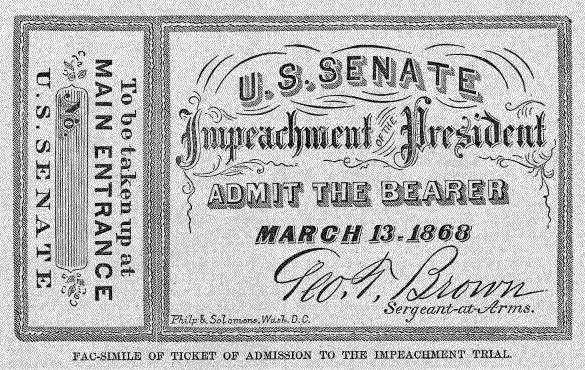
A ticket to the Impeachment Trial of President Andrew Johnson in the Senate in 1868.


Lyndon B. Johnson. 36th POTUS. 37th VPOTUS. Texas. Democrat.

The punchline of the fact sheet from the pre-Internet days ends with Lincoln being in Monroe, Maryland a week before his assassination setting up Kennedy to be in Marilyn Monroe a week before his. There is no Monroe, Maryland and Marilyn Monroe died in 1962...all according to Google.

All of this is nothing but historical coincidences. Nothing more. These comparisons between the two American presidents has been going on since the mid-1960s, more than likely.

Monday, April 15, 2013

Pointless Presidential Pfacts #34 - "The Last Time Lincoln Was in a Theater"

On April 14, 1865, Abraham Lincoln and Mary Todd Lincoln went to Ford's Theater to watch "Our American Cousin". Now while the 16th President of the United States wanted to relax at the theater as the Civil War came to an end, an individual with so much opposition to the central government's involvement in freeing the enslaved black man wanted nothing more than to topple the U.S. government on the night of the 14th. John Wilkes Booth and his conspirators planned to kill Lincoln, the loyal Southern Democrat from Tennessee and the recently sworn-in vice president, Andrew Johnson, and the Secretary of State, William Seward. Lincoln and Johnson ran on the Union Party ticket, dumping his vice president Hannibal Hamlin for the loyal southerner of the opposition party. Seward had been the nation's chief diplomat since the start of Lincoln's first term and prior to that had challenged Lincoln for the Republican nomination in 1860 and was expected to win it. Booth was a southern sympathizer from a famous family of actors, he was not unknown like his future fellow presidential assassins like Charles Guiteau, Leon Czolgosz, or Lee Harvey Oswald (and his conspirators???).


Abraham Lincoln, 16th President of the United States. Republican from Illinois.

The guy that was to kill Vice President Johnson chickened out and Johnson had no clue about an attempt. Although Booth did try to make a connection between himself and the vice president, but nothing came of it.

Lewis Powell, one of Booth's co-conspirators, had the responsibility of killing Secretary Seward. Powell made it into the secretary's home and fought off his son before stabbing him. What saved Seward was a neck-brace he wore after being in a carriage accident. Powell fled the scene and was later caught.


Lewis Powell

The only one successful that night was Booth. He had scoped out Ford's Theater and planned out his moves. He knew the play's funniest line, "Don't know the manners of good society, eh? Well, I guess I know enough to turn you inside out, old gal — you sockdologizing old man-trap." And that was when he was going to strike. Booth shot Lincoln with a derringer. After he shot Lincoln in the back of the head, Booth fought off Major Henry Rathbone, he and his wife shared the theater box with the First Couple, after bigger names like Grant and Sherman turned the play down. Booth slashed away at Rathbone, but the attack threw Booth off his game. Booth jumped from the box to the stage and his spur got caught in the flag. He broke his leg but before rushing off the stage yelled something to the audience. Two things were reported said, "Sic semper tyrannis!" which is the motto of Virginia and translates to "Thus always to tyrants." The line heard was "The South is avenged!"


Booth got on a horse, which he asked someone to hold, although they didn't know why, and he rode out of town. The Secretary of War, Edwin Stanton, issued a manhunt for Booth and his accomplices. Booth sought help for his leg and eventually made his way to Garrett's farm and stayed in the barn until Federal troops circled the barn with fire. A soldier shot Booth and he died shortly afterward. His conspirators were tried and hung for the crime. Among those executed on July 7, 1865, was the first female, Mary Surratt.


John Wilkes Booth

But on the night of April 14th, doctors in Ford's Theater tried to save the president's life. Fearful that President Lincoln would not survive the bumpy road back to the Executive Mansion, they moved the president across the street. Lincoln died the next morning. It is said that Stanton said, "now he belongs to the angels" and later he changed his quote to "now he belongs to the ages."


Johnson was sworn-in as the 17th president of the United States. Lincoln's plans for Reconstruction of the South would never come to light and a political power struggle between President Johnson and the Radical Republicans would harm Reconstruction and Civil Rights for about 100 years until after another assassinated president is succeeded by another Vice President Johnson.


Andrew Johnson, 17th President of the United States. Democrat from Tennessee.