
Showing posts with label Andrew Johnson. Show all posts
Showing posts with label Andrew Johnson. Show all posts
Thursday, July 31, 2014

Tuesday, July 1, 2014
Pointless Presidential Pfacts #53 - "Deathdays of July"
While June boasts six presidential deaths it is not the month with the most presidential deaths. On June 1st in 1868 the only president named Buchanan, thankfully says the past 25-plus years, died starting off the month with you know what kind of death...presidential. James Madison ends the month, so far, on June 28th. 6 days and 6 presidents...not listed Ronald Reagan, Andrew Jackson, James K. Polk, and Grover Cleveland. Since Cleveland is in the mix there must be an asterisk.
June's second, currently, because in July 3 presidents died on the same day and there's only 2 death years for those 3 presidential deaths. July 4th is not just celebrated as independence from Great Britain in 1776 but fifty year's after the passing of 2 famous founders. The historical coincident which did not go unnoticed by contemporaries of Thomas Jefferson and John Adams only enhanced the young Union of States. Adams 2 worried with his last words that Jefferson lived that 50th anniversary of independence when in the non-telegraph (most recent form of instant communication) era and information moved slower Jefferson passed away 5 hours before.
Sharing that historical day but in 1831 is the last president to be considered a founding father, James Monroe. Then there's Zachary Taylor's death on July 9, 1850, leaving Millard Fillmore to decide upon the Compromise of 1850. July 23, 1885 is when Ulysses S. Grant passed away after finishing an epic memoir like no other. The next day, the 24th, but in 1862, is when Martin Van Buren passed. He, like Former President Grant, tried for a non-consecutive term. Where Grant never got the nomination, Democratic Party founder Van Buren was nominated by the Free Soil Party, a single-issue party whose members would later find a home in the Republican Party founded in 1854. Andrew Johnson died on the 31st months after being sworn-in as a U.S. Senator from Tennessee. Johnson-17, so far, is the only former president to be elected to the Senate and for Johnson-17, a body that 7 years prior had almost removed him from the not-yet-built-Oval-Office.
That's 7 presidential deaths and just 5 days.
Tuesday, April 15, 2014
THE DEAD PRESIDENTS - ABE DEFENDING HIS MEMORIAL
Today in history Andrew Johnson became the 17th POTUS and Abe Lincoln became a DEAD PRESIDENT!


Wednesday, December 4, 2013
RE:POTUS - Summary of Presidential Impeachment
Impeachment of the President of the United States is the only way to remove a president from office outside of death, resignation, or rejection by the American people in an election. Politicians say they do not want to go down the road of impeachment. Impeachment is part of the checks and balances within the Constitution. In the 224 years under the Constitution, the House of Representatives, the chamber with the power to impeach, has only written articles of impeachment on three different occasions. Of those three instances only two of those three were actually impeached, however they survived the trial in the Senate so they were not removed from office. To impeach a president, the House of Representatives in session determines the meaning of “high crimes and misdemeanors,” part of the definition of impeachment in the Constitution.
Seventy-nine years into the government under the Constitution, the House impeached a president for the first time. Andrew Johnson, from Tennessee, was the only southern senator to remain loyal to the Union after eleven southern States seceded from the Union from 1860-61. His loyalty was repaid with a spot on the bottom of the presidential ticket in the election of 1864. The Union Party of Republican Abraham Lincoln and Democrat Andrew Johnson won the election. Just a little over a month into Lincoln’s second term, Lincoln was shot by John Wilkes Booth while watching “Our American Cousin” at Ford’s Theater. Lincoln died the next morning elevating the loyal southern Democratic vice president to the highest office in the land.

Vice President Andrew Johnson taking the presidential oath of office on April 15, 1865, after President Abraham Lincoln's death from an assassin's bullet.
President Johnson would continue, to the best of his ability, the plan for Reconstruction of the Union as Lincoln had intended. By 1868, the Radical Republicans in the Congress were not happy with the President and his handling of Reconstruction. The legislative branch sought to curb Johnson’s executive power. The first attempt to curb Johnson’s power came in the form of the Tenure of Office Act. The act required the approval of the Senate for the President to fire anyone in a position the Senate gave their consent to. Johnson disagreed with the law and knew its true meaning, an attempt to weaken the executive. Johnson decided to test the new law by firing Secretary of War Edwin Stanton, without the consent of the Congress.
The House wrote up eleven articles of impeachment, eight having to do with Johnson’s violation of the Tenure of Office Act. Johnson knew it was more political than rational. In the Senate, Johnson survived the impeachment by a single vote on three of the articles of impeachment. Since Johnson survived three of the articles, the Senate adjourned without further consideration of the remaining eight articles. In the end, Johnson quietly finished out the remainder of the term as the Congress took control of rebuilding the Union. His impeachment was a blow to presidential power and an increase in legislative authority that would dominate the government for the next twenty years.

The Impeachment Trial of Andrew Johnson in the U.S. Senate from March to May 1868.
The Radical Republicans in the Congress wanted to be in charge of Reconstruction and were not happy with Johnson and his handling of Reconstruction and his leniency toward ex-Confederates. They created a political situation or confrontation via the Tenure of Office Act, seizing on Johnson’s violation of the law as means for removal from office.
It would be 106 years until the House of Representatives would write articles of impeachment for another president, Richard Nixon. What would seem like a “third-rate burglary” would turn into a Constitutional crisis. In 1972, operatives connected to the White House broke into the Democratic National Committee Headquarters at the Watergate hotel. Nixon knew of the break-in and began a cover up which would bring down his presidency.

President Richard Nixon released 1,254 pages of edited transcripts of 20 audio tapes on April 30, 1974, to avoid handing over subpoenaed tapes to the House Judiciary Committee. It did not help.
By the summer of 1974 impeachment of the president was being considered by the House. That summer the “smoking gun,” an audio tape implicating Nixon’s involvement, was discovered. The House Judiciary committee wrote up three articles of impeachment and voted on the articles. The three articles consisted of obstruction of justice, abuse of power, and contempt of Congress. While the Congress of the United States was a Democratic majority, Nixon was advised by leading Republicans in the Senate, headed by Barry Goldwater of Arizona, that he would not survive a trial in the Senate. Republican National Committee Chairman George Herbert Walker Bush suggested the same. Nixon resigned on August 9, 1974, at noon before the articles of impeachment could be voted on by the entire House.
In this instance, the House Judiciary committee used the political solution of impeachment to uphold the Constitution, whereas the House of the late 1860s used impeachment as a weapon in a political fight between an embattled president and Congress. Investigation into another president would begin twenty years after Nixon’s resignation.
Kenneth Starr headed the independent council’s office and began the investigation of potential illegal dealings done by the Clintons, such as the Whitewater land development. In 1998, Monica Lewinsky, a White House intern, gave a false affidavit about her relationship with President William Jefferson Clinton in the case involving Paula Jones. Clinton also lied under oath about his relationship with Lewinsky. This led Starr to begin an investigation into the Lewinsky allegations, stemming from the Jones case. Lewinsky’s stained blue dress became the “smoking gun” in this instance.
The House Judiciary voted on four articles of impeachment, three for lying under oath and one for obstruction of justice. The full House passed two articles of impeachment; both had to do with lying under oath. The president survived the trial in the Senate and completed the remaining years of his second term as popular as ever.

First Lady Hillary Clinton watches as President Bill Clinton addresses his impeachment by the House of Representatives to the press and the nation on December 19, 1998.
Johnson and Clinton were both impeached because of those that ran the House of Representatives did not like the Chief Executive. The House sought to remove from office someone they did not agree with or get along with. The attempt to impeach Nixon was justifiable, an effort to uphold the Constitution, however he resigned before a full House vote of impeachment could take place. Nixon would not have survived a trial in the Senate. The three terms of Congress which made up George W. Bush’s first six years of the presidency did not contemplate impeachment. The Republicans who led the Congress did not see the need to investigate the president. When the Democratic Party took control of the House of Representatives in 2007, an assurance of no impeachment was given in the run up to the 2006 mid-term elections. Comparing the possible impeachable offenses made by Bush and his administration to his impeached or would be impeached predecessors leads to the realization that the sitting members of the House of Representatives do determine what is a “high crime and misdemeanor.”
Friday, April 19, 2013
Pointless Presidential Pfacts #35 - "Lincoln, Kennedy and Monroe"
There are many coincidences throughout history and even within a country's own history, like the United States. Now the internets have been passing misinformation around big time, including on the legend of the connections between Abraham Lincoln and John F. Kennedy. The inaccuracies forced me to write this piece based off of simple coinkydinks that occurred during the Lincoln and Kennedy presidencies, starting with some accurate non-coinkydinks events in presidential history.
Abraham Lincoln was born on February 12, 1809 and John F. Kennedy was born on May 29, 1917. No similarity there between the two. Lincoln was elected the 16th POTUS while Kennedy became the 35th POTUS. Still nothing coincidental about those facts.

Abraham Lincoln. 16th POTUS. Illinois. Republican.
Lincoln was elected to Congress in 1846 and JFK was elected in 1946. Exactly (well in years) one hundred years apart Lincoln and Kennedy were elected to the House of Representatives. Representative Lincoln served only one term in the House after being a part of the Whig Party's opposition to President James K. Polk and the Democratic Party's war win against Mexico, making the United States a continental power. Representative Kennedy on the other hand went on to win reelection to his House seat two more times and then in 1952 wins the race for Massachusetts' open senate seat in the U.S. Senate, the other house of Congress.

John F. Kennedy. 35th POTUS. Massachusetts. Democrat.
Senator Kennedy went from the Senate to the White House in 1960, whereas Lincoln won the presidential election of 1860 without having served in elected politics since he left the House in 1849, when Polk was leaving office and Zachary Taylor was entering office. One hundred years apart both became president of the United States. They were both challenged by an incumbent, and youthful, vice president in the General Election, John C. Breckinridge in 1860 and Richard M. Nixon in 1960, both would announce their loss to Lincoln and Kennedy, respectively, to a Joint-Session of Congress.
President Lincoln had to deal with States in rebellion from the start of his term and his goal was first and foremost to preserve the Union of States before the Civil War took on the responsibility of freeing the enslaved blacks in the South. He was president during the Civil War, while JFK was a president that served during the Cold War, another "C"-"W" initialed event. His hundred year counterpart would become associated with Civil Rights as well and his death would help push Civil Rights legislation through the Congress by his successor one hundred years after the Civil War ended. Essentially the Civil Rights that Lincoln began fighting for don't come to until almost one hundred years after his death.
As president, they both had young children in the White House, or during Lincoln's time, the Executive Mansion. Their wives also lost a child while living in the presidential mansion. Mary Todd Lincoln, and the president, lost their youngest William to an illness at the age of 11, where Jack and Jackie Kennedy lost their child, Patrick, two days after being born. The two died one hundred and one years apart.
Both presidents had secretaries named after the other. President Lincoln had a secretary named Kennedy and President Kennedy had a secretary named Lincoln.
But there's more connections.

John Wilkes Booth shoots President Lincoln while he, his wife and the Rathbones (such a 19th Century-sounding name) watch "Our American Cousin" from box seats at Ford's Theater. Why the sketch artist just sketched and didn't help is one of history's greatest unsolved mysteries so says the ghost of Robert Stack.
Lincoln was assassinated in 1865 and Kennedy was assassinated in 1963, almost one hundred years. Almost. But they were both shot on a Friday while sitting next to their wives. Both were shot in the head. They were with another couple. The Lincolns went to Ford's Theater with the Rathbones and the Kennedys rode with the Connallys in an automobile named Lincoln. Both males that were with the president when they were shot were both injured and survived the attacks. The presidents were shot by men from the South. One was born in 1838 and the other born in 1939. The assassins were known by their full name, three names made up of 15 letters, John Wilkes Booth and Lee Harvey Oswald. Booth fled a theater for an abandoned warehouse, whereas Oswald did the opposite, he went from a warehouse to a theater. Both Booth and Oswald were shot and killed before their trial.

"Oswald!" yelled Jack Ruby as he shot Lee Harvey Oswald on LIVE television.
Both presidents were succeeded by Southerners who were their vice presidents. Both vice presidents were named Johnson and born one hundred years apart, 1808 and 1908 Tennessee's Andrew Johnson was loyal to the Union and put on the Union Party ticket with President Lincoln in 1864, a ticket made up of a Republican and a Democrat. Johnson became the 17th POTUS the day after Lincoln was shot and three hours after he died. Texas' Lyndon Johnson ran with Kennedy in 1960 and was sworn in as the 36th POTUS the day JFK was shot and killed in Dallas. Johnson-17 would go on to become the first impeached POTUS but survived the trial in the Senate by one vote in a battle to control Reconstruction of the South. His impeachment would weaken the executive branch, which was strong during Lincoln's terms, for the rest of the 19th Century. Johnson-36 would go on to win a landslide election of his own in 1964 but while he had success with Civil Rights and hoped for a great society, Johnson-36 eventually lost favor with the American people and his party as reelection in 1968 seemed impossible thanks to the longevity of the Vietnam War and his mishandling of the Cold War's proxy hot war.
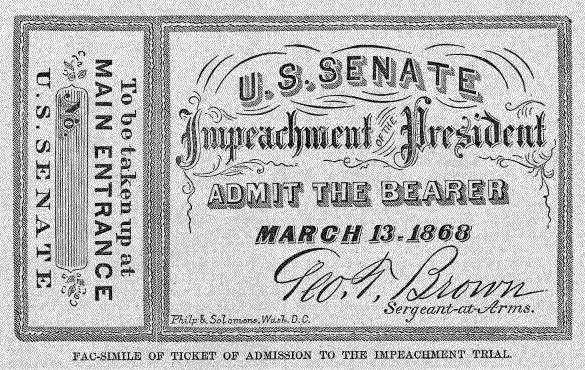
A ticket to the Impeachment Trial of President Andrew Johnson in the Senate in 1868.

Lyndon B. Johnson. 36th POTUS. 37th VPOTUS. Texas. Democrat.
The punchline of the fact sheet from the pre-Internet days ends with Lincoln being in Monroe, Maryland a week before his assassination setting up Kennedy to be in Marilyn Monroe a week before his. There is no Monroe, Maryland and Marilyn Monroe died in 1962...all according to Google.
All of this is nothing but historical coincidences. Nothing more. These comparisons between the two American presidents has been going on since the mid-1960s, more than likely.
Monday, April 15, 2013
Pointless Presidential Pfacts #34 - "The Last Time Lincoln Was in a Theater"
On April 14, 1865, Abraham Lincoln and Mary Todd Lincoln went to Ford's Theater to watch "Our American Cousin". Now while the 16th President of the United States wanted to relax at the theater as the Civil War came to an end, an individual with so much opposition to the central government's involvement in freeing the enslaved black man wanted nothing more than to topple the U.S. government on the night of the 14th. John Wilkes Booth and his conspirators planned to kill Lincoln, the loyal Southern Democrat from Tennessee and the recently sworn-in vice president, Andrew Johnson, and the Secretary of State, William Seward. Lincoln and Johnson ran on the Union Party ticket, dumping his vice president Hannibal Hamlin for the loyal southerner of the opposition party. Seward had been the nation's chief diplomat since the start of Lincoln's first term and prior to that had challenged Lincoln for the Republican nomination in 1860 and was expected to win it. Booth was a southern sympathizer from a famous family of actors, he was not unknown like his future fellow presidential assassins like Charles Guiteau, Leon Czolgosz, or Lee Harvey Oswald (and his conspirators???).

Abraham Lincoln, 16th President of the United States. Republican from Illinois.
The guy that was to kill Vice President Johnson chickened out and Johnson had no clue about an attempt. Although Booth did try to make a connection between himself and the vice president, but nothing came of it.
Lewis Powell, one of Booth's co-conspirators, had the responsibility of killing Secretary Seward. Powell made it into the secretary's home and fought off his son before stabbing him. What saved Seward was a neck-brace he wore after being in a carriage accident. Powell fled the scene and was later caught.

Lewis Powell
The only one successful that night was Booth. He had scoped out Ford's Theater and planned out his moves. He knew the play's funniest line, "Don't know the manners of good society, eh? Well, I guess I know enough to turn you inside out, old gal — you sockdologizing old man-trap." And that was when he was going to strike. Booth shot Lincoln with a derringer. After he shot Lincoln in the back of the head, Booth fought off Major Henry Rathbone, he and his wife shared the theater box with the First Couple, after bigger names like Grant and Sherman turned the play down. Booth slashed away at Rathbone, but the attack threw Booth off his game. Booth jumped from the box to the stage and his spur got caught in the flag. He broke his leg but before rushing off the stage yelled something to the audience. Two things were reported said, "Sic semper tyrannis!" which is the motto of Virginia and translates to "Thus always to tyrants." The line heard was "The South is avenged!"

Booth got on a horse, which he asked someone to hold, although they didn't know why, and he rode out of town. The Secretary of War, Edwin Stanton, issued a manhunt for Booth and his accomplices. Booth sought help for his leg and eventually made his way to Garrett's farm and stayed in the barn until Federal troops circled the barn with fire. A soldier shot Booth and he died shortly afterward. His conspirators were tried and hung for the crime. Among those executed on July 7, 1865, was the first female, Mary Surratt.

John Wilkes Booth
But on the night of April 14th, doctors in Ford's Theater tried to save the president's life. Fearful that President Lincoln would not survive the bumpy road back to the Executive Mansion, they moved the president across the street. Lincoln died the next morning. It is said that Stanton said, "now he belongs to the angels" and later he changed his quote to "now he belongs to the ages."

Johnson was sworn-in as the 17th president of the United States. Lincoln's plans for Reconstruction of the South would never come to light and a political power struggle between President Johnson and the Radical Republicans would harm Reconstruction and Civil Rights for about 100 years until after another assassinated president is succeeded by another Vice President Johnson.

Andrew Johnson, 17th President of the United States. Democrat from Tennessee.

Monday, January 14, 2013
Pointless Presidential Pfacts #27 - "Second Billing"
Traditionally the vice president of the United States takes the oath office prior to the president on Inauguration Day. John Adams was sworn in as the first VPOTUS on April 21, 1789, 9 days before George Washington took the oath of office as the first president of the United States. Four years later when they took the oath of office for a second term, Adams took it first and then Washington.
When inaugurations became common place in the new capital city of Washington on the steps of the capitol, vice president-elects took their oath inside followed by a speech. The most well remembered vice presidential inaugural address was by Andrew Johnson on March 4, 1865. It is more remembered for the belief that Johnson 17 was drunk. He had been suffering a cold and took some whiskey to remedy himself, which led to his speech being slurred. Once outside for the presidential oath, president-elects would first give their address and then take the oath of office. With the passage of the 20th Amendment, things began to change.

Inauguration Day 1969, the outgoing and incoming administrations were comprised of former and present vice presidents. FROM L to R (the brief Johnson/Agnew administration): President Lyndon Johnson (36th POTUS and 37th VPOTUS), President-elect Richard Nixon (37th POTUS and 36th VPOTUS), Vice President Spiro Agnew (39th VPOTUS), and former Vice President Hubert Humphrey (38th VPOTUS)
Once January 20th became Inauguration Day in 1937, vice president-elects took their oath of office outside a few minutes prior to the presidential oath...but minus the address. Since then vice presidents take their oath and enjoy the day. The tradition of not having a set official to swear them in remained. Sometimes the Chief Justice swore in both men (still only men as of 2013), or the vice president chose an associate justice of their liking, or the out going vice president, or the president pro tempore or even the speaker of the House of Representatives administered the oath. The vice president even gets his own song after being sworn in, "Hail Columbia".

Henry Wallace being sworn in as vice president in 1941 by out going two term FDR vice president, John Nance Garner.
On January 21, 2013, the Chief Justice of the United States will once again swear-in the POTUS. Vice President Joe Biden will be sworn in by Associate Justice Sonia Sotomayor. Ruth Bader Ginsburg was the last female to swear-in a vice president, and that was Al Gore for a second term in 1997. Prior to that, Sandra Day O'Connor was the first woman to administer the Constitutional oath to a vice president, James Danforth Quayle in 1989. Sarah T. Hughes, a federal district judge in Texas, became the first to give the presidential oath in 1963 to Lyndon Johnson in Dallas.
Thursday, August 13, 2009
Anti-Progress
Progress in the United States has its counterpart and it is Anti-Progress. The choice of the Founding Fathers to rebel against King George III is the first strike for progress of the young nation. The Founders chose to become a separate government and one where the people rule. Shocking thing for the humans on Earth in the late 18th Century. The idea of more freedom appealed to the Founders and they wanted it to be part of the country they were creating.
The first signs of Anti-Progress appeared when it became clear that not all men are created equal. To include non-white males in this new government was too much progress for the collective States calling themselves a nation. One have of the nation relied heavily on the enslavement of blacks, and this peculiar institution needed to be maintained. Compromises were made in the drafting of our nation's second Constitution in 1787. Freedom for some, about zero to three-fifths for others. Major progress was averted.
The progress for blacks to be equal to whites would take time. Those demanding abolition were unable to end slavery in the United States peacefully, and after over 80 years of boiling up civil war erupted. While President Abraham Lincoln offered a peaceful resolution to succession he vowed to preserve the Union. The South chose war. And it became a war to free the slave and progress the nation toward that freedom our Founding Fathers sought in 1776.
Believing that progress won after the Civil War ended in 1865 is wrong. The supporters of an Anti-Progress mindset would be the true victors. The failure of Reconstruction in the South by both President Andrew Johnson from 1865-67 and the Radical Republicans from 1867 until 1877, contributed a lot to the success the Anti-Progress movement would have over the next ninety years. Presidential Reconstruction and Congressional, or Radical, Reconstruction both failed to live up to Lincoln's wish of malice toward none. Segregation and lynchings would leave the supporters of Anti-Progress as the victors in the 20th Century.
Sure the supporters of progress had some victories with women suffrage granted early in the century. As our history has shown progress takes time and the reason that is true is because of Anti-Progress and its followers. With the victories in the Civil Rights Movements of the 1950s and 1960s led by Martin Luther King Jr. and President Lyndon Johnson, to name two of the many, progress was taking place. Anti-Progress was hit hard and they adapted to the times. The spirit of 1776 was making its way through the country's growth.
The Minority Majority, the small portion of Americans supporting Anti-Progress have made a push for Anti-Progress since President Barack Obama's inauguration in 2009. Their presence was made known when same-sex marriage started appearing on the ballot, at City Hall, and before State Supreme Courts. They are the descendants of those that bonded and sold human beings, treated women as second class citizens, segregated society, happily and freely kill the innocent. The reason they support these Anti-Progress and not the freedom sought by the Founders in 1776, is because they the Minority Majority are misinformed and show no signs of intelligence.
The progress of our nation is something that bothers these people so they accept what they are told about legitimate birth certificate of Barack Obama or screaming while spreading the falsehoods of the health care debate. Anti-Progress is fueled by the misinformed and contribute to the explanation why progress takes time.
The first signs of Anti-Progress appeared when it became clear that not all men are created equal. To include non-white males in this new government was too much progress for the collective States calling themselves a nation. One have of the nation relied heavily on the enslavement of blacks, and this peculiar institution needed to be maintained. Compromises were made in the drafting of our nation's second Constitution in 1787. Freedom for some, about zero to three-fifths for others. Major progress was averted.
The progress for blacks to be equal to whites would take time. Those demanding abolition were unable to end slavery in the United States peacefully, and after over 80 years of boiling up civil war erupted. While President Abraham Lincoln offered a peaceful resolution to succession he vowed to preserve the Union. The South chose war. And it became a war to free the slave and progress the nation toward that freedom our Founding Fathers sought in 1776.
Believing that progress won after the Civil War ended in 1865 is wrong. The supporters of an Anti-Progress mindset would be the true victors. The failure of Reconstruction in the South by both President Andrew Johnson from 1865-67 and the Radical Republicans from 1867 until 1877, contributed a lot to the success the Anti-Progress movement would have over the next ninety years. Presidential Reconstruction and Congressional, or Radical, Reconstruction both failed to live up to Lincoln's wish of malice toward none. Segregation and lynchings would leave the supporters of Anti-Progress as the victors in the 20th Century.
Sure the supporters of progress had some victories with women suffrage granted early in the century. As our history has shown progress takes time and the reason that is true is because of Anti-Progress and its followers. With the victories in the Civil Rights Movements of the 1950s and 1960s led by Martin Luther King Jr. and President Lyndon Johnson, to name two of the many, progress was taking place. Anti-Progress was hit hard and they adapted to the times. The spirit of 1776 was making its way through the country's growth.
The Minority Majority, the small portion of Americans supporting Anti-Progress have made a push for Anti-Progress since President Barack Obama's inauguration in 2009. Their presence was made known when same-sex marriage started appearing on the ballot, at City Hall, and before State Supreme Courts. They are the descendants of those that bonded and sold human beings, treated women as second class citizens, segregated society, happily and freely kill the innocent. The reason they support these Anti-Progress and not the freedom sought by the Founders in 1776, is because they the Minority Majority are misinformed and show no signs of intelligence.
The progress of our nation is something that bothers these people so they accept what they are told about legitimate birth certificate of Barack Obama or screaming while spreading the falsehoods of the health care debate. Anti-Progress is fueled by the misinformed and contribute to the explanation why progress takes time.
Tuesday, February 10, 2009
Today in POTUStory
Finally after 178 years under our current Constitution these words were written into the great document:
In case of the removal of the President from office or of his death or resignation, the Vice President shall become President.
And that was just the start.
Before 1967 the Constitution never specified what exactly would happen if something happened to the president of the United States. For the first time on April 4, 1841, a president passed away. The nation's 9th chief magistrate, William Henry Harrison gave the longest inaugural address in the depths of winter on March 4th of that year. The oldest man elected to the office to that point (Ronald Reagan would later hold that title) decided to give his long address without a top hat or overcoat. The 68 year old president died 30 days (or 32?) later of pneumonia.

William Henry Harrison, 9th President of the United States
Hay dios mio! What do we do?
The 10th vice president of the United States, John Tyler, found out the next day that President Harrison had passed away. The Constitution said:
In Case of the Removal of the President from Office, or of his Death, Resignation, or Inability to discharge the Powers and Duties of the said Office, the same shall devolve on the Vice President
What did devolve mean? It was unclear and the Founding Fathers made it unclear intentionally or unintentionally. But Vice President Tyler took it to mean that he would become the president of the United States.

John Tyler, 10th Vice President of the United States and 10th President of the United States
On April 6th he took the oath of office and the reigns of power. The cabinet, which Harrison appointed, tried to deny Tyler the authority of the presidency. Tyler made it clear to them and his detractors in the Congress that he was the president of the United States, not Acting-President or the Vice President in the role of the presidency until some kind of special election.
The 10th vice president went on to become the 10th president.

Vice President Tyler being informed of the death of President Harrison
The Tyler Precedent would be followed by Millard Fillmore, Andrew Johnson, Chester Arthur, Theodore Roosevelt, Calvin Coolidge, Harry Truman, and Lyndon Johnson. The Tyler Precedent would go on to be written into the Constitution as the 25th Amendment. Gerald Ford would be the first to be elevated thanks to the 25th Amendment. Ford would also be the first to be appointed vice president due to a vacancy.
House Minority Leader Gerald Ford being sworn in as the 40th Vice President of the United States
The 25th Amendment would also make sure that there would never be a vacancy in the vice presidency. Whenever the vice presidents succeeded to the presidency, died in office, or resigned leaving the vice presidency vacant it would remain so until the next election and then inauguration.
The acknowledgment that the vice president becomes the president is the first thing mentioned in the 25th Amendment and has taken effect only by Gerald Ford's ascendancy. Filling the vacancy is the second part of the Amendment which has only occurred twice, Ford replacing Spiro Agnew after his resignation in 1973 and Nelson Rockefeller's appointment once Ford succeeded President Nixon in 1974. The third section of the Amendment allows the president to inform the President Pro Tempore and the Speaker of the House that he or she cannot perform the duties of the office and transmit the powers to the Vice President to perform them as Acting President and can reclaim the powers once he or she informs the two leaders of the Congress. Ronald Reagan did this in 1985, making Vice President George Herbert Walker Bush the first Acting-Presidnet. While Dick Cheney held the title twice during the George W. Bush administration once in 2002 and then again in 2007.
The final section of the 25th Amendment has never taken place. George H. W. Bush calls the fourth section a legal coup. The vice president and a majority of the cabinet officers are needed to declare the president unable to execute the duties of the office. The closest we've come to this is in the feature film Air Force One when the vice president played by Glenn Close is presented with a letter readied for her to sign initiating the Acting President status under the fourth section of the 25th Amendment. She tears it up at the end of the film once the president is safe from the Russian terrorists and no longer in danger.
Air Force One movie poster
It took the threat of a nuclear age for the line of succession of vice president to president to be clearly written into the Constitution. After the assassination of John F. Kennedy in 1963, the vice presidency remained vacant. Where as before then no evil or dangerous threat really harmed or threatened the country as succession slowly took its time. But in the post-Cuban Missile Crisis United States immediate succession took precedent.


Tuesday, February 26, 2008
The Summary of Presidential Impeachment
Impeachment of the President of the United States is the only way to remove a president from office outside of death, resignation, or rejection by the American people in an election. Politicians say they do not want to go down the road of impeachment. Impeachment is part of the checks and balances within the Constitution. In the 219 years under the Constitution, the House of Representatives, the chamber with the power to impeach, has only written articles of impeachment on three different occasions. Of those three instances only two of those three were actually impeached, however they survived the trial in the Senate so they were not removed from office. To impeach a president, the House of Representatives in session determines the meaning of “high crimes and misdemeanors,” part of the definition of impeachment in the Constitution.
Seventy-nine years into the government under the Constitution, the House impeached a president for the first time. Andrew Johnson, from Tennessee, was the only southern senator to remain loyal to the Union after eleven southern states seceded from the Union from 1860-61. His loyalty was repaid with a spot on the bottom of the presidential ticket in the election of 1864. The Union Party of Republican Abraham Lincoln and Democrat Andrew Johnson won the election. Almost a month into Lincoln’s second term, Lincoln was shot by John Wilkes Booth while watching “Our American Cousin” at Ford’s Theater. Lincoln died the next morning elevating the loyal southern Democrat to the highest office in the land.
Vice President Andrew Johnson taking the presidential oath of office on April 15, 1865, after President Abraham Lincoln's death from an assassin's bullet.
President Johnson would continue, to the best of his ability, the plan for Reconstruction of the South as Lincoln had intended. By 1868, the Radical Republicans in the Congress were not happy with the President and his handling of Reconstruction. The legislative branch sought to curb Johnson’s executive power. The first attempt to curb Johnson’s power came in the form of the Tenure of Office Act. The act required the approval of the Senate for the President to fire anyone in a position the Senate gave their consent to. Johnson disagreed with the law and knew its true meaning, an attempt to weaken the executive. Johnson decided to test the new law by firing Secretary of War Edwin Stanton, without the consent of the Congress.
The House wrote up eleven articles of impeachment, eight having to do with Johnson’s violation of the Tenure of Office Act. Johnson knew it was more political than rational. In the Senate, Johnson survived the impeachment by a single vote on three of the articles of impeachment. Since Johnson survived three of the articles, the Senate adjourned without further consideration of the remaining eight articles. In the end, Johnson quietly finished out the remainder of the term as the Congress took control of rebuilding the Union. His impeachment was a blow to presidential power and an increase in legislative authority that would dominate the government for the next twenty years.
The Impeachment Trial of Andrew Johnson in the U.S. Senate from March to May 1868.
The Radical Republicans in the Congress wanted to be in charge of Reconstruction and were not happy with Johnson and his handling of Reconstruction and his leniency toward ex-Confederates. They created a political situation or confrontation via the Tenure of Office Act, seizing on Johnson’s violation of the law as means for removal from office.
It would be 106 years until the House of Representatives would write articles of impeachment for another president, Richard Nixon. What would seem like a “third-rate burglary” would turn into a Constitutional crisis. In 1972, operatives connected to the White House broke into the Democratic National Committee Headquarters at the Watergate hotel. Nixon knew of the break-in and began a cover up which would bring down his presidency.
President Richard Nixon released 1,254 pages of edited transcripts of 20 audio tapes on April 30, 1974, to avoid handing over subpoenaed tapes to the House Judiciary Committee. It did not help.
By the summer of 1974 impeachment of the president was being considered by the House. That summer the “smoking gun,” an audio tape implicating Nixon’s involvement, was discovered. The House Judiciary committee wrote up three articles of impeachment and voted on the articles. The three articles consisted of obstruction of justice, abuse of power, and contempt of Congress. While the Congress of the United States was a Democratic majority, Nixon was advised by leading Republicans in the Senate, headed by Barry Goldwater of Arizona, that he would not survive a trial in the Senate. Republican National Committee Chairman George Herbert Walker Bush suggested the same. Nixon resigned on August 9, 1974, at noon before the articles of impeachment could be voted on by the entire House.
In this instance, the House Judiciary committee used the political solution of impeachment to uphold the Constitution, whereas the House of the late 1860s used impeachment as a weapon in a political fight between an embattled president and Congress. Investigation into another president would begin twenty years after Nixon’s resignation.
Kenneth Starr headed the independent council’s office and began the investigation of potential illegal dealings done by the Clintons, such as the Whitewater land development. In 1998, Monica Lewinsky, a White House intern, gave a false affidavit about her relationship with President William Jefferson Clinton in the case involving Paula Jones. Clinton also lied under oath about his relationship with Lewinsky. This led Starr to begin an investigation into the Lewinsky allegations, stemming from the Jones case. Lewinsky’s stained blue dress became the “smoking gun” in this instance.
The House Judiciary voted on four articles of impeachment, three for lying under oath and one for obstruction of justice. The full House passed two articles of impeachment; both had to do with lying under oath. The president survived the trial in the Senate and completed the remaining years of his second term as popular as ever.
First Lady Hillary Clinton watches as President Bill Clinton addresses his impeachment by the House of Representatives to the press and the nation on December 19, 1998.
Johnson and Clinton were both impeached because of those that ran the House of Representatives did not like the Chief Executive. The House sought to remove from office someone they did not agree with or get along with. The attempt to impeach Nixon was justifiable, an effort to uphold the Constitution, however he resigned before a full House vote of impeachment could take place. Nixon would not have survived a trial in the Senate. The three terms of Congress which made up George W. Bush’s first six years of the presidency did not contemplate impeachment. The Republicans who led the Congress did not see the need to investigate the president. When the Democratic Party took control of the House of Representatives in 2007, an assurance of no impeachment was given in the run up to the 2006 mid-term elections. Comparing the possible impeachable offenses made by Bush and his administration to his impeached or would be impeached predecessors leads to the realization that the sitting members of the House of Representatives do determine what is a “high crime and misdemeanor.”
Thursday, January 11, 2007
the I Word - impeachment
I sometimes wonder if the Constitution is really followed or is it cherry-picked like intelligence for a war? Democrats before the election of 2006 wanted the voters to know they were not going to be impeaching the Bush Administration. This is not a pro-impeachment or anti-Bush rant. This is a question historians will ponder in the future when the topic of presidential impeachments is discussed.
If someone is today is teaching a government or civics class and the topic of impeachment comes up the teacher would explain what impeachment is. The House of Representatives is the chamber of Congress that can write Articles of Impeachment indicted the president of "a high crime or misdemeanor." The Senate then sits as the jury in the trial to impeach the president, with the Chief Justice of the Supreme Court presiding as judge. Members of the House Judiciary Committee prosecute the president's defense counsel. The Senate votes to either convict to remove the president from office or acquit him of the crime.
The teacher then explains that only two presidents have been impeached, Andrew Johnson and William Jefferson Clinton. A teacher would just give the general facts and skip any of the historical context and analysis. Neither were convicted, but both were targets of the political opposition.
Johnson survived impeachment by one vote. The Radical Republicans running the Congress wanted to take over the Reconstruction of the South from Johnson, who tried his best to live up to President Lincoln's goal in the South's Reconstruction. The Radical Republicans created a situation threating executive power. Johnson had violated the Tenure of Office Act which said that the president could not fire anyone who was confirmed by the Senate without the consent of the Senate. President Johnson rightfully saw this as wrong and fired Secretary of War Edwin Stanton and replaced him. The House of Representatives found their excuse to impeach him.
Eleven Articles of Impeachment threatened Andrew Johnson's presidency. When three of the Articles of Impeachment could not reach a vote of conviction the remaining eight were tabled and never voted on. The Radical Republicans were able to make a blow at the executive branch and controlled a mismanaged Reconstruction of the South.
Clinton had been investigated by both the Republican led Congress and Kenneth Starr, the Independent Counsel investigating possible wrong doing by the Clintons. In the end, all the money spent investigating the Clintons proved them innocent. President Clinton did however lie under oath about an affair with an intern. Clinton was impeached by the Republican House for perjury and obstruction of justice. Clinton was not in as bad a situation as President Johnson was in 1868. Clinton survived the trial in the Senate and finished his remaining 2 years in office as popular as ever.
Teachers need to let their students know that President Richard Nixon was not impeached. The Judiciary committee headed by the majority party, the Democrats, began voting on Articles of Impeachment which included obstruction of justice and illegal wire tapping. President Nixon resigned before the full House of Representatives could vote on any of Articles of Impeachment.
Historians and those explaining impeachment will wonder why George W. Bush was not impeached since he too has done far worse than Andrew Johnson and Bill Clinton. Evidence such as the Downing Street Memo or the White House Memo have shown the president and his administration misleading us into a war of choice for false reasons. If the new Democratic controlled Congress begins investigating the president and finds wrong doing comparable to Nixon, is it okay to impeach?
The politicians say they don't want to take the nation down the road of impeachment. It is the duty of the Congress, the legislative branch, to oversee the executive which had been lacking for the past six years. The Republican Party had a duty to their country first, before party when leading the Congress' support for the president and his war. They did not take that approach accepting, not questioning, the reasons the administration laid out for war in Iraq.
The idea of censure by Senator Feingold is not acceptable. Censuring Clinton seems more appropriate than impeachment when you compare Clinton versus Bush. People in power are more concerned with their next election and fear of backlash from impeachment like what happened to Republicans in 1998 is feared by those in power now. The Democrats need to put the interest of the nation ahead of electoral politics. By investigating the president and the reasons we went to war in Iraq will help history and explain to the families why their sons and daughters fought in this war of choice.
More than likely George W. Bush and Richard B. Cheney will end their term at noon on January 20, 2009. An impeachment will not take place and they will go un-investigated. When is it ok to impeach the president? Comparing the wrong doings of Clinton versus Bush must make explaining impeachment very difficult. The Constitution should be upheld and since the executive hasn't been doing its part these past six years, it's time the legislative branch stepped up.
If someone is today is teaching a government or civics class and the topic of impeachment comes up the teacher would explain what impeachment is. The House of Representatives is the chamber of Congress that can write Articles of Impeachment indicted the president of "a high crime or misdemeanor." The Senate then sits as the jury in the trial to impeach the president, with the Chief Justice of the Supreme Court presiding as judge. Members of the House Judiciary Committee prosecute the president's defense counsel. The Senate votes to either convict to remove the president from office or acquit him of the crime.
The teacher then explains that only two presidents have been impeached, Andrew Johnson and William Jefferson Clinton. A teacher would just give the general facts and skip any of the historical context and analysis. Neither were convicted, but both were targets of the political opposition.
Johnson survived impeachment by one vote. The Radical Republicans running the Congress wanted to take over the Reconstruction of the South from Johnson, who tried his best to live up to President Lincoln's goal in the South's Reconstruction. The Radical Republicans created a situation threating executive power. Johnson had violated the Tenure of Office Act which said that the president could not fire anyone who was confirmed by the Senate without the consent of the Senate. President Johnson rightfully saw this as wrong and fired Secretary of War Edwin Stanton and replaced him. The House of Representatives found their excuse to impeach him.
Eleven Articles of Impeachment threatened Andrew Johnson's presidency. When three of the Articles of Impeachment could not reach a vote of conviction the remaining eight were tabled and never voted on. The Radical Republicans were able to make a blow at the executive branch and controlled a mismanaged Reconstruction of the South.
Clinton had been investigated by both the Republican led Congress and Kenneth Starr, the Independent Counsel investigating possible wrong doing by the Clintons. In the end, all the money spent investigating the Clintons proved them innocent. President Clinton did however lie under oath about an affair with an intern. Clinton was impeached by the Republican House for perjury and obstruction of justice. Clinton was not in as bad a situation as President Johnson was in 1868. Clinton survived the trial in the Senate and finished his remaining 2 years in office as popular as ever.
Teachers need to let their students know that President Richard Nixon was not impeached. The Judiciary committee headed by the majority party, the Democrats, began voting on Articles of Impeachment which included obstruction of justice and illegal wire tapping. President Nixon resigned before the full House of Representatives could vote on any of Articles of Impeachment.
Historians and those explaining impeachment will wonder why George W. Bush was not impeached since he too has done far worse than Andrew Johnson and Bill Clinton. Evidence such as the Downing Street Memo or the White House Memo have shown the president and his administration misleading us into a war of choice for false reasons. If the new Democratic controlled Congress begins investigating the president and finds wrong doing comparable to Nixon, is it okay to impeach?
The politicians say they don't want to take the nation down the road of impeachment. It is the duty of the Congress, the legislative branch, to oversee the executive which had been lacking for the past six years. The Republican Party had a duty to their country first, before party when leading the Congress' support for the president and his war. They did not take that approach accepting, not questioning, the reasons the administration laid out for war in Iraq.
The idea of censure by Senator Feingold is not acceptable. Censuring Clinton seems more appropriate than impeachment when you compare Clinton versus Bush. People in power are more concerned with their next election and fear of backlash from impeachment like what happened to Republicans in 1998 is feared by those in power now. The Democrats need to put the interest of the nation ahead of electoral politics. By investigating the president and the reasons we went to war in Iraq will help history and explain to the families why their sons and daughters fought in this war of choice.
More than likely George W. Bush and Richard B. Cheney will end their term at noon on January 20, 2009. An impeachment will not take place and they will go un-investigated. When is it ok to impeach the president? Comparing the wrong doings of Clinton versus Bush must make explaining impeachment very difficult. The Constitution should be upheld and since the executive hasn't been doing its part these past six years, it's time the legislative branch stepped up.
Subscribe to:
Posts (Atom)