
Showing posts with label Abraham Lincoln. Show all posts
Showing posts with label Abraham Lincoln. Show all posts
Tuesday, April 15, 2014
THE DEAD PRESIDENTS - ABE DEFENDING HIS MEMORIAL
Today in history Andrew Johnson became the 17th POTUS and Abe Lincoln became a DEAD PRESIDENT!


Tuesday, April 8, 2014

Monday, February 17, 2014

Pointless Presidential Pfacts #50 - "Presid--...er-uh WASHINGTON's BIRTHDAY!"
There is no federal holiday called Presidents (or President's or like the State of California labels it: Presidents') Day no matter what the stores tell you. It is George Washington's Birthday (which is actually the 22nd).
So, happy not-officially-presidents-day-but-really-the-day-we-observe-Washington's-Birthday-which-is-really-on-the-22nd-day! Now go out and save money on that mattress and who knows maybe you'll produce a future POTUS!

Thursday, February 13, 2014

Wednesday, February 12, 2014

Friday, April 19, 2013
Pointless Presidential Pfacts #35 - "Lincoln, Kennedy and Monroe"
There are many coincidences throughout history and even within a country's own history, like the United States. Now the internets have been passing misinformation around big time, including on the legend of the connections between Abraham Lincoln and John F. Kennedy. The inaccuracies forced me to write this piece based off of simple coinkydinks that occurred during the Lincoln and Kennedy presidencies, starting with some accurate non-coinkydinks events in presidential history.
Abraham Lincoln was born on February 12, 1809 and John F. Kennedy was born on May 29, 1917. No similarity there between the two. Lincoln was elected the 16th POTUS while Kennedy became the 35th POTUS. Still nothing coincidental about those facts.

Abraham Lincoln. 16th POTUS. Illinois. Republican.
Lincoln was elected to Congress in 1846 and JFK was elected in 1946. Exactly (well in years) one hundred years apart Lincoln and Kennedy were elected to the House of Representatives. Representative Lincoln served only one term in the House after being a part of the Whig Party's opposition to President James K. Polk and the Democratic Party's war win against Mexico, making the United States a continental power. Representative Kennedy on the other hand went on to win reelection to his House seat two more times and then in 1952 wins the race for Massachusetts' open senate seat in the U.S. Senate, the other house of Congress.

John F. Kennedy. 35th POTUS. Massachusetts. Democrat.
Senator Kennedy went from the Senate to the White House in 1960, whereas Lincoln won the presidential election of 1860 without having served in elected politics since he left the House in 1849, when Polk was leaving office and Zachary Taylor was entering office. One hundred years apart both became president of the United States. They were both challenged by an incumbent, and youthful, vice president in the General Election, John C. Breckinridge in 1860 and Richard M. Nixon in 1960, both would announce their loss to Lincoln and Kennedy, respectively, to a Joint-Session of Congress.
President Lincoln had to deal with States in rebellion from the start of his term and his goal was first and foremost to preserve the Union of States before the Civil War took on the responsibility of freeing the enslaved blacks in the South. He was president during the Civil War, while JFK was a president that served during the Cold War, another "C"-"W" initialed event. His hundred year counterpart would become associated with Civil Rights as well and his death would help push Civil Rights legislation through the Congress by his successor one hundred years after the Civil War ended. Essentially the Civil Rights that Lincoln began fighting for don't come to until almost one hundred years after his death.
As president, they both had young children in the White House, or during Lincoln's time, the Executive Mansion. Their wives also lost a child while living in the presidential mansion. Mary Todd Lincoln, and the president, lost their youngest William to an illness at the age of 11, where Jack and Jackie Kennedy lost their child, Patrick, two days after being born. The two died one hundred and one years apart.
Both presidents had secretaries named after the other. President Lincoln had a secretary named Kennedy and President Kennedy had a secretary named Lincoln.
But there's more connections.

John Wilkes Booth shoots President Lincoln while he, his wife and the Rathbones (such a 19th Century-sounding name) watch "Our American Cousin" from box seats at Ford's Theater. Why the sketch artist just sketched and didn't help is one of history's greatest unsolved mysteries so says the ghost of Robert Stack.
Lincoln was assassinated in 1865 and Kennedy was assassinated in 1963, almost one hundred years. Almost. But they were both shot on a Friday while sitting next to their wives. Both were shot in the head. They were with another couple. The Lincolns went to Ford's Theater with the Rathbones and the Kennedys rode with the Connallys in an automobile named Lincoln. Both males that were with the president when they were shot were both injured and survived the attacks. The presidents were shot by men from the South. One was born in 1838 and the other born in 1939. The assassins were known by their full name, three names made up of 15 letters, John Wilkes Booth and Lee Harvey Oswald. Booth fled a theater for an abandoned warehouse, whereas Oswald did the opposite, he went from a warehouse to a theater. Both Booth and Oswald were shot and killed before their trial.

"Oswald!" yelled Jack Ruby as he shot Lee Harvey Oswald on LIVE television.
Both presidents were succeeded by Southerners who were their vice presidents. Both vice presidents were named Johnson and born one hundred years apart, 1808 and 1908 Tennessee's Andrew Johnson was loyal to the Union and put on the Union Party ticket with President Lincoln in 1864, a ticket made up of a Republican and a Democrat. Johnson became the 17th POTUS the day after Lincoln was shot and three hours after he died. Texas' Lyndon Johnson ran with Kennedy in 1960 and was sworn in as the 36th POTUS the day JFK was shot and killed in Dallas. Johnson-17 would go on to become the first impeached POTUS but survived the trial in the Senate by one vote in a battle to control Reconstruction of the South. His impeachment would weaken the executive branch, which was strong during Lincoln's terms, for the rest of the 19th Century. Johnson-36 would go on to win a landslide election of his own in 1964 but while he had success with Civil Rights and hoped for a great society, Johnson-36 eventually lost favor with the American people and his party as reelection in 1968 seemed impossible thanks to the longevity of the Vietnam War and his mishandling of the Cold War's proxy hot war.
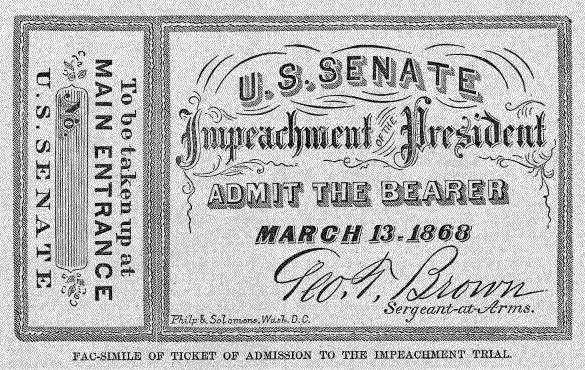
A ticket to the Impeachment Trial of President Andrew Johnson in the Senate in 1868.

Lyndon B. Johnson. 36th POTUS. 37th VPOTUS. Texas. Democrat.
The punchline of the fact sheet from the pre-Internet days ends with Lincoln being in Monroe, Maryland a week before his assassination setting up Kennedy to be in Marilyn Monroe a week before his. There is no Monroe, Maryland and Marilyn Monroe died in 1962...all according to Google.
All of this is nothing but historical coincidences. Nothing more. These comparisons between the two American presidents has been going on since the mid-1960s, more than likely.
Monday, April 15, 2013
Pointless Presidential Pfacts #34 - "The Last Time Lincoln Was in a Theater"
On April 14, 1865, Abraham Lincoln and Mary Todd Lincoln went to Ford's Theater to watch "Our American Cousin". Now while the 16th President of the United States wanted to relax at the theater as the Civil War came to an end, an individual with so much opposition to the central government's involvement in freeing the enslaved black man wanted nothing more than to topple the U.S. government on the night of the 14th. John Wilkes Booth and his conspirators planned to kill Lincoln, the loyal Southern Democrat from Tennessee and the recently sworn-in vice president, Andrew Johnson, and the Secretary of State, William Seward. Lincoln and Johnson ran on the Union Party ticket, dumping his vice president Hannibal Hamlin for the loyal southerner of the opposition party. Seward had been the nation's chief diplomat since the start of Lincoln's first term and prior to that had challenged Lincoln for the Republican nomination in 1860 and was expected to win it. Booth was a southern sympathizer from a famous family of actors, he was not unknown like his future fellow presidential assassins like Charles Guiteau, Leon Czolgosz, or Lee Harvey Oswald (and his conspirators???).

Abraham Lincoln, 16th President of the United States. Republican from Illinois.
The guy that was to kill Vice President Johnson chickened out and Johnson had no clue about an attempt. Although Booth did try to make a connection between himself and the vice president, but nothing came of it.
Lewis Powell, one of Booth's co-conspirators, had the responsibility of killing Secretary Seward. Powell made it into the secretary's home and fought off his son before stabbing him. What saved Seward was a neck-brace he wore after being in a carriage accident. Powell fled the scene and was later caught.

Lewis Powell
The only one successful that night was Booth. He had scoped out Ford's Theater and planned out his moves. He knew the play's funniest line, "Don't know the manners of good society, eh? Well, I guess I know enough to turn you inside out, old gal — you sockdologizing old man-trap." And that was when he was going to strike. Booth shot Lincoln with a derringer. After he shot Lincoln in the back of the head, Booth fought off Major Henry Rathbone, he and his wife shared the theater box with the First Couple, after bigger names like Grant and Sherman turned the play down. Booth slashed away at Rathbone, but the attack threw Booth off his game. Booth jumped from the box to the stage and his spur got caught in the flag. He broke his leg but before rushing off the stage yelled something to the audience. Two things were reported said, "Sic semper tyrannis!" which is the motto of Virginia and translates to "Thus always to tyrants." The line heard was "The South is avenged!"

Booth got on a horse, which he asked someone to hold, although they didn't know why, and he rode out of town. The Secretary of War, Edwin Stanton, issued a manhunt for Booth and his accomplices. Booth sought help for his leg and eventually made his way to Garrett's farm and stayed in the barn until Federal troops circled the barn with fire. A soldier shot Booth and he died shortly afterward. His conspirators were tried and hung for the crime. Among those executed on July 7, 1865, was the first female, Mary Surratt.

John Wilkes Booth
But on the night of April 14th, doctors in Ford's Theater tried to save the president's life. Fearful that President Lincoln would not survive the bumpy road back to the Executive Mansion, they moved the president across the street. Lincoln died the next morning. It is said that Stanton said, "now he belongs to the angels" and later he changed his quote to "now he belongs to the ages."

Johnson was sworn-in as the 17th president of the United States. Lincoln's plans for Reconstruction of the South would never come to light and a political power struggle between President Johnson and the Radical Republicans would harm Reconstruction and Civil Rights for about 100 years until after another assassinated president is succeeded by another Vice President Johnson.

Andrew Johnson, 17th President of the United States. Democrat from Tennessee.

Sunday, December 16, 2012

Saturday, November 17, 2012
Steven's Lincoln

I loved Steven Spielberg's Lincoln, both as a student of history and of film. No longer is Henry Fonda the Abraham Lincoln of cinema, now it is Daniel Day-Lewis. 1860s America was brought to life in the Dreamworks picture set in the last four months of Lincoln's life.
It tells the story of a recently reelected Lincoln that seeks to pass the 13th Amendment before the end of his first term. A year and a half prior, Lincoln had issued the Emancipation Proclamation which limited freeing slaves in the rebel States. The 13th Amendment was to abolish it for all time by writing it into the Constitution. He must bring a divided Republican Party, conservatives and radicals, together while still trying to get Democratic support in the House of Representatives, the place where the legislative action takes place. We see the two sides argue like nothing C-SPAN has ever shown. Another obstacle Lincoln must face is the peace envoy from the rebel States. The peace talks are used as a reason not to pass the amendment.
Legislative procedure and wartime diplomacy are turned into a screenplay with the main tension: will Lincoln get the 13th Amendment passed in the House of Representatives? With the tension of the 3rd Act, Lincoln meeting with envoy from the South. Like a good character in any film, Lincoln has obstacles he must over come and what we get a glimpse of is 19th Century politics, as Lincoln plays politics to accomplish a truly noble goal of abolishing slavery with the 13th Amendment. We see Lincoln the politician, which all great presidents are. We also see Lincoln the man.
Lincoln shows his human side from visiting the troops, to giving piggy-back rides to his son Tad, to arguing with his wife. We also get to see the human side of other 19th Century figures and the struggles with accepting equality with blacks, both from a tolerant and intolerant view. The human side was brought to life, giving a glimpse of world known through historical bullet points.
This film was about a politician trying to do good for his country and it happened that it took place two months before his death. The film never really touched on his assassination, except for a couple of beats, once in the beginning and then again at the end. But it wasn't a rehash of the conspiracy that is well known...well to a good number of people. I'm sure a good portion know the basics of the Lincoln assassination conspiracy which 1/3 of was played out on April 14, 1865. Spoiler alert, for real too, we never see the Lincolns and the Rathbones (a total 19th Century sounding name) at Ford's Theater, just that Lincoln is running late for an evening out with the young couple. Just telling that moment in time can be an entire picture. Spielberg approaches the moment of assassination moment from the average Washingtonian that night in nation's capital with the young Tad as our emotional and character connection. All that is accomplished to also resolve the politician, human, and character by introducing the historical figure of Abraham Lincoln.
Sunday, February 15, 2009
Presidents Day (or Presidents' Day)
What is Presidents Day?
Well it's a combination of our nation's two greatest presidents' birthdays, George Washington (February 22nd) and Abraham Lincoln (February 12th). Or should that be written the other way around based on which birthday comes first in the month or who historians believe is the greater of the top two presidents?
Or is Presidents Day supposed to celebrate all the presidents? There have been 43 men who have served in the nation's highest office, remember Grover Cleveland was the 22nd and 24th president...s.
What are we supposed to do on this quasi-holiday? Quasi, because federal jobs have the day off while non-government jobs go on like it was a day in August. Some college level schools are opened, while others aren't. No matter what, nobody does anything to celebrate the day like the Fourth of July except of course for businesses using the day to promote sales.
There is no solution for what we should do on this holiday. Maybe sit around the fire and tell sad tales about James Buchanan or hang stove-pipe top hats on the Lincoln pole...or log.
We can learn about our nations leaders.
-There have been 44 presidents and 43 men elected to the office under our current Constitution which was written in 1787 and began in 1789.

-prior to our current Constitution there were 7 presidents under the Articles of Confederation.
-George Washington was unanimously elected twice and established the precedent of only serving two terms.

-John Adams was the first vice president of the United States and the first to be elected to president as an incumbent vice president. Adams was the first to move in to the White House in November of 1800. He was the first to lose reelection.

-Thomas Jefferson was the first and only sitting vice president to defeat a sitting president in the election of 1800. Jefferson was the first president to be sworn in in the nation's permanent and new capital, the city of Washington. Jefferson was also the first to be elected by the House of Representatives.

-James Madison was the last commander-in-chief to lead troops in battle during the War of 1812.

-James Monroe ran unopposed for reelection in the election of 1820 after the Federalist Party became no more of a threat after the War of 1812. Monroe received all but one electoral vote so that Washington would remain the only individual elected unanimously. John Quincy Adams received that one electoral vote.

-John Quincy Adams was the first son of a U.S. president elected president and the second to be elected by the House of Representatives. In the election of 1824 four members of the Democratic-Republicans ran against each other since there was no Federalist challenge, Andrew Jackson received the plurality of both popular and electoral votes but not a majority needed. Speaker of the House Henry Clay, the fourth place winner in the election, made a deal with Adams to help elect him. Jackson called this a "corrupt bargain" when the House elected the second place Adams. Henry Clay became Adams' Secretary of State, once a stepping stone to the presidency, since Monroe, Madison, and Jefferson had each been secretaries of state prior to the presidency.

-Andrew Jackson finally became president four years later and became the first Democrat elected. He claimed to be the first man of the people elected. He was the first to be sworn in on the East front of the Capitol. Jackson was the first president to have his life threatened by an assassin. The assassin, Richard Lawrence, fired twice and each time his two separate guns backfired. Jackson beat him with his cane. Jackson is the only president to have an era named after him.

-Martin Van Buren, a founding member of the Democratic Party and former secretary of state for President Jackson became the last sitting vice president to be directly elected to the presidency in 1836.

-William Henry Harrison was the first Whig elected to the presidency and the first president to die in office. He was then the oldest elected (Ronald Reagan would take that title in 1980) and gave the longest inaugural address on one of the coldest March 4ths without a top hat or overcoat. He caught pneumonia and died 30 days later.

-John Tyler became the first vice president to be elevated to the presidency through the death of the president. It was unclear as to what was to happen if a president died. This became known as the Tyler precedent and would be written into the Constitution in February of 1967 as the 25th Amendment. Tyler became the first president threatened with impeachment and to be absolved of a political party making him without a political party. He was the first not to be renominated, since he had no party, the Whigs, and his former party the Democrats wouldn't nominate him, Tyler did not run. John Tyler's first wife Letitia passed away while in office, and became the first president to marry while in office. Julia Tyler became the youngest first lady at that time at the age of 24.

-James K. Polk set out to accomplish four goals and achieved all four goals and chose not to run for reelection. He made the United States a continental power by acquiring Oregon and after war with Mexico in the Mexican-US War California and New Mexico territory were added.

-Zachary Taylor was the second and last Whig elected. He was also the second president to die in office. A hero of the Mexican-US War, Taylor was believed to be poisoned but in 1991 it was proven that he was not.

-Millard Fillmore put off the Civil War by signing the Compromise of 1850. Attempted for a third term in 1856 as a Know-Nothing Party candidate.

-Franklin Pierce is related to First Lady Barbara Bush, as her maiden name is Pierce. Pierce is considered one of the worst presidents for not preventing the Civil War.

-Continuing in the line of presidents unable to prevent the Civil War is James Buchanan who believed that history would redeem him and it has yet to do so. Good luck George W. Bush. Buchanan did nothing to stop South Carolina from leaving the Union after the election of Abraham Lincoln in November of 1860. Buchanan is also considered one of the worst presidents of the United States because of his do-nothing actions. He is the last Democratic president elected until 1884.

-Abraham Lincoln is considered by historians as the nations greatest president or second greatest after George Washington. Some love him and some despise him to this day. He did not want to punish the South, just preserve the Union as he did while he prosecuted the war, he continued the construction of the Capitol dome and built the transcontinental railroad. Lincoln was elected to a second term on the Union Party ticket in 1864 with Andrew Johnson a Democrat. Lincoln was the first president assassinated, a little over a month into his second term, by John Wilkes Booth, popular actor and southern sympathizer.

-Andrew Johnson was no Lincoln. He was a Democrat and the only senator from a southern state to remain loyal to the Union after the succession of the southern states. He tried his best to implement Lincoln's wishes but failed. He is the first president to be impeached by the House of Representatives. His impeachment is for firing Secretary of War Edwin Stanton after the passage of the Tenure of Office Act which established that the Senate had to approve any firings of those they confirmed. Johnson rightly believed otherwise and removed Stanton and replaced him with Ulysses S. Grant. The House impeached him and the Senate acquitted him by one vote after voting on the first three Articles of Impeachment, in which there were eleven. His impeachment diminished the power of the executive branch, and shifted it toward the legislative branch.

-Ulysses S. Grant, the hero of the Civil War served two full terms. He served during the Reconstruction of the South which was implemented by the Radical Republicans in the Congress. Grant's administration was plagued by scandal by the members of his cabinet.

-Rutherford B. Hayes did not win the popular vote in 1876, Democratic candidate New York Governor Samuel Tilden did. Florida played a role in this electoral battle as it would in the year 2000. The 1876 election would not be decided until 1877 when a commission decided who receive the needed electoral votes to become president. The Compromise of 1877 decided that Rutherford B. Hayes would be president as long as federal troops were removed from the South ending Reconstruction. Hayes pledged to only serve on term. His wife prohibited alcohol in the White House and was known as Lemonade Lucy.

-James A. Garfield was the first and only president to go from the House of Representatives to the presidency. He was the second president assassinated, which occurred four months into his presidency. He was shot by Charles Guiteau an office seeker who wanted the spoils of political victory and did not receive it.

-Chester A. Arthur was a product of the spoils system and became the president to put an end to the system with the Civil Service Reform Act. He was not renominated by his party continuing the "tradition" of ascendant vice presidents not getting elected to their own term.

-Stephen Grover Cleveland was the first Democrat elected since the Civil War. Cleveland brought back some of the power back to the executive branch. He vetoed more legislation than all of his predecessors combined. He brought long hours and honesty back to the presidency. Cleveland won the popular vote in his reelection bid in 1888 but lost the electoral college. Aside from losing his home state of New York, vetoing pensions for Civil War veterans was also contributed to his loss. He did it for fear of what was to happen...young ladies marrying the veterans so they could receive the pension long after their husbands had passed on. He was right. He was the first to marry in the White House. He married 21 year old Frances Folsom Cleveland, becoming a popular figure in the United States and the greatest asset to the president. When the first couple left the White House in March of 1889, Francis predicted that they would return when she told the White House staff to keep things in order until their return.

-Benjamin Harrison was the first and only grandson of a president elected to the presidency. He is the grandson of William Henry Harrison. Harrison was president on the 100th anniversary of the presidency and he was a clear distinction from Washington to Harrison. In 1892 for the first and only time a sitting president went up against a former president and the former president won.

-Grover Cleveland became the only former president elected to a non-consecutive term. His second term, like most other second termers, was not as successful as his first. Cleveland suffered from the panic of 1893, a depression. Cleveland was not renominated by his party in 1896. Cleveland was the last of the laid back presidents of the late-19th century.
-William McKinely's Republicans elected in 1896 were a shift from the social reform Lincoln Republicans to a more business conservative ideology. McKinley became the first active president in terms of setting a legislative agenda, although his successor Theodore Roosevelt would get more of that credit. McKinley would become the third president killed by an assassin. Leon Czolgosz was an anarchist and killed McKinley simply because he did not believe in governments. McKinley was shot six months into his second term.

-Theodore Roosevelt was put on the ticket in 1900 as vice president to keep him quiet within the Republican Party. That position of course put him into the presidency after McKinley died of the assassin's bullet in September 1901. Roosevelt would be the first president to have full time Secret Service protection. TR would go on to become on of the most popular U.S. presidents. He would become the first ascendant president to be reelected to his own term establishing a tradition that would last throughout the 20th century with the exception of Gerald Ford in 1976. TR established the new formal name for the Executive Mansion as the White House when he changed the stationary in 1901. With his children running around and filling the White House, TR created a temporary office building, the West Wing in 1902, which eventually became permanent. TR shot himself in the foot, not literally, when he declared he would not run for reelection in 1908...because he really wanted to in the end. He would run for a non-consecutive term in 1912 and fail, although as a candidate for the Bull Moose or Progressive Party ticket, he would be the last third party candidate to come in second in the 1912 election.

-William Howard Taft was our nation's largest president. His wife Helen, wanted to Taft to be president more than he did. In her youth she visited the White House often during the Benjamin Harrison presidency. William Howard Taft was TR's hand picked successor but the hand picked successor started drifting from the TR policies. This contributed to TR's return for another run for the presidency and split the Republican Party in two giving the election of 1912 to...

-Thomas Woodrow Wilson was the first Democrat elected since Cleveland. Wilson was a progressive Democrat. Wilson ran for reelection in 1916 promising to keep the United States out of the Great War or World War in Europe. By April of 1917 he was asking for a declaration of war against the Central Powers. After the victory of the war, Wilson helped create the League of Nations but was unable to convince the Senate that the U.S. should be a member. Wilson suffered a stroke and his second wife, Edith, who he married while in office after his first wife Ellen died early in his first term, decided who saw the president in the last two years in office. She essentially ran the executive branch.

-Warren G. Harding was the first president elected after the passage of the 19th Amendment which gave women the right to vote. Harding ran on a campaign of a return to normalcy after the war years. Harding died in office.

-Calvin Coolidge was sworn in by his father when news arrived that President Harding had died. While vice president Coolidge participated in cabinet meetings, becoming the first to do so. Coolidge won election in his own right in 1924 and declined the opportunity to run again in 1928. Coolidge was known as Silent Cal. It is said at a dinner party that a female guest sitting next to him said she had a bet with a friend that she could get Coolidge to say more than two words. Coolidge's response, "You lose."

-Herbert Hoover is the last cabinet secretary to go directly from the cabinet to the presidency. He served as the nation's 3rd Secretary of Commerce under both Presidents Harding and Coolidge. Hoover was of course the president during the stock market crash of 1929 which contributed to his defeat and the rise of the Democrats in 1932.

-Franklin Roosevelt is the first president to break Washington's established tradition and became the first to be elected to four terms. FDR died less than three months in to his fourth term. FDR dealt with the Great Depression by creating government programs to help get the nation out of the economic depression, however it was the country's entrance into the Second World War which got the nation out of its trouble. FDR was the last president to be sworn in on March 4 in 1933 and the first to be sworn in on January 20 in 1937. FDR is the last president to die of natural causes while in office.

-Harry S. Truman restructured the federal government with the National Security Act of 1947. The Department of War became the Department of Defense. The vice president was brought into the loop more so than ever. Truman finished America's involvement in World War II by dropping two atomic bombs on Japan in August of 1945. Truman led the nation through the early days of the Cold War with the Soviet Union. Truman was the last president who had the opportunity to run for as many terms as he wanted since the 22nd Amendment established a term limit for the president.

-Dwight David Eisenhower named the presidential retreat after his grandson and since then every president has enjoyed going to Camp David. Everybody liked Ike, he ran twice in the 1950s and defeated Illinois governor Adlai Stevenson both times.

-John F. Kennedy defeated the sitting vice president in a close election in 1960. JFK was the youngest president elected, although TR was the youngest president sworn in. Kennedy dealt with one of the greatest crises in U.S. history and human history, the Cuban Missile Crisis. JFK is the first president the Secret Service loses since they began protecting presidents. Kennedy is the last president to die by an assassin's bullet...or bullets.

-Lyndon Baines Johnson was the first president sworn in by a female. LBJ tried to fight a war on poverty with government programs under a legislative agenda called the Great Society. However the escalating involvement in the Vietnam War ruined his image. Johnson passed the greatest civil rights legislation since the days of Reconstruction, creating a solid Republican stronghold in the South. LBJ is the last president not to seek reelection. Johnson won the greatest landslide in the percentage of popular vote in 1964.

-Richard M. Nixon is the first president to resign from office. A once staunch anti-communist he went on to open relations with communist China and the Soviet Union. Nixon won his 1972 reelection in a landslide similar to LBJ's in 1964, but Nixon won all the states but one. Nixon campaigned in 1968 with a secret plan to get out of Vietnam, but did not get the nation out of the war until 1973 all the while escalating the country's involvement since taking office.

-Gerald R. Ford is the first president not to have run in a presidential campaign as either vice president or president prior to taking office. Ford became the first person appointed the vice presidency under the 25th Amendment and thus was elevated to the presidency after Nixon resigned. Ford did not win election in 1976 making him the firs vice president elevated to the presidency to not win his own term since before TR.

-Jimmy Carter is the first president sworn in with a nickname. Jimmy Carter was the last president sworn in on the East front of the Capitol.

-Ronald Reagan was the first president sworn in on the Capitol's West front. Reagan is considered the Great Communicator. Reagan's election in 1980 realigned the political landscape putting an end to the New Deal Democrats and brought the conservative movement to the forefront with the Reagan Revolution.

-George Bush is the first sitting vice president since 1836 to be elected president. Bush would receive high approval ratings for a successful military campaign against Saddam Hussein in the Gulf War. However raising taxes after breaking his "read my lips" promise of no new taxes would ruin his relationship with the conservatives in his party and an economic down turn after the Gulf War would ruin his chances for reelection. He would be the last president to lose reelection, up to this point.

-William Jefferson Clinton is the first Democratic president to be reelected since FDR. Clinton is the second president to be impeached and acquitted. Clinton would preside over a time of peace and prosperity. He would lower the national debt and create a surplus. His wife, Hillary, would go on to become the first First Lady elected to public office as the senator from New York.

-George W. Bush would be the second son of a president to become president. Bush would receive less of the popular vote in the 2000 and the first and only president who's election was decided by the Supreme Court when they ended the recounting of votes in Florida which would eventually determine that Vice President Al Gore received the majority of votes. His 2004 election would also be controversial but rather than the State of Florida it would be the State of Ohio. Bush would invade the country of Iraq after trying to convince the nation that Iraq had some kind of connection to the September 11, 2001 terrorist attacks. He would also start a "war on terror." Bush would leave office as a very unpopular president with hopes that history will redeem him and his administration.

-Barack Obama is the first African-American president. His administration still less than a month old. Like Lincoln he is from Illinois. Like Lincoln he would appoint his chief rival for the presidential nomination of his party, Hillary Clinton, to the secretary of state position, both Hillary and Seward were from New York. Obama wants to be a bipartisan president after decades of partisan squabbling.

-The southern states under rebellion as the Confederate States of American elected Jefferson Davis as their first and only president to serve a single six year term. Davis was Secretary of War to the 14th president of the United States Franklin Pierce and the son-in-law to the 12th president, Zachary Taylor.

-The president has his own song, "Hail to the Chief."
-His own plane which when aboard is known as "Air Force One."

-The presidential seal was established in 1880 by President Hayes and reworked in 1945 by President Truman with the eagle's head facing the olive branch instead of the arrows.

So yeah there are way more facts...
Well it's a combination of our nation's two greatest presidents' birthdays, George Washington (February 22nd) and Abraham Lincoln (February 12th). Or should that be written the other way around based on which birthday comes first in the month or who historians believe is the greater of the top two presidents?
Or is Presidents Day supposed to celebrate all the presidents? There have been 43 men who have served in the nation's highest office, remember Grover Cleveland was the 22nd and 24th president...s.
What are we supposed to do on this quasi-holiday? Quasi, because federal jobs have the day off while non-government jobs go on like it was a day in August. Some college level schools are opened, while others aren't. No matter what, nobody does anything to celebrate the day like the Fourth of July except of course for businesses using the day to promote sales.
There is no solution for what we should do on this holiday. Maybe sit around the fire and tell sad tales about James Buchanan or hang stove-pipe top hats on the Lincoln pole...or log.
We can learn about our nations leaders.
-There have been 44 presidents and 43 men elected to the office under our current Constitution which was written in 1787 and began in 1789.
-prior to our current Constitution there were 7 presidents under the Articles of Confederation.
-George Washington was unanimously elected twice and established the precedent of only serving two terms.
-John Adams was the first vice president of the United States and the first to be elected to president as an incumbent vice president. Adams was the first to move in to the White House in November of 1800. He was the first to lose reelection.
-Thomas Jefferson was the first and only sitting vice president to defeat a sitting president in the election of 1800. Jefferson was the first president to be sworn in in the nation's permanent and new capital, the city of Washington. Jefferson was also the first to be elected by the House of Representatives.
-James Madison was the last commander-in-chief to lead troops in battle during the War of 1812.
-James Monroe ran unopposed for reelection in the election of 1820 after the Federalist Party became no more of a threat after the War of 1812. Monroe received all but one electoral vote so that Washington would remain the only individual elected unanimously. John Quincy Adams received that one electoral vote.
-John Quincy Adams was the first son of a U.S. president elected president and the second to be elected by the House of Representatives. In the election of 1824 four members of the Democratic-Republicans ran against each other since there was no Federalist challenge, Andrew Jackson received the plurality of both popular and electoral votes but not a majority needed. Speaker of the House Henry Clay, the fourth place winner in the election, made a deal with Adams to help elect him. Jackson called this a "corrupt bargain" when the House elected the second place Adams. Henry Clay became Adams' Secretary of State, once a stepping stone to the presidency, since Monroe, Madison, and Jefferson had each been secretaries of state prior to the presidency.
-Andrew Jackson finally became president four years later and became the first Democrat elected. He claimed to be the first man of the people elected. He was the first to be sworn in on the East front of the Capitol. Jackson was the first president to have his life threatened by an assassin. The assassin, Richard Lawrence, fired twice and each time his two separate guns backfired. Jackson beat him with his cane. Jackson is the only president to have an era named after him.
-Martin Van Buren, a founding member of the Democratic Party and former secretary of state for President Jackson became the last sitting vice president to be directly elected to the presidency in 1836.
-William Henry Harrison was the first Whig elected to the presidency and the first president to die in office. He was then the oldest elected (Ronald Reagan would take that title in 1980) and gave the longest inaugural address on one of the coldest March 4ths without a top hat or overcoat. He caught pneumonia and died 30 days later.
-John Tyler became the first vice president to be elevated to the presidency through the death of the president. It was unclear as to what was to happen if a president died. This became known as the Tyler precedent and would be written into the Constitution in February of 1967 as the 25th Amendment. Tyler became the first president threatened with impeachment and to be absolved of a political party making him without a political party. He was the first not to be renominated, since he had no party, the Whigs, and his former party the Democrats wouldn't nominate him, Tyler did not run. John Tyler's first wife Letitia passed away while in office, and became the first president to marry while in office. Julia Tyler became the youngest first lady at that time at the age of 24.
-James K. Polk set out to accomplish four goals and achieved all four goals and chose not to run for reelection. He made the United States a continental power by acquiring Oregon and after war with Mexico in the Mexican-US War California and New Mexico territory were added.
-Zachary Taylor was the second and last Whig elected. He was also the second president to die in office. A hero of the Mexican-US War, Taylor was believed to be poisoned but in 1991 it was proven that he was not.
-Millard Fillmore put off the Civil War by signing the Compromise of 1850. Attempted for a third term in 1856 as a Know-Nothing Party candidate.
-Franklin Pierce is related to First Lady Barbara Bush, as her maiden name is Pierce. Pierce is considered one of the worst presidents for not preventing the Civil War.
-Continuing in the line of presidents unable to prevent the Civil War is James Buchanan who believed that history would redeem him and it has yet to do so. Good luck George W. Bush. Buchanan did nothing to stop South Carolina from leaving the Union after the election of Abraham Lincoln in November of 1860. Buchanan is also considered one of the worst presidents of the United States because of his do-nothing actions. He is the last Democratic president elected until 1884.
-Abraham Lincoln is considered by historians as the nations greatest president or second greatest after George Washington. Some love him and some despise him to this day. He did not want to punish the South, just preserve the Union as he did while he prosecuted the war, he continued the construction of the Capitol dome and built the transcontinental railroad. Lincoln was elected to a second term on the Union Party ticket in 1864 with Andrew Johnson a Democrat. Lincoln was the first president assassinated, a little over a month into his second term, by John Wilkes Booth, popular actor and southern sympathizer.
-Andrew Johnson was no Lincoln. He was a Democrat and the only senator from a southern state to remain loyal to the Union after the succession of the southern states. He tried his best to implement Lincoln's wishes but failed. He is the first president to be impeached by the House of Representatives. His impeachment is for firing Secretary of War Edwin Stanton after the passage of the Tenure of Office Act which established that the Senate had to approve any firings of those they confirmed. Johnson rightly believed otherwise and removed Stanton and replaced him with Ulysses S. Grant. The House impeached him and the Senate acquitted him by one vote after voting on the first three Articles of Impeachment, in which there were eleven. His impeachment diminished the power of the executive branch, and shifted it toward the legislative branch.
-Ulysses S. Grant, the hero of the Civil War served two full terms. He served during the Reconstruction of the South which was implemented by the Radical Republicans in the Congress. Grant's administration was plagued by scandal by the members of his cabinet.
-Rutherford B. Hayes did not win the popular vote in 1876, Democratic candidate New York Governor Samuel Tilden did. Florida played a role in this electoral battle as it would in the year 2000. The 1876 election would not be decided until 1877 when a commission decided who receive the needed electoral votes to become president. The Compromise of 1877 decided that Rutherford B. Hayes would be president as long as federal troops were removed from the South ending Reconstruction. Hayes pledged to only serve on term. His wife prohibited alcohol in the White House and was known as Lemonade Lucy.
-James A. Garfield was the first and only president to go from the House of Representatives to the presidency. He was the second president assassinated, which occurred four months into his presidency. He was shot by Charles Guiteau an office seeker who wanted the spoils of political victory and did not receive it.
-Chester A. Arthur was a product of the spoils system and became the president to put an end to the system with the Civil Service Reform Act. He was not renominated by his party continuing the "tradition" of ascendant vice presidents not getting elected to their own term.
-Stephen Grover Cleveland was the first Democrat elected since the Civil War. Cleveland brought back some of the power back to the executive branch. He vetoed more legislation than all of his predecessors combined. He brought long hours and honesty back to the presidency. Cleveland won the popular vote in his reelection bid in 1888 but lost the electoral college. Aside from losing his home state of New York, vetoing pensions for Civil War veterans was also contributed to his loss. He did it for fear of what was to happen...young ladies marrying the veterans so they could receive the pension long after their husbands had passed on. He was right. He was the first to marry in the White House. He married 21 year old Frances Folsom Cleveland, becoming a popular figure in the United States and the greatest asset to the president. When the first couple left the White House in March of 1889, Francis predicted that they would return when she told the White House staff to keep things in order until their return.
-Benjamin Harrison was the first and only grandson of a president elected to the presidency. He is the grandson of William Henry Harrison. Harrison was president on the 100th anniversary of the presidency and he was a clear distinction from Washington to Harrison. In 1892 for the first and only time a sitting president went up against a former president and the former president won.
-Grover Cleveland became the only former president elected to a non-consecutive term. His second term, like most other second termers, was not as successful as his first. Cleveland suffered from the panic of 1893, a depression. Cleveland was not renominated by his party in 1896. Cleveland was the last of the laid back presidents of the late-19th century.
-William McKinely's Republicans elected in 1896 were a shift from the social reform Lincoln Republicans to a more business conservative ideology. McKinley became the first active president in terms of setting a legislative agenda, although his successor Theodore Roosevelt would get more of that credit. McKinley would become the third president killed by an assassin. Leon Czolgosz was an anarchist and killed McKinley simply because he did not believe in governments. McKinley was shot six months into his second term.
-Theodore Roosevelt was put on the ticket in 1900 as vice president to keep him quiet within the Republican Party. That position of course put him into the presidency after McKinley died of the assassin's bullet in September 1901. Roosevelt would be the first president to have full time Secret Service protection. TR would go on to become on of the most popular U.S. presidents. He would become the first ascendant president to be reelected to his own term establishing a tradition that would last throughout the 20th century with the exception of Gerald Ford in 1976. TR established the new formal name for the Executive Mansion as the White House when he changed the stationary in 1901. With his children running around and filling the White House, TR created a temporary office building, the West Wing in 1902, which eventually became permanent. TR shot himself in the foot, not literally, when he declared he would not run for reelection in 1908...because he really wanted to in the end. He would run for a non-consecutive term in 1912 and fail, although as a candidate for the Bull Moose or Progressive Party ticket, he would be the last third party candidate to come in second in the 1912 election.
-William Howard Taft was our nation's largest president. His wife Helen, wanted to Taft to be president more than he did. In her youth she visited the White House often during the Benjamin Harrison presidency. William Howard Taft was TR's hand picked successor but the hand picked successor started drifting from the TR policies. This contributed to TR's return for another run for the presidency and split the Republican Party in two giving the election of 1912 to...
-Thomas Woodrow Wilson was the first Democrat elected since Cleveland. Wilson was a progressive Democrat. Wilson ran for reelection in 1916 promising to keep the United States out of the Great War or World War in Europe. By April of 1917 he was asking for a declaration of war against the Central Powers. After the victory of the war, Wilson helped create the League of Nations but was unable to convince the Senate that the U.S. should be a member. Wilson suffered a stroke and his second wife, Edith, who he married while in office after his first wife Ellen died early in his first term, decided who saw the president in the last two years in office. She essentially ran the executive branch.
-Warren G. Harding was the first president elected after the passage of the 19th Amendment which gave women the right to vote. Harding ran on a campaign of a return to normalcy after the war years. Harding died in office.
-Calvin Coolidge was sworn in by his father when news arrived that President Harding had died. While vice president Coolidge participated in cabinet meetings, becoming the first to do so. Coolidge won election in his own right in 1924 and declined the opportunity to run again in 1928. Coolidge was known as Silent Cal. It is said at a dinner party that a female guest sitting next to him said she had a bet with a friend that she could get Coolidge to say more than two words. Coolidge's response, "You lose."
-Herbert Hoover is the last cabinet secretary to go directly from the cabinet to the presidency. He served as the nation's 3rd Secretary of Commerce under both Presidents Harding and Coolidge. Hoover was of course the president during the stock market crash of 1929 which contributed to his defeat and the rise of the Democrats in 1932.
-Franklin Roosevelt is the first president to break Washington's established tradition and became the first to be elected to four terms. FDR died less than three months in to his fourth term. FDR dealt with the Great Depression by creating government programs to help get the nation out of the economic depression, however it was the country's entrance into the Second World War which got the nation out of its trouble. FDR was the last president to be sworn in on March 4 in 1933 and the first to be sworn in on January 20 in 1937. FDR is the last president to die of natural causes while in office.
-Harry S. Truman restructured the federal government with the National Security Act of 1947. The Department of War became the Department of Defense. The vice president was brought into the loop more so than ever. Truman finished America's involvement in World War II by dropping two atomic bombs on Japan in August of 1945. Truman led the nation through the early days of the Cold War with the Soviet Union. Truman was the last president who had the opportunity to run for as many terms as he wanted since the 22nd Amendment established a term limit for the president.
-Dwight David Eisenhower named the presidential retreat after his grandson and since then every president has enjoyed going to Camp David. Everybody liked Ike, he ran twice in the 1950s and defeated Illinois governor Adlai Stevenson both times.
-John F. Kennedy defeated the sitting vice president in a close election in 1960. JFK was the youngest president elected, although TR was the youngest president sworn in. Kennedy dealt with one of the greatest crises in U.S. history and human history, the Cuban Missile Crisis. JFK is the first president the Secret Service loses since they began protecting presidents. Kennedy is the last president to die by an assassin's bullet...or bullets.
-Lyndon Baines Johnson was the first president sworn in by a female. LBJ tried to fight a war on poverty with government programs under a legislative agenda called the Great Society. However the escalating involvement in the Vietnam War ruined his image. Johnson passed the greatest civil rights legislation since the days of Reconstruction, creating a solid Republican stronghold in the South. LBJ is the last president not to seek reelection. Johnson won the greatest landslide in the percentage of popular vote in 1964.
-Richard M. Nixon is the first president to resign from office. A once staunch anti-communist he went on to open relations with communist China and the Soviet Union. Nixon won his 1972 reelection in a landslide similar to LBJ's in 1964, but Nixon won all the states but one. Nixon campaigned in 1968 with a secret plan to get out of Vietnam, but did not get the nation out of the war until 1973 all the while escalating the country's involvement since taking office.
-Gerald R. Ford is the first president not to have run in a presidential campaign as either vice president or president prior to taking office. Ford became the first person appointed the vice presidency under the 25th Amendment and thus was elevated to the presidency after Nixon resigned. Ford did not win election in 1976 making him the firs vice president elevated to the presidency to not win his own term since before TR.
-Jimmy Carter is the first president sworn in with a nickname. Jimmy Carter was the last president sworn in on the East front of the Capitol.
-Ronald Reagan was the first president sworn in on the Capitol's West front. Reagan is considered the Great Communicator. Reagan's election in 1980 realigned the political landscape putting an end to the New Deal Democrats and brought the conservative movement to the forefront with the Reagan Revolution.
-George Bush is the first sitting vice president since 1836 to be elected president. Bush would receive high approval ratings for a successful military campaign against Saddam Hussein in the Gulf War. However raising taxes after breaking his "read my lips" promise of no new taxes would ruin his relationship with the conservatives in his party and an economic down turn after the Gulf War would ruin his chances for reelection. He would be the last president to lose reelection, up to this point.
-William Jefferson Clinton is the first Democratic president to be reelected since FDR. Clinton is the second president to be impeached and acquitted. Clinton would preside over a time of peace and prosperity. He would lower the national debt and create a surplus. His wife, Hillary, would go on to become the first First Lady elected to public office as the senator from New York.
-George W. Bush would be the second son of a president to become president. Bush would receive less of the popular vote in the 2000 and the first and only president who's election was decided by the Supreme Court when they ended the recounting of votes in Florida which would eventually determine that Vice President Al Gore received the majority of votes. His 2004 election would also be controversial but rather than the State of Florida it would be the State of Ohio. Bush would invade the country of Iraq after trying to convince the nation that Iraq had some kind of connection to the September 11, 2001 terrorist attacks. He would also start a "war on terror." Bush would leave office as a very unpopular president with hopes that history will redeem him and his administration.
-Barack Obama is the first African-American president. His administration still less than a month old. Like Lincoln he is from Illinois. Like Lincoln he would appoint his chief rival for the presidential nomination of his party, Hillary Clinton, to the secretary of state position, both Hillary and Seward were from New York. Obama wants to be a bipartisan president after decades of partisan squabbling.
-The southern states under rebellion as the Confederate States of American elected Jefferson Davis as their first and only president to serve a single six year term. Davis was Secretary of War to the 14th president of the United States Franklin Pierce and the son-in-law to the 12th president, Zachary Taylor.
-The president has his own song, "Hail to the Chief."
-His own plane which when aboard is known as "Air Force One."
-The presidential seal was established in 1880 by President Hayes and reworked in 1945 by President Truman with the eagle's head facing the olive branch instead of the arrows.
So yeah there are way more facts...
Subscribe to:
Posts (Atom)