Showing posts with label John Wilkes Booth. Show all posts

Friday, April 19, 2013

Pointless Presidential Pfacts #35 - "Lincoln, Kennedy and Monroe"

There are many coincidences throughout history and even within a country's own history, like the United States. Now the internets have been passing misinformation around big time, including on the legend of the connections between Abraham Lincoln and John F. Kennedy. The inaccuracies forced me to write this piece based off of simple coinkydinks that occurred during the Lincoln and Kennedy presidencies, starting with some accurate non-coinkydinks events in presidential history.

Abraham Lincoln was born on February 12, 1809 and John F. Kennedy was born on May 29, 1917. No similarity there between the two. Lincoln was elected the 16th POTUS while Kennedy became the 35th POTUS. Still nothing coincidental about those facts.


Abraham Lincoln. 16th POTUS. Illinois. Republican.

Lincoln was elected to Congress in 1846 and JFK was elected in 1946. Exactly (well in years) one hundred years apart Lincoln and Kennedy were elected to the House of Representatives. Representative Lincoln served only one term in the House after being a part of the Whig Party's opposition to President James K. Polk and the Democratic Party's war win against Mexico, making the United States a continental power. Representative Kennedy on the other hand went on to win reelection to his House seat two more times and then in 1952 wins the race for Massachusetts' open senate seat in the U.S. Senate, the other house of Congress.


John F. Kennedy. 35th POTUS. Massachusetts. Democrat.

Senator Kennedy went from the Senate to the White House in 1960, whereas Lincoln won the presidential election of 1860 without having served in elected politics since he left the House in 1849, when Polk was leaving office and Zachary Taylor was entering office. One hundred years apart both became president of the United States. They were both challenged by an incumbent, and youthful, vice president in the General Election, John C. Breckinridge in 1860 and Richard M. Nixon in 1960, both would announce their loss to Lincoln and Kennedy, respectively, to a Joint-Session of Congress.

President Lincoln had to deal with States in rebellion from the start of his term and his goal was first and foremost to preserve the Union of States before the Civil War took on the responsibility of freeing the enslaved blacks in the South. He was president during the Civil War, while JFK was a president that served during the Cold War, another "C"-"W" initialed event. His hundred year counterpart would become associated with Civil Rights as well and his death would help push Civil Rights legislation through the Congress by his successor one hundred years after the Civil War ended. Essentially the Civil Rights that Lincoln began fighting for don't come to until almost one hundred years after his death.

As president, they both had young children in the White House, or during Lincoln's time, the Executive Mansion. Their wives also lost a child while living in the presidential mansion. Mary Todd Lincoln, and the president, lost their youngest William to an illness at the age of 11, where Jack and Jackie Kennedy lost their child, Patrick, two days after being born. The two died one hundred and one years apart.

Both presidents had secretaries named after the other. President Lincoln had a secretary named Kennedy and President Kennedy had a secretary named Lincoln.

But there's more connections.


John Wilkes Booth shoots President Lincoln while he, his wife and the Rathbones (such a 19th Century-sounding name) watch "Our American Cousin" from box seats at Ford's Theater. Why the sketch artist just sketched and didn't help is one of history's greatest unsolved mysteries so says the ghost of Robert Stack.

Lincoln was assassinated in 1865 and Kennedy was assassinated in 1963, almost one hundred years. Almost. But they were both shot on a Friday while sitting next to their wives. Both were shot in the head. They were with another couple. The Lincolns went to Ford's Theater with the Rathbones and the Kennedys rode with the Connallys in an automobile named Lincoln. Both males that were with the president when they were shot were both injured and survived the attacks. The presidents were shot by men from the South. One was born in 1838 and the other born in 1939. The assassins were known by their full name, three names made up of 15 letters, John Wilkes Booth and Lee Harvey Oswald. Booth fled a theater for an abandoned warehouse, whereas Oswald did the opposite, he went from a warehouse to a theater. Both Booth and Oswald were shot and killed before their trial.


"Oswald!" yelled Jack Ruby as he shot Lee Harvey Oswald on LIVE television.

Both presidents were succeeded by Southerners who were their vice presidents. Both vice presidents were named Johnson and born one hundred years apart, 1808 and 1908 Tennessee's Andrew Johnson was loyal to the Union and put on the Union Party ticket with President Lincoln in 1864, a ticket made up of a Republican and a Democrat. Johnson became the 17th POTUS the day after Lincoln was shot and three hours after he died. Texas' Lyndon Johnson ran with Kennedy in 1960 and was sworn in as the 36th POTUS the day JFK was shot and killed in Dallas. Johnson-17 would go on to become the first impeached POTUS but survived the trial in the Senate by one vote in a battle to control Reconstruction of the South. His impeachment would weaken the executive branch, which was strong during Lincoln's terms, for the rest of the 19th Century. Johnson-36 would go on to win a landslide election of his own in 1964 but while he had success with Civil Rights and hoped for a great society, Johnson-36 eventually lost favor with the American people and his party as reelection in 1968 seemed impossible thanks to the longevity of the Vietnam War and his mishandling of the Cold War's proxy hot war.
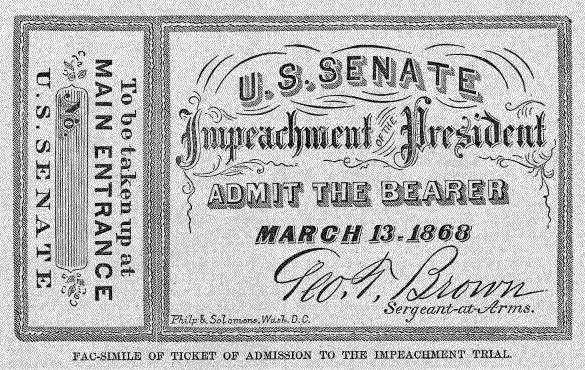

A ticket to the Impeachment Trial of President Andrew Johnson in the Senate in 1868.


Lyndon B. Johnson. 36th POTUS. 37th VPOTUS. Texas. Democrat.

The punchline of the fact sheet from the pre-Internet days ends with Lincoln being in Monroe, Maryland a week before his assassination setting up Kennedy to be in Marilyn Monroe a week before his. There is no Monroe, Maryland and Marilyn Monroe died in 1962...all according to Google.

All of this is nothing but historical coincidences. Nothing more. These comparisons between the two American presidents has been going on since the mid-1960s, more than likely.

Monday, April 15, 2013

Pointless Presidential Pfacts #34 - "The Last Time Lincoln Was in a Theater"

On April 14, 1865, Abraham Lincoln and Mary Todd Lincoln went to Ford's Theater to watch "Our American Cousin". Now while the 16th President of the United States wanted to relax at the theater as the Civil War came to an end, an individual with so much opposition to the central government's involvement in freeing the enslaved black man wanted nothing more than to topple the U.S. government on the night of the 14th. John Wilkes Booth and his conspirators planned to kill Lincoln, the loyal Southern Democrat from Tennessee and the recently sworn-in vice president, Andrew Johnson, and the Secretary of State, William Seward. Lincoln and Johnson ran on the Union Party ticket, dumping his vice president Hannibal Hamlin for the loyal southerner of the opposition party. Seward had been the nation's chief diplomat since the start of Lincoln's first term and prior to that had challenged Lincoln for the Republican nomination in 1860 and was expected to win it. Booth was a southern sympathizer from a famous family of actors, he was not unknown like his future fellow presidential assassins like Charles Guiteau, Leon Czolgosz, or Lee Harvey Oswald (and his conspirators???).


Abraham Lincoln, 16th President of the United States. Republican from Illinois.

The guy that was to kill Vice President Johnson chickened out and Johnson had no clue about an attempt. Although Booth did try to make a connection between himself and the vice president, but nothing came of it.

Lewis Powell, one of Booth's co-conspirators, had the responsibility of killing Secretary Seward. Powell made it into the secretary's home and fought off his son before stabbing him. What saved Seward was a neck-brace he wore after being in a carriage accident. Powell fled the scene and was later caught.


Lewis Powell

The only one successful that night was Booth. He had scoped out Ford's Theater and planned out his moves. He knew the play's funniest line, "Don't know the manners of good society, eh? Well, I guess I know enough to turn you inside out, old gal — you sockdologizing old man-trap." And that was when he was going to strike. Booth shot Lincoln with a derringer. After he shot Lincoln in the back of the head, Booth fought off Major Henry Rathbone, he and his wife shared the theater box with the First Couple, after bigger names like Grant and Sherman turned the play down. Booth slashed away at Rathbone, but the attack threw Booth off his game. Booth jumped from the box to the stage and his spur got caught in the flag. He broke his leg but before rushing off the stage yelled something to the audience. Two things were reported said, "Sic semper tyrannis!" which is the motto of Virginia and translates to "Thus always to tyrants." The line heard was "The South is avenged!"


Booth got on a horse, which he asked someone to hold, although they didn't know why, and he rode out of town. The Secretary of War, Edwin Stanton, issued a manhunt for Booth and his accomplices. Booth sought help for his leg and eventually made his way to Garrett's farm and stayed in the barn until Federal troops circled the barn with fire. A soldier shot Booth and he died shortly afterward. His conspirators were tried and hung for the crime. Among those executed on July 7, 1865, was the first female, Mary Surratt.


John Wilkes Booth

But on the night of April 14th, doctors in Ford's Theater tried to save the president's life. Fearful that President Lincoln would not survive the bumpy road back to the Executive Mansion, they moved the president across the street. Lincoln died the next morning. It is said that Stanton said, "now he belongs to the angels" and later he changed his quote to "now he belongs to the ages."


Johnson was sworn-in as the 17th president of the United States. Lincoln's plans for Reconstruction of the South would never come to light and a political power struggle between President Johnson and the Radical Republicans would harm Reconstruction and Civil Rights for about 100 years until after another assassinated president is succeeded by another Vice President Johnson.


Andrew Johnson, 17th President of the United States. Democrat from Tennessee.

Thursday, February 12, 2009

Today in POTUStory

Today in 1809 the myth, the legend, and the man...well just the man was born. The myth and the legend would come on April 15, 1865.

200 years ago our nation's 16th president of the United States was born in Kentucky. He and his family then moved to Indiana before settling down in his home state he has become associated with Illinois.


The 16th President of the United States

Lincoln would go on to become a lawyer traveling the judicial circuit of Illinois. As a lawyer he honed his skills which would help him become the great writer and speaker of his later years.

From 1847-1849, Lincoln served one term in the United States House of Representatives during the Mexican-US War in which he strongly opposed. While he would go on to become a founding member of the Republican Party, he served in the House as a member of the Whigs, a political party which would contribute to the founding of the Grand Old Party.

Lincoln would rise to national prominence in the most famous senate race in U.S. history. In 1858 Lincoln would debate his Democratic opponent Stephen Douglas and utter the famous "house divide" lines in terms of the nation existing half slave and half free. Although not competing in a directly elected senate contest since this took place prior to 1913, the Democrats won the majority in the State legislature and thus elected Douglas to the U.S. Senate. Lincoln may have lost but he became a national figure.


The Lincoln-Douglas Debates

In 1860 the New York Republican Party invited Lincoln to speak at Cooper Union. His speech elevated his status within the Republican Party. That year Lincoln would take on the big names of the Republican Party for the party's presidential nomination. Men like William Seward of New York, Salmon P. Chase of Ohio, and Edward Bates of Missouri. Lincoln, the one term Representative from Illinois, would be the victor in the contest against the heavy weights.


Lincoln's chief rival for the Republican nomination and his pick for Secretary of State, William Seward

By November Lincoln would face three other opponents for the presidency: the incumbent vice president John Breckinridge, John Bell, and his former opponent for the U.S. senate, Stephen Douglas. Lincoln won.

With Lincoln's election, or the election of a Republican, the South protested in form of succeeding from the Union. Lincoln would be inaugurated as president without a complete Union of States.


Seal of the Confederate States of America

Those that left the Union feared Lincoln would abolish their way of life or violate their States' Right. Lincoln made it clear he had no intention of doing such a thing. But that did not stop the southern States from leaving the Union and rebelling.

Lincoln's term would become defined by war like no other president in U.S. history. While Lincoln struggled with the war he thought would be over quickly, he also tried to maintain the status of the Union by continuing construction on the dome of the Capitol or building the transcontinental railroad connecting east and west.

The war between the States (or the Civil War or The War against Northern Aggression) was not fought on the issue of slavery. For Lincoln the war was fought to preserve the idea of the Union which was established in 1776. The war took on the notion of ending slavery by January of 1863 when the Emancipation Proclamation took effect, freeing the slaves within the States in rebellion. With that new cause taken by President Lincoln, the war was not only fought to preserve the Union and free the slaves but to essentially fight for a new definition of what the United States was truly about.

All the way up until 1864, Lincoln thought he would be a one term president. But as successes came in by Generals Ulysses S. Grant and William Sherman, Lincoln's election became clear. Instead of running as a Republican, he ran on the Union Party ticket with Democrat Andrew Johnson, the only senator from the South to remain loyal to the Union. The Union Party won and Lincoln was reelected.

Lincoln was determined to not punish the South and he made it clear in his Second Inaugural Address as he declared "With malice toward none, with charity for all."


Lincoln's Second Inaugural on the east front of the Capitol

Lincoln would be shot by southern sympathizer, Confederate spy, and well known actor John Wilkes Booth on Good Friday, April 14, 1865, creating the myth and the legend of the man.


John Wilkes Booth

After his death Abraham Lincoln became a secular saint to some Americans and a war criminal to others. Historians rank him as the best or second best president (George Washington and Lincoln duke it out for the top two spots), while others claim him to be a tyrant and should be removed from Mount Rushmore.

No matter what you believe about Abraham Lincoln, savior of the Union or aggressor toward southerners, he now belongs to the ages.