
Illustrated by Jeremy Massie

President Gerald Ford in Sacramento's Capitol Park.
First at a park in Sacramento, his assassin wannabe, Lynette "Squeaky" Fromme pointed a hand-gun at President Ford. She wanted to bring attention to the California Redwoods. A Secret Service agent grabbed the gun and prevented it from firing. As after any breech of security, procedures are reviewed, more precaution on future presidential outings.

Lynette "Squeaky" Fromme, after failed attempt at assassinating President Gerald Ford.
Like the one three weeks later in San Francisco, he was leaving the St. Francis Hotel when Sara Jane Moore aimed her gun at Ford from a crowd of people wanting a glimpse of the POTUS from across the street. Moore, like the first wannabe presidential assassin Richard Lawrence in 1835 attempted two shots, first shot missed and just as she was about to shoot another bullet the shot is deflect and misses nearly hitting the president in the head, but the bullet, now ricochet, wounds a taxi driver.

Ford, the Secret Service, the press and everybody react to the shots fired at the president.

Sara Jane Moore after her arrest.
Both wannabe-assassins were sentenced to life in prison, however Moore was paroled in 2007 and Fromme, a follower of Charles Manson, was paroled in 2009. Richard Lawrence is still dead.

The Democratic ticket in 1920, James Cox of Ohio and Franklin D. Roosevelt of New York. They're for peace, progress and prosperity, almost like the Republicans in 1960.

Here's a picture of Cox and FDR walking at a campaign event in 1920.

Richard Nixon's "For Peace and Prosperity Vote Straight Republican" 1960 campaign button. Something familiar. For War and Failure Vote Gay Republican, an unused button from another time.
On Nixon's first attempt at high office in 1952 he won and that's because the top of the ticket was Dwight D. Eisenhower, the man that saved Europe from the Nazis. The pick of Richard Nixon as vice president is comparable to future picks. Ike represented the internationalists and right of center Republicans. At the age of 39, Nixon's youth countered Ike's grandfatherly image. Nixon was openly anti-communist but not on the level of the disgraceful Joe McCarthy. While Ike didn't really care who became vice president, the party did and balanced the ticket, or Ike, with Nixon. Ike was getting pressure to kick Nixon off the ticket after a political fund run by financial backers to Nixon came to light. Nixon had not done anything illegal, but to clear his name and reputation Nixon went on television and revealed how modestly he and his wife Pat and their two daughters lived in 1952. Nixon also revealed that a gift from Texas, "a little cocker spaniel dog" that Tricia, the 6-year old, named Checkers. The speech, the most viewed thing on television up to that point, the birth of Ricky Ricardo Junior on I Love Lucy a few months later will become the most watched thing on television up to that point. Everyone loved Dick Nixon after that. (His mother preferred Richard to Dick). Especially Eisenhower, who kept him on the ticket and the two went on to easy victory against Adlai Stevenson (that's right, the grandson to the 23rd VPOTUS, Adlai Stevenson, to the 24th POTUS Grover Cleveland's third vice presidential running mate, but second vice president, from 1893-1897) of Illinois and John Sparkman of Alabama.

A candid shot of the GOP Republican nominee for vice president, Senator Richard Nixon of California and his dog Checkers, in 1952.
Vice President Nixon had an office in the Old Executive Office Building, which would later be renamed the Eisenhower Executive Office Building. Nixon would be part of cabinet meetings and because of the 1947 National Security Act, like his predecessor Alben Barkley he too would be part of the National Security Council and maintain Secret Service protection. President Eisenhower suffered a heart attack in September 1955, a year before the next Presidential Election, as well as two months before Marty McFly's arrival from the year 1985. This put Nixon a heartbeat away from the presidency like never before. Ike survived and was encouraged by his doctors that a second term would help the president's health. U-S-A! U-S-A! U-S-A!
Ike however wasn't encouraging Nixon off the ticket, but that's what he really wanted. President Eisenhower left the decision up to Vice President Nixon whether he should remain on the ticket or not. In private Ike never told Nixon to get off the ticket or that he wants him replaced, he just hoped Nixon would get the hint so Ike's decision in 1952 to accept him as the party's vice presidential nominee wasn't a wrong decision. If Nixon stepped down as VPOTUS, it would be the first vice presidential switch since Vice President Henry A. Wallace was dumped for the less-liberal Harry Truman in 1944. In that similar situation, the party wouldn't renominate the left leaning liberal Wallace for fear he'll be president if or when FDR dies before 1949, the end year of the 4th term. Except it wasn't the party's decision or Ike's since he left it up to Nixon to decide. Nixon knew if he was replaced that vice president might be president before the Republican's convention in 1960 or would be the frontrunner for the nomination if Ike makes it to 1961. Nixon chose to remain on the ticket and Ike accepted his (both Ike and Nixon) decision.

TIME magazine featured the winning ticket for the 1956 Presidential Election, the reelection of Dwight D. Eisenhower as the 34th POTUS and Richard Nixon as the 36th VPOTUS.
Like his first time on the national ticket, Nixon's second time was winner with President Eisenhower at the top of the ticket in 1956. Eisenhower ran against the Democrat's 1952 nominee Adlai Stevenson again but instead of Alabama's Sparkman the Democrat's chose Estes Kefauver of Tennessee for the second spot. Nixon's reelection as vice president was the first since John Nance Garner and Franklin Roosevelt won reelection in 1936, the difference here is Vice President Nixon was the incumbent and natural front-runner since for the first time since the passage of the 22nd Amendment, which limited the president to two terms. Ike was limited, unlike living former president Harry S. Truman, who was in office when the Amendment was written so thus he was not effected. He chose not to run in 1952 for a second term of his own which would also be a third term since he finished off FDR's fourth term. So for a third time Nixon was on a national ticket, but this time he was at the top of the ticket in 1960. This time without Ike and just like reelection in 1956 no real words of support from the POTUS.
The last time an incumbent vice president won the presidency was in 1836, when one term vice president Martin Van Buren followed two term president Andrew Jackson. Nixon will be the first two-term incumbent to try since John Adams in 1796 after two-terms as VPOTUS under George Washington. Vice President Nixon's one hundred year-ago counter-part, 14th Vice President of the United States John C. Breckinridge, was the Southern Democrat's choice for president against the Republican's Abraham Lincoln of Illinois. Breckinridge came in third in the popular votes but second in the Electoral College which in the post-12th Amendment U.S. that means nothing. Although Nixon and Breckinridge had to announce their opponent's victory as presiding officer of a Joint-Session of Congress. Nixon faced a close race and some would say stolen election against Senator John F. Kennedy of Massachusetts. The 2000 election was closer, but this was up there in very very very very (multiple verys means it's very important) very close terms. Vice President Nixon chose not to contest the outcome, something no candidate had done until Vice President Al Gore in the 2000 election.

The two presidential candidates from the two major political parties in the United States, Democrat John F. Kennedy, senator from Massachusetts and Republican Richard Nixon, vice president of the United States and from the great State of California.

Nixon's reaction to the news that he lost the 1960 Presidential Election, but not really.
So Nixon lost in 1960. What was a young former vice president supposed to do with his future? His one hundred year-ago counterpart, Breckinridge is the youngest to be elected VPOTUS at 36. What did former vice president Breckinridge do? Well he served in the U.S. Senate in 1861 and resigned in support of the Confederate States of America. So he was labeled a traitor. Former Vice President Nixon went on to run for governor of his home State of California and lost to the incumbent governor Pat Brown. Governor Brown would be defeated in 1966 by future POTUS, number 40, Ronald Reagan. The press labeled Nixon's loss the end of his political career, while the former vice president told the press they "won't have Nixon to kick around anymore".
The next national election wouldn't be until 1964 and before the assassination of JFK Nixon knew nobody was going to defeat him in his reelection bid. Just as he was sure of Kennedy's success in 1964 had he had the chance, the same was true about President Lyndon Johnson as an opponent in '64. Johnson would win a landslide election, which would be repeated 8 years later and slightly better by Nixon. So the former vice president chose not run in 1964 and let Barry Goldwater of Arizona and Nelson Rockefeller of New York vie for the nomination, two different wings conservative and moderates. The conservatives won in 1964 and lost as well in the General Election.

A photo from July of 1968 before the Republicans nominate the former vice president, Richard Nixon talks with President Lyndon B. Johnson, in I guess, the Cabinet Room. 7 years prior in 1961, Nixon was the outgoing VPOTUS (#36) and LBJ was the incoming VPOTUS (#37), six months after this photo LBJ will be the outgoing POTUS (#36) and Nixon will be the incoming POTUS (#37).
By 1968, Nixon was ready to get back in the game of politics. The Democratic Party was torn over the Vietnam War. President Johnson chose not to seek reelection after facing challenges from the left, like Eugene McCarthy and Robert Kennedy. With LBJ out of the running, this let Vice President Hubert Humphrey run for the nomination. In the end the Democrats went with Humphrey, after Senator Kennedy's assassination during the primaries. The Republicans went with the former vice president, so the 1968 election was the first time there was an incumbent vice president running against a former vice president and the former vice president won, also a first. Nixon won his 4th national election and his second national election as the Republican Nominee. The 1968 election was just as close as Nixon's 1960 run.

"Nixon's the One" was his 1968 campaign slogan.
Nixon's 5th an last run for national office would be his reelection as president in 1972. He would run simply as "the President". Nixon was again, like Ike, limited to two terms. Nixon and Spiro Agnew would easily win reelection against Democrat George McGovern. While Nixon's reelection would be one of the nation's largest, the events that would bring Nixon's presidency to an end long before January 20, 1977. The cover-up of the Watergate break-in was taking place and Nixon's order of cover-up his downfall. Once evidence surfaced, or the smoking gun, Nixon faced impeachment by the House of Representatives. The Articles of Impeachment, two of them, were written and voted on by the House Judiciary Committee. Republican National Committee Chair George H.W. Bush, the future POTUS, wrote to Nixon telling him to resign. Republicans in the Senate led by Senator Goldwater, warned the President that if the impeachment made it to trial in the Senate, that he would not survive. Nixon chose to resign the office in August 1974, the first and only president to resign. The presidential ticket elected in 1972 would resign before 1977, as Vice President Agnew resigned in 1973 for reasons not associated with Watergate but from his time as Governor of Maryland. The 25th Amendment was passed in 1967 and did not allow for there to be a vacancy in the vice presidency, so for the first time Nixon appointed a vice president in 1973. Gerald Ford was the Republican Minority Leader in the House of Representatives, known as a guy loved by everyone on Capitol Hill. Ford was also someone with no connection to Watergate. With Nixon's resignation, Ford became the 38th POTUS and the first never to have run for either the vice presidency or presidency.

TIME magazine's post-1972 Presidential Election issue with a mention of the landslide.
Nixon would return to his home State of California. President Ford would pardon Nixon a month later, leading some to believe a deal was made between the two. But no such deal has ever been discovered or proven. Ford believed nation needed to move on and that pardoning Nixon would stop the press from constantly asking questions related to the break-in and cover-up. Nixon would rehabilitate his political image until his death in 1994. Nixon could never run again for national office, and since Nixon, Bush 41 has run on a national ticket four times, 1980, 1984, 1988, and 1992. Bush won 3 of the 4. Just like FDR, Nixon won 4 of the 5, but one big difference outside of term-limits on the presidency, Nixon won his home State of California in all 5 of his national run.

President Nixon, with the First Family, gives a farewell speech to the White House staff in the East Room on August 9, 1974, his last day in office.
Abraham Lincoln was born on February 12, 1809 and John F. Kennedy was born on May 29, 1917. No similarity there between the two. Lincoln was elected the 16th POTUS while Kennedy became the 35th POTUS. Still nothing coincidental about those facts.

Abraham Lincoln. 16th POTUS. Illinois. Republican.
Lincoln was elected to Congress in 1846 and JFK was elected in 1946. Exactly (well in years) one hundred years apart Lincoln and Kennedy were elected to the House of Representatives. Representative Lincoln served only one term in the House after being a part of the Whig Party's opposition to President James K. Polk and the Democratic Party's war win against Mexico, making the United States a continental power. Representative Kennedy on the other hand went on to win reelection to his House seat two more times and then in 1952 wins the race for Massachusetts' open senate seat in the U.S. Senate, the other house of Congress.

John F. Kennedy. 35th POTUS. Massachusetts. Democrat.
Senator Kennedy went from the Senate to the White House in 1960, whereas Lincoln won the presidential election of 1860 without having served in elected politics since he left the House in 1849, when Polk was leaving office and Zachary Taylor was entering office. One hundred years apart both became president of the United States. They were both challenged by an incumbent, and youthful, vice president in the General Election, John C. Breckinridge in 1860 and Richard M. Nixon in 1960, both would announce their loss to Lincoln and Kennedy, respectively, to a Joint-Session of Congress.
President Lincoln had to deal with States in rebellion from the start of his term and his goal was first and foremost to preserve the Union of States before the Civil War took on the responsibility of freeing the enslaved blacks in the South. He was president during the Civil War, while JFK was a president that served during the Cold War, another "C"-"W" initialed event. His hundred year counterpart would become associated with Civil Rights as well and his death would help push Civil Rights legislation through the Congress by his successor one hundred years after the Civil War ended. Essentially the Civil Rights that Lincoln began fighting for don't come to until almost one hundred years after his death.
As president, they both had young children in the White House, or during Lincoln's time, the Executive Mansion. Their wives also lost a child while living in the presidential mansion. Mary Todd Lincoln, and the president, lost their youngest William to an illness at the age of 11, where Jack and Jackie Kennedy lost their child, Patrick, two days after being born. The two died one hundred and one years apart.
Both presidents had secretaries named after the other. President Lincoln had a secretary named Kennedy and President Kennedy had a secretary named Lincoln.
But there's more connections.

John Wilkes Booth shoots President Lincoln while he, his wife and the Rathbones (such a 19th Century-sounding name) watch "Our American Cousin" from box seats at Ford's Theater. Why the sketch artist just sketched and didn't help is one of history's greatest unsolved mysteries so says the ghost of Robert Stack.
Lincoln was assassinated in 1865 and Kennedy was assassinated in 1963, almost one hundred years. Almost. But they were both shot on a Friday while sitting next to their wives. Both were shot in the head. They were with another couple. The Lincolns went to Ford's Theater with the Rathbones and the Kennedys rode with the Connallys in an automobile named Lincoln. Both males that were with the president when they were shot were both injured and survived the attacks. The presidents were shot by men from the South. One was born in 1838 and the other born in 1939. The assassins were known by their full name, three names made up of 15 letters, John Wilkes Booth and Lee Harvey Oswald. Booth fled a theater for an abandoned warehouse, whereas Oswald did the opposite, he went from a warehouse to a theater. Both Booth and Oswald were shot and killed before their trial.

"Oswald!" yelled Jack Ruby as he shot Lee Harvey Oswald on LIVE television.
Both presidents were succeeded by Southerners who were their vice presidents. Both vice presidents were named Johnson and born one hundred years apart, 1808 and 1908 Tennessee's Andrew Johnson was loyal to the Union and put on the Union Party ticket with President Lincoln in 1864, a ticket made up of a Republican and a Democrat. Johnson became the 17th POTUS the day after Lincoln was shot and three hours after he died. Texas' Lyndon Johnson ran with Kennedy in 1960 and was sworn in as the 36th POTUS the day JFK was shot and killed in Dallas. Johnson-17 would go on to become the first impeached POTUS but survived the trial in the Senate by one vote in a battle to control Reconstruction of the South. His impeachment would weaken the executive branch, which was strong during Lincoln's terms, for the rest of the 19th Century. Johnson-36 would go on to win a landslide election of his own in 1964 but while he had success with Civil Rights and hoped for a great society, Johnson-36 eventually lost favor with the American people and his party as reelection in 1968 seemed impossible thanks to the longevity of the Vietnam War and his mishandling of the Cold War's proxy hot war.
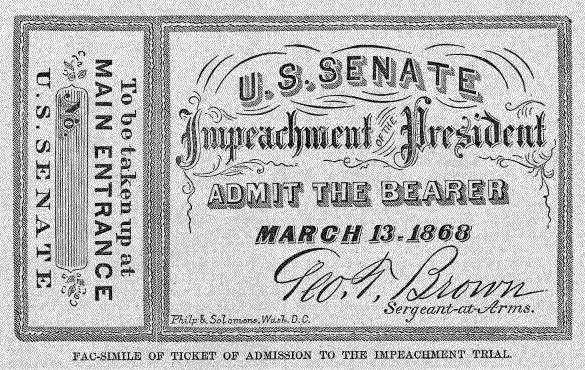
A ticket to the Impeachment Trial of President Andrew Johnson in the Senate in 1868.

Lyndon B. Johnson. 36th POTUS. 37th VPOTUS. Texas. Democrat.
The punchline of the fact sheet from the pre-Internet days ends with Lincoln being in Monroe, Maryland a week before his assassination setting up Kennedy to be in Marilyn Monroe a week before his. There is no Monroe, Maryland and Marilyn Monroe died in 1962...all according to Google.
All of this is nothing but historical coincidences. Nothing more. These comparisons between the two American presidents has been going on since the mid-1960s, more than likely.

President John F. Kennedy's inauguration in 1961 on the East Front of the U.S. Capitol.
A new precedent began with a new president, with Ronald Reagan's swearing-in on January 20, 1981, presidents have taken the oath of office on the West Front. The West Front of the Capitol allowed for more space both on the make-shift stage and the crowds of people. It also gave the television audience sweeping scenes of the Mall.

President Barack Obama's first term inauguration in 2009 on the West Front.
In case of the removal of the President from office or of his death or resignation, the Vice President shall become President.
And that was just the start.
Before 1967 the Constitution never specified what exactly would happen if something happened to the president of the United States. For the first time on April 4, 1841, a president passed away. The nation's 9th chief magistrate, William Henry Harrison gave the longest inaugural address in the depths of winter on March 4th of that year. The oldest man elected to the office to that point (Ronald Reagan would later hold that title) decided to give his long address without a top hat or overcoat. The 68 year old president died 30 days (or 32?) later of pneumonia.

William Henry Harrison, 9th President of the United States
Hay dios mio! What do we do?
The 10th vice president of the United States, John Tyler, found out the next day that President Harrison had passed away. The Constitution said:
In Case of the Removal of the President from Office, or of his Death, Resignation, or Inability to discharge the Powers and Duties of the said Office, the same shall devolve on the Vice President
What did devolve mean? It was unclear and the Founding Fathers made it unclear intentionally or unintentionally. But Vice President Tyler took it to mean that he would become the president of the United States.

John Tyler, 10th Vice President of the United States and 10th President of the United States
On April 6th he took the oath of office and the reigns of power. The cabinet, which Harrison appointed, tried to deny Tyler the authority of the presidency. Tyler made it clear to them and his detractors in the Congress that he was the president of the United States, not Acting-President or the Vice President in the role of the presidency until some kind of special election.
The 10th vice president went on to become the 10th president.

Vice President Tyler being informed of the death of President Harrison
The Tyler Precedent would be followed by Millard Fillmore, Andrew Johnson, Chester Arthur, Theodore Roosevelt, Calvin Coolidge, Harry Truman, and Lyndon Johnson. The Tyler Precedent would go on to be written into the Constitution as the 25th Amendment. Gerald Ford would be the first to be elevated thanks to the 25th Amendment. Ford would also be the first to be appointed vice president due to a vacancy.
House Minority Leader Gerald Ford being sworn in as the 40th Vice President of the United States
The 25th Amendment would also make sure that there would never be a vacancy in the vice presidency. Whenever the vice presidents succeeded to the presidency, died in office, or resigned leaving the vice presidency vacant it would remain so until the next election and then inauguration.
The acknowledgment that the vice president becomes the president is the first thing mentioned in the 25th Amendment and has taken effect only by Gerald Ford's ascendancy. Filling the vacancy is the second part of the Amendment which has only occurred twice, Ford replacing Spiro Agnew after his resignation in 1973 and Nelson Rockefeller's appointment once Ford succeeded President Nixon in 1974. The third section of the Amendment allows the president to inform the President Pro Tempore and the Speaker of the House that he or she cannot perform the duties of the office and transmit the powers to the Vice President to perform them as Acting President and can reclaim the powers once he or she informs the two leaders of the Congress. Ronald Reagan did this in 1985, making Vice President George Herbert Walker Bush the first Acting-Presidnet. While Dick Cheney held the title twice during the George W. Bush administration once in 2002 and then again in 2007.
The final section of the 25th Amendment has never taken place. George H. W. Bush calls the fourth section a legal coup. The vice president and a majority of the cabinet officers are needed to declare the president unable to execute the duties of the office. The closest we've come to this is in the feature film Air Force One when the vice president played by Glenn Close is presented with a letter readied for her to sign initiating the Acting President status under the fourth section of the 25th Amendment. She tears it up at the end of the film once the president is safe from the Russian terrorists and no longer in danger.
Air Force One movie poster
It took the threat of a nuclear age for the line of succession of vice president to president to be clearly written into the Constitution. After the assassination of John F. Kennedy in 1963, the vice presidency remained vacant. Where as before then no evil or dangerous threat really harmed or threatened the country as succession slowly took its time. But in the post-Cuban Missile Crisis United States immediate succession took precedent.
Recently it has been said that Senator John McCain should reveal who is on his short list for vice president, since the search for his v.p. is going on behind closed doors. And why not? Go back eight years when then-Governor George W. Bush of Texas selected former Secretary of Defense Richard B. Cheney to head up his vice president selection committee. In the end, Secretary Cheney chose himself as the best candidate for vice president. After eight years of Cheney as vice president, who has become indisputably the most powerful vice president in United States history, the citizens of the United States should have more say as to who their vice president is.
Long ago the presidential nominating conventions lost the right to pick the vice presidential candidate for either party. The presidential candidates have been the ones to choose their respective running mates. Some were once bitter rivals during the primary campaign season and then became a presidential ticket, like Senator John F. Kennedy and Senator Lyndon Johnson in 1960, former Governor Ronald Reagan and former Director of the CIA George Herbert Walker Bush in 1980, and Senator John Kerry and Senator John Edwards in 2004. The time has come for the voters to decide the vice president.
A perfect example is the 2008 Democratic primary race for president. Neither Senator Barack Obama or Senator Hillary Clinton have enough votes to obtain the Democratic nomination. The party is almost split on the decision. It has come to the point where the two need to be on the same ticket to appease supporters of both candidates whether it is Obama/Clinton or Clinton/Obama. Also with the request of McCain to reveal his "short list" of v.p. candidates, it seems ever apparent that electing a vice president instead of having the presidential candidate making his or her first presidential decision pre-presidency is what the electorate wants. During the primary election each state should not only vote for their choice for president but their choice for vice president, on a separate ballot just like in the general election.
This separate ballot primary election will once again return the stature that was taken away by the 12th Amendment and return some electoral glory to the office as well as prevent the long drawn out primary or closed door selection as seen in the 2008 presidential/vice presidential selection.


