Showing posts with label Lyndon Johnson. Show all posts

Thursday, June 13, 2013

Pointless Presidential Pfacts #44 - "THE FIRST DEMOCRAT SINCE... PART 2: THE 50 PERCENT"

In 1996, President William Jefferson Clinton, the 42nd POTUS, was the first Democratic president of the United States to be reelected to a second term since Franklin D. Roosevelt, the 32nd POTUS. Harry Truman, the 33rd, and Lyndon Johnson, the 36th, were reelected to the office after finishing the term of the late president they succeeded. This pfact is focusing on full presidential terms. The difference between Clinton's reelection and FDR's, is that Roosevelt 32 received more than 50% of the popular vote in all four of his presidential runs. Clinton's plurality wins in both 1992 and 1996 is the first for a Democratic president since Woodrow Wilson's two-term wins in 1912 and 1916.


President William Jefferson Clinton the night he won reelection as the 42nd POTUS with the First Lady, Hillary, and their Daughter Chelsea on Election Night 1996.

When Clinton won the White House in 1992, he only won 43% of the popular vote, the same amount won by Richard Nixon in 1968. Unlike President Nixon's reelection in 1972, Clinton did not win in a landslide but just short of getting 50% with just 49%. So the last double plurality popular vote wins was President Wilson. Whereas Clinton faced a three-way race in 1992 between the incumbent Republican President George Bush and independent businessman Ross Perot, eighty years prior Wilson faced a four-way race against the incumbent Republican President William Howard Taft, the Progressive Party, or Bull-Moose Party ran former president Theodore Roosevelt, and Socialist Party candidate Eugene Debs. Wilson won 41% of the popular vote and in his reelection bid four years later he came just as close to 50% as Clinton would 80 years later in 1996.


Campaigning for Woodrow Wilson in 1916.

After Roosevelt 32, of the rest of the 20th Century Democratic presidents Johnson 36 and Jimmy Carter are the only other ones to receive more than 50% of the popular vote. In 1964, Johnson 36 won reelection in a landslide to the office he inherited through assassination. Then-former-Governor Carter got 50% of the popular vote in the super close 1976 election, not a mandate like Johnson 36's but 50%.

The first Democratic president elected in the 21st Century would be the first Democrat to win the presidency with more than 50% of the vote since Carter's win in 1976, and that would be Barack Obama in 2008. It would be with President Obama's reelection in 2012 that he would achieve what only two other Democratic presidents have achieved, winning over 50% of the popular vote in back-to-back elections. Andrew Jackson's two wins in 1828 and 1832 (there was also his plurality win, but of no matter to the House of Representatives in 1824) and FDR's 1932 and 1936 wins, as well as his 1940 and 1944 reelections to a third and fourth term, respectively.


President Barack Obama on the night he won reelection to a second term as the 44th POTUS.

Thursday, April 25, 2013

Pointless Presidential Pfacts #37 - "You Won't Have Nixon to Kick Around Anymore"

Richard Nixon is one of two individuals that ran 5 times for federal office nationally, the only thing all the States vote on together, a presidential ticket. Just like Franklin D. Roosevelt ran for high office 5 times (once in 1920 for V.P. on the losing ticket of James Cox and Franklin Roosevelt and four times successfully as POTUS), Nixon did too, sort of.


The Democratic ticket in 1920, James Cox of Ohio and Franklin D. Roosevelt of New York. They're for peace, progress and prosperity, almost like the Republicans in 1960.

Here's a picture of Cox and FDR walking at a campaign event in 1920.


Richard Nixon's "For Peace and Prosperity Vote Straight Republican" 1960 campaign button. Something familiar. For War and Failure Vote Gay Republican, an unused button from another time.

On Nixon's first attempt at high office in 1952 he won and that's because the top of the ticket was Dwight D. Eisenhower, the man that saved Europe from the Nazis. The pick of Richard Nixon as vice president is comparable to future picks. Ike represented the internationalists and right of center Republicans. At the age of 39, Nixon's youth countered Ike's grandfatherly image. Nixon was openly anti-communist but not on the level of the disgraceful Joe McCarthy. While Ike didn't really care who became vice president, the party did and balanced the ticket, or Ike, with Nixon. Ike was getting pressure to kick Nixon off the ticket after a political fund run by financial backers to Nixon came to light. Nixon had not done anything illegal, but to clear his name and reputation Nixon went on television and revealed how modestly he and his wife Pat and their two daughters lived in 1952. Nixon also revealed that a gift from Texas, "a little cocker spaniel dog" that Tricia, the 6-year old, named Checkers. The speech, the most viewed thing on television up to that point, the birth of Ricky Ricardo Junior on I Love Lucy a few months later will become the most watched thing on television up to that point. Everyone loved Dick Nixon after that. (His mother preferred Richard to Dick). Especially Eisenhower, who kept him on the ticket and the two went on to easy victory against Adlai Stevenson (that's right, the grandson to the 23rd VPOTUS, Adlai Stevenson, to the 24th POTUS Grover Cleveland's third vice presidential running mate, but second vice president, from 1893-1897) of Illinois and John Sparkman of Alabama.


A candid shot of the GOP Republican nominee for vice president, Senator Richard Nixon of California and his dog Checkers, in 1952.

Vice President Nixon had an office in the Old Executive Office Building, which would later be renamed the Eisenhower Executive Office Building. Nixon would be part of cabinet meetings and because of the 1947 National Security Act, like his predecessor Alben Barkley he too would be part of the National Security Council and maintain Secret Service protection. President Eisenhower suffered a heart attack in September 1955, a year before the next Presidential Election, as well as two months before Marty McFly's arrival from the year 1985. This put Nixon a heartbeat away from the presidency like never before. Ike survived and was encouraged by his doctors that a second term would help the president's health. U-S-A! U-S-A! U-S-A!

Ike however wasn't encouraging Nixon off the ticket, but that's what he really wanted. President Eisenhower left the decision up to Vice President Nixon whether he should remain on the ticket or not. In private Ike never told Nixon to get off the ticket or that he wants him replaced, he just hoped Nixon would get the hint so Ike's decision in 1952 to accept him as the party's vice presidential nominee wasn't a wrong decision. If Nixon stepped down as VPOTUS, it would be the first vice presidential switch since Vice President Henry A. Wallace was dumped for the less-liberal Harry Truman in 1944. In that similar situation, the party wouldn't renominate the left leaning liberal Wallace for fear he'll be president if or when FDR dies before 1949, the end year of the 4th term. Except it wasn't the party's decision or Ike's since he left it up to Nixon to decide. Nixon knew if he was replaced that vice president might be president before the Republican's convention in 1960 or would be the frontrunner for the nomination if Ike makes it to 1961. Nixon chose to remain on the ticket and Ike accepted his (both Ike and Nixon) decision.


TIME magazine featured the winning ticket for the 1956 Presidential Election, the reelection of Dwight D. Eisenhower as the 34th POTUS and Richard Nixon as the 36th VPOTUS.

Like his first time on the national ticket, Nixon's second time was winner with President Eisenhower at the top of the ticket in 1956. Eisenhower ran against the Democrat's 1952 nominee Adlai Stevenson again but instead of Alabama's Sparkman the Democrat's chose Estes Kefauver of Tennessee for the second spot. Nixon's reelection as vice president was the first since John Nance Garner and Franklin Roosevelt won reelection in 1936, the difference here is Vice President Nixon was the incumbent and natural front-runner since for the first time since the passage of the 22nd Amendment, which limited the president to two terms. Ike was limited, unlike living former president Harry S. Truman, who was in office when the Amendment was written so thus he was not effected. He chose not to run in 1952 for a second term of his own which would also be a third term since he finished off FDR's fourth term. So for a third time Nixon was on a national ticket, but this time he was at the top of the ticket in 1960. This time without Ike and just like reelection in 1956 no real words of support from the POTUS.

The last time an incumbent vice president won the presidency was in 1836, when one term vice president Martin Van Buren followed two term president Andrew Jackson. Nixon will be the first two-term incumbent to try since John Adams in 1796 after two-terms as VPOTUS under George Washington. Vice President Nixon's one hundred year-ago counter-part, 14th Vice President of the United States John C. Breckinridge, was the Southern Democrat's choice for president against the Republican's Abraham Lincoln of Illinois. Breckinridge came in third in the popular votes but second in the Electoral College which in the post-12th Amendment U.S. that means nothing. Although Nixon and Breckinridge had to announce their opponent's victory as presiding officer of a Joint-Session of Congress. Nixon faced a close race and some would say stolen election against Senator John F. Kennedy of Massachusetts. The 2000 election was closer, but this was up there in very very very very (multiple verys means it's very important) very close terms. Vice President Nixon chose not to contest the outcome, something no candidate had done until Vice President Al Gore in the 2000 election.


The two presidential candidates from the two major political parties in the United States, Democrat John F. Kennedy, senator from Massachusetts and Republican Richard Nixon, vice president of the United States and from the great State of California.


Nixon's reaction to the news that he lost the 1960 Presidential Election, but not really.

So Nixon lost in 1960. What was a young former vice president supposed to do with his future? His one hundred year-ago counterpart, Breckinridge is the youngest to be elected VPOTUS at 36. What did former vice president Breckinridge do? Well he served in the U.S. Senate in 1861 and resigned in support of the Confederate States of America. So he was labeled a traitor. Former Vice President Nixon went on to run for governor of his home State of California and lost to the incumbent governor Pat Brown. Governor Brown would be defeated in 1966 by future POTUS, number 40, Ronald Reagan. The press labeled Nixon's loss the end of his political career, while the former vice president told the press they "won't have Nixon to kick around anymore".

The next national election wouldn't be until 1964 and before the assassination of JFK Nixon knew nobody was going to defeat him in his reelection bid. Just as he was sure of Kennedy's success in 1964 had he had the chance, the same was true about President Lyndon Johnson as an opponent in '64. Johnson would win a landslide election, which would be repeated 8 years later and slightly better by Nixon. So the former vice president chose not run in 1964 and let Barry Goldwater of Arizona and Nelson Rockefeller of New York vie for the nomination, two different wings conservative and moderates. The conservatives won in 1964 and lost as well in the General Election.


A photo from July of 1968 before the Republicans nominate the former vice president, Richard Nixon talks with President Lyndon B. Johnson, in I guess, the Cabinet Room. 7 years prior in 1961, Nixon was the outgoing VPOTUS (#36) and LBJ was the incoming VPOTUS (#37), six months after this photo LBJ will be the outgoing POTUS (#36) and Nixon will be the incoming POTUS (#37).

By 1968, Nixon was ready to get back in the game of politics. The Democratic Party was torn over the Vietnam War. President Johnson chose not to seek reelection after facing challenges from the left, like Eugene McCarthy and Robert Kennedy. With LBJ out of the running, this let Vice President Hubert Humphrey run for the nomination. In the end the Democrats went with Humphrey, after Senator Kennedy's assassination during the primaries. The Republicans went with the former vice president, so the 1968 election was the first time there was an incumbent vice president running against a former vice president and the former vice president won, also a first. Nixon won his 4th national election and his second national election as the Republican Nominee. The 1968 election was just as close as Nixon's 1960 run.


"Nixon's the One" was his 1968 campaign slogan.

Nixon's 5th an last run for national office would be his reelection as president in 1972. He would run simply as "the President". Nixon was again, like Ike, limited to two terms. Nixon and Spiro Agnew would easily win reelection against Democrat George McGovern. While Nixon's reelection would be one of the nation's largest, the events that would bring Nixon's presidency to an end long before January 20, 1977. The cover-up of the Watergate break-in was taking place and Nixon's order of cover-up his downfall. Once evidence surfaced, or the smoking gun, Nixon faced impeachment by the House of Representatives. The Articles of Impeachment, two of them, were written and voted on by the House Judiciary Committee. Republican National Committee Chair George H.W. Bush, the future POTUS, wrote to Nixon telling him to resign. Republicans in the Senate led by Senator Goldwater, warned the President that if the impeachment made it to trial in the Senate, that he would not survive. Nixon chose to resign the office in August 1974, the first and only president to resign. The presidential ticket elected in 1972 would resign before 1977, as Vice President Agnew resigned in 1973 for reasons not associated with Watergate but from his time as Governor of Maryland. The 25th Amendment was passed in 1967 and did not allow for there to be a vacancy in the vice presidency, so for the first time Nixon appointed a vice president in 1973. Gerald Ford was the Republican Minority Leader in the House of Representatives, known as a guy loved by everyone on Capitol Hill. Ford was also someone with no connection to Watergate. With Nixon's resignation, Ford became the 38th POTUS and the first never to have run for either the vice presidency or presidency.


TIME magazine's post-1972 Presidential Election issue with a mention of the landslide.

Nixon would return to his home State of California. President Ford would pardon Nixon a month later, leading some to believe a deal was made between the two. But no such deal has ever been discovered or proven. Ford believed nation needed to move on and that pardoning Nixon would stop the press from constantly asking questions related to the break-in and cover-up. Nixon would rehabilitate his political image until his death in 1994. Nixon could never run again for national office, and since Nixon, Bush 41 has run on a national ticket four times, 1980, 1984, 1988, and 1992. Bush won 3 of the 4. Just like FDR, Nixon won 4 of the 5, but one big difference outside of term-limits on the presidency, Nixon won his home State of California in all 5 of his national run.


President Nixon, with the First Family, gives a farewell speech to the White House staff in the East Room on August 9, 1974, his last day in office.

Friday, April 19, 2013

Pointless Presidential Pfacts #35 - "Lincoln, Kennedy and Monroe"

There are many coincidences throughout history and even within a country's own history, like the United States. Now the internets have been passing misinformation around big time, including on the legend of the connections between Abraham Lincoln and John F. Kennedy. The inaccuracies forced me to write this piece based off of simple coinkydinks that occurred during the Lincoln and Kennedy presidencies, starting with some accurate non-coinkydinks events in presidential history.

Abraham Lincoln was born on February 12, 1809 and John F. Kennedy was born on May 29, 1917. No similarity there between the two. Lincoln was elected the 16th POTUS while Kennedy became the 35th POTUS. Still nothing coincidental about those facts.


Abraham Lincoln. 16th POTUS. Illinois. Republican.

Lincoln was elected to Congress in 1846 and JFK was elected in 1946. Exactly (well in years) one hundred years apart Lincoln and Kennedy were elected to the House of Representatives. Representative Lincoln served only one term in the House after being a part of the Whig Party's opposition to President James K. Polk and the Democratic Party's war win against Mexico, making the United States a continental power. Representative Kennedy on the other hand went on to win reelection to his House seat two more times and then in 1952 wins the race for Massachusetts' open senate seat in the U.S. Senate, the other house of Congress.


John F. Kennedy. 35th POTUS. Massachusetts. Democrat.

Senator Kennedy went from the Senate to the White House in 1960, whereas Lincoln won the presidential election of 1860 without having served in elected politics since he left the House in 1849, when Polk was leaving office and Zachary Taylor was entering office. One hundred years apart both became president of the United States. They were both challenged by an incumbent, and youthful, vice president in the General Election, John C. Breckinridge in 1860 and Richard M. Nixon in 1960, both would announce their loss to Lincoln and Kennedy, respectively, to a Joint-Session of Congress.

President Lincoln had to deal with States in rebellion from the start of his term and his goal was first and foremost to preserve the Union of States before the Civil War took on the responsibility of freeing the enslaved blacks in the South. He was president during the Civil War, while JFK was a president that served during the Cold War, another "C"-"W" initialed event. His hundred year counterpart would become associated with Civil Rights as well and his death would help push Civil Rights legislation through the Congress by his successor one hundred years after the Civil War ended. Essentially the Civil Rights that Lincoln began fighting for don't come to until almost one hundred years after his death.

As president, they both had young children in the White House, or during Lincoln's time, the Executive Mansion. Their wives also lost a child while living in the presidential mansion. Mary Todd Lincoln, and the president, lost their youngest William to an illness at the age of 11, where Jack and Jackie Kennedy lost their child, Patrick, two days after being born. The two died one hundred and one years apart.

Both presidents had secretaries named after the other. President Lincoln had a secretary named Kennedy and President Kennedy had a secretary named Lincoln.

But there's more connections.


John Wilkes Booth shoots President Lincoln while he, his wife and the Rathbones (such a 19th Century-sounding name) watch "Our American Cousin" from box seats at Ford's Theater. Why the sketch artist just sketched and didn't help is one of history's greatest unsolved mysteries so says the ghost of Robert Stack.

Lincoln was assassinated in 1865 and Kennedy was assassinated in 1963, almost one hundred years. Almost. But they were both shot on a Friday while sitting next to their wives. Both were shot in the head. They were with another couple. The Lincolns went to Ford's Theater with the Rathbones and the Kennedys rode with the Connallys in an automobile named Lincoln. Both males that were with the president when they were shot were both injured and survived the attacks. The presidents were shot by men from the South. One was born in 1838 and the other born in 1939. The assassins were known by their full name, three names made up of 15 letters, John Wilkes Booth and Lee Harvey Oswald. Booth fled a theater for an abandoned warehouse, whereas Oswald did the opposite, he went from a warehouse to a theater. Both Booth and Oswald were shot and killed before their trial.


"Oswald!" yelled Jack Ruby as he shot Lee Harvey Oswald on LIVE television.

Both presidents were succeeded by Southerners who were their vice presidents. Both vice presidents were named Johnson and born one hundred years apart, 1808 and 1908 Tennessee's Andrew Johnson was loyal to the Union and put on the Union Party ticket with President Lincoln in 1864, a ticket made up of a Republican and a Democrat. Johnson became the 17th POTUS the day after Lincoln was shot and three hours after he died. Texas' Lyndon Johnson ran with Kennedy in 1960 and was sworn in as the 36th POTUS the day JFK was shot and killed in Dallas. Johnson-17 would go on to become the first impeached POTUS but survived the trial in the Senate by one vote in a battle to control Reconstruction of the South. His impeachment would weaken the executive branch, which was strong during Lincoln's terms, for the rest of the 19th Century. Johnson-36 would go on to win a landslide election of his own in 1964 but while he had success with Civil Rights and hoped for a great society, Johnson-36 eventually lost favor with the American people and his party as reelection in 1968 seemed impossible thanks to the longevity of the Vietnam War and his mishandling of the Cold War's proxy hot war.


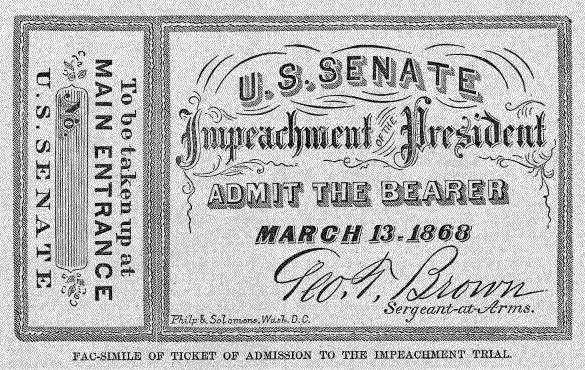
A ticket to the Impeachment Trial of President Andrew Johnson in the Senate in 1868.


Lyndon B. Johnson. 36th POTUS. 37th VPOTUS. Texas. Democrat.

The punchline of the fact sheet from the pre-Internet days ends with Lincoln being in Monroe, Maryland a week before his assassination setting up Kennedy to be in Marilyn Monroe a week before his. There is no Monroe, Maryland and Marilyn Monroe died in 1962...all according to Google.

All of this is nothing but historical coincidences. Nothing more. These comparisons between the two American presidents has been going on since the mid-1960s, more than likely.

Thursday, January 17, 2013

Pointless Presidential Pfacts #29 - "First Frist Ladies and Inauguration"

The role of a first lady on Inauguration Day increased early in the 20th Century.

Helen Taft became the first to ride back to the White House with the newly sworn in president, William Howard Taft, in 1909.


The Tafts ride back from the Capitol after the inaugural ceremonies on March 4, 1909.

For Woodrow Wilson's second swearing-in, Edith Wilson became the first First Lady to accompany the president to and from the ceremony. In 1921, the outgoing first lady, Wilson, rode with incoming first lady Florence Harding to the Capitol starting the tradition of first ladies following the president and president-elect. Eventually, First Ladies and Second Ladies would ride to the Capitol with their successors separately from their husbands.

On Lyndon Johnson's Inauguration Day in 1965, Lady Bird Johnson became the first First Lady to hold the Bible for the president. Judy Agnew became the first Second Lady to hold the Bible for the vice president on Vice President Spiro Agnew's second inauguration in 1973.


Lady Bird Johnson holds the Bible for President Lyndon Johnson on January 20, 1965.


Judy Agnew holds the Bible for Vice President Spiro Agnew on January 20, 1973.

Monday, January 14, 2013

Pointless Presidential Pfacts #27 - "Second Billing"

Traditionally the vice president of the United States takes the oath office prior to the president on Inauguration Day. John Adams was sworn in as the first VPOTUS on April 21, 1789, 9 days before George Washington took the oath of office as the first president of the United States. Four years later when they took the oath of office for a second term, Adams took it first and then Washington.

When inaugurations became common place in the new capital city of Washington on the steps of the capitol, vice president-elects took their oath inside followed by a speech. The most well remembered vice presidential inaugural address was by Andrew Johnson on March 4, 1865. It is more remembered for the belief that Johnson 17 was drunk. He had been suffering a cold and took some whiskey to remedy himself, which led to his speech being slurred. Once outside for the presidential oath, president-elects would first give their address and then take the oath of office. With the passage of the 20th Amendment, things began to change.


Inauguration Day 1969, the outgoing and incoming administrations were comprised of former and present vice presidents. FROM L to R (the brief Johnson/Agnew administration): President Lyndon Johnson (36th POTUS and 37th VPOTUS), President-elect Richard Nixon (37th POTUS and 36th VPOTUS), Vice President Spiro Agnew (39th VPOTUS), and former Vice President Hubert Humphrey (38th VPOTUS)

Once January 20th became Inauguration Day in 1937, vice president-elects took their oath of office outside a few minutes prior to the presidential oath...but minus the address. Since then vice presidents take their oath and enjoy the day. The tradition of not having a set official to swear them in remained. Sometimes the Chief Justice swore in both men (still only men as of 2013), or the vice president chose an associate justice of their liking, or the out going vice president, or the president pro tempore or even the speaker of the House of Representatives administered the oath. The vice president even gets his own song after being sworn in, "Hail Columbia".


Henry Wallace being sworn in as vice president in 1941 by out going two term FDR vice president, John Nance Garner.

On January 21, 2013, the Chief Justice of the United States will once again swear-in the POTUS. Vice President Joe Biden will be sworn in by Associate Justice Sonia Sotomayor. Ruth Bader Ginsburg was the last female to swear-in a vice president, and that was Al Gore for a second term in 1997. Prior to that, Sandra Day O'Connor was the first woman to administer the Constitutional oath to a vice president, James Danforth Quayle in 1989. Sarah T. Hughes, a federal district judge in Texas, became the first to give the presidential oath in 1963 to Lyndon Johnson in Dallas.

Friday, January 4, 2013

Pointless Presidential Pfacts #25 - "The Sampler-Elected Presidents"

So 17 presidents have been reelected to second terms, there were another 4 that were reelected to the presidency. Of the vice presidents that succeeded to the presidency through death of the president, only four were ever reelected to a term of their own after completing their predecessor's term of office like Theodore Roosevelt who finished William McKinley's second term and was reelected to the presidency in his own right in 1904. But it can also be argued that since TR took over so early in the 1901-05 term, six months in, that McKinley's second term was TR's first and the 1905-1909 term was TR's second. The same could be argued for someone like Lyndon Johnson who took over John F. Kennedy's first term with less than one year until the presidential election and then won his own election. And yes, both reasons can be considered correct. This is about the four vice presidents-turned-presidents with on-the-job-training prior to their first run at the top of the ticket.

John Tyler became the first vice president to become president after William Henry Harrison died 30 days after being inaugurated. The U.S. Constitution didn't clearly state that the vice president officially became the president until the passage of the 25th Amendment in 1967. Tyler, in 1841, established the precedent which Millard Fillmore, Andrew Johnson, Chester Arthur, Roosevelt 26, Calvin Coolidge, Harry Truman, and LBJ would all follow until the amendment was written. But it wouldn't be until Roosevelt 26 in 1904, that one of these VPOTUS turned POTUS would win an election after succeeding to the office. Some would try to run for the job they got from outside the democratic process (although elected vice president), but only a few would actually get the chance to try on their own...and even win.

For Tyler, he was more of an independent after being shunned by the Whig Party that nominated him as vice president in 1840 and the Democrats didn't want him. He considered running as an independent but chose not to run in the end. Fillmore, Johnson 17, and Arthur weren't even given a chance for renomination. Tyler would eventually side with the Confederate States of America, or as Lincoln called them the States in rebellion, or something like that. Fillmore gave the presidency another chance in 1856 as the Know Nothing Party's presidential candidate. He would place 3rd in the general election and not like early 21st Century 3rd Parties and their 3rd place positions. Fillmore would win a State, Maryland and not his home State of New York, which means 8 electoral votes and 21% of the popular vote. Johnson 17 would get reelected to the U.S. Senate from Tennessee becoming the first and only former president to be elected to the Congress as a senator, but never ran at the top of a presidential ticket. Arthur wanted to try but realized, like Fillmore in 1852, the party wasn't with the incumbent. A challenge TR wouldn't have to face thus starting a new trend.

TR was a popular American with his stories of gallantry in the Spanish-American War leading the Rough Riders. He'd served as McKinley's Assistant Secretary of the Navy and went on to be the governor of New York, a stepping stone to national office. When McKinley's first vice president, Garret Hobart, died in 1899, Roosevelt was put on the ticket because New York Republican Party bosses wanted to put an end to TR's corrupt-busting from the State capital. Of course putting TR, a crazy cowboy according to Mark Hana, McKinley's political brain or Karl Rove, thought it was unwise to put him so close to the presidency. His fears came true when McKinley was shot in September 1901 by Leon Czolgosz. Since McKinley was shot in the first year of his second term, President Theodore Roosevelt's popularity continued to grow through the remainder of that term. His 1904 reelection was a given. However after winning the 1904 election, he declared he wouldn't run for reelection in 1908 because he was following in the tradition set by George Washington and limiting one's self to two terms. Roosevelt 26 considered McKinley's second term as his first term but his declaration as a two term president made him a lame duck president from the start of his second term.

He would however handpick his successor William Howard Taft, his Secretary of War. After realizing Taft was no TR, former President Roosevelt decided to do what only a few former presidents had tried... run for reelection as a former president. Only one has been successful, TR's fellow New Yorker Grover Cleveland. And he was renominated by his own party 3 times in a row. Roosevelt 26 would have to do what former presidents Fillmore and Martin Van Buren did. They went the 3 party route. Whereas Fillmore won a State in 1856, Free Soil Party nominee Van Buren got 10% of the popular vote and no electoral votes. Very modern. All 3 were vice presidents, but Van Buren was the last incumbent vice president to become president through election until 1988 with Vice President George Bush's election to the presidency. As a 3rd Party candidate in 1912, Progressive Party or the Bull Moose Party nominee former President Theodore Roosevelt became the last 3rd Party candidate to come in second place. The 1920 election would be the first election since Roosevelt 26's death in 1919, but there would be a Roosevelt on the ticket. Franklin D. Roosevelt, President Woodrow Wilson's Assistant Secretary of the Navy and future governor of New York, was the Democratic Party's vice presidential nominee to James Cox. A son of Ohio would've been president had either ticket won, but the vice presidents were different. FDR was from New York and Republican vice presidential nominee Calvin Coolidge of Vermont was from Massachusetts. He would be president of the United States before the presidential election of 1924, not that much different from TR 20 years prior.

Calvin Coolidge finished Warren G. Harding's first term after he died of natural causes in 1923. (Myth will have you believe his wife, Florence Harding, poisoned President Harding...she didn't. But there are some that would want you to think that.) Coolidge presided over a prosperous America in the Roaring 20s and was easily renominated by the GOP in 1924. Like Roosevelt 26, but not with the proclamation of not running in 1908 (which limited TR from seeking his own second term or historically speaking an unheard of 3rd term), Coolidge didn't run for another term in 1928 in the days before the 22nd Amendment which limited presidents to two terms, or 8-10 years in office. But Coolidge's successor, Herbert Hoover would face the man in 1932 for which the 22nd Amendment was passed, Coolidge's rival for the vice presidency 12 years before.

Franklin D. Roosevelt was the first and only man to be elected to a third and fourth term. He also had the most vice presidents, 3. And it was lucky number 3 that succeeded him after he passed in April of 1945. Harry Truman was the lucky one of FDR's vice presidents and served about two and a half months as the nation's number 2 before taking on the big job of filling the shoe's of the POTUS that presided over the nation through the Great Depression and most of the Second World War. Truman's chances of reelection weren't great by 1948, but at least he was easily renominated. The election was close and even though everyone including the press thought Thomas E. Dewey, Governor of New York (there's that State again) and 1944 Republican Presidential Nominee, would be the 34th POTUS. Truman woke up to learn that he had finally become a president-elect.

Like Johnson 17, Arthur and Roosevelt 26's ascensions to the presidency, LBJ, or Johnson 36, would also become president because of an assassin. John F. Kennedy was killed in Dallas, Texas, on November 22, 1963, while riding in the backseat of an open motorcade. Johnson 36 was sworn in on Air Force One before taking off for Washington, D.C. In 1964, LBJ's popularity propelled him into his own term as president with one of the biggest landslides in a presidential election.

It would be during Johnson 36's term that the 25th Amendment would pass and put John Tyler's precedent into the Constitution. "In case of the removal of the President from office or of his death or resignation, the Vice President shall become President.". It also makes sure there is no vacancy in the vice presidency. When all the vice presidents listed above became POTUS, the office of the vice president remained vacant, as well as the times that the vice president died while in office. Vice President James Sherman was the last to die in office just weeks before the 1912 election. Votes for Sherman would go to Nicholas Butler of New York. This amendment takes care of that.

So when Spiro Agnew became the second vice president (after John C. Calhoun in 1832) to resign from the office in 1973, Richard Nixon became the first POTUS to use the 25th Amendment and fill the vacancy. Gerald Ford became the first vice president never elected by the people, but approved by a majority of the Congress of the United States, House and Senate. With Nixon's unprecedented resignation in 1974, Ford was the first unelected POTUS and went on to appoint Nelson Rockefeller as vice president. They would be the first unelected administration. Ford would earn his party's nomination in 1976, even though he did have a challenge from California's Ronald Reagan. But in a close election, Ford would become the first of these 20th Century vice presidents that moved on up to the presidency through death or resignation to lose election to his own term. Unlike his 19th Century vice president-turned-president counterparts, he at least won his party's nomination and got to face the electorate at the top of the ticket.

Nixon's resignation was the last time a vice president, Ford, became president outside of being elected, George H. W. Bush ran for president in 1988 while he served as Reagan's vice president and won. So while 17 won reelection to a second term and 4 won reelection to the presidency, 21 have spent more than four years as president of the United States.

Thursday, August 13, 2009

Anti-Progress

Progress in the United States has its counterpart and it is Anti-Progress. The choice of the Founding Fathers to rebel against King George III is the first strike for progress of the young nation. The Founders chose to become a separate government and one where the people rule. Shocking thing for the humans on Earth in the late 18th Century. The idea of more freedom appealed to the Founders and they wanted it to be part of the country they were creating.

The first signs of Anti-Progress appeared when it became clear that not all men are created equal. To include non-white males in this new government was too much progress for the collective States calling themselves a nation. One have of the nation relied heavily on the enslavement of blacks, and this peculiar institution needed to be maintained. Compromises were made in the drafting of our nation's second Constitution in 1787. Freedom for some, about zero to three-fifths for others. Major progress was averted.

The progress for blacks to be equal to whites would take time. Those demanding abolition were unable to end slavery in the United States peacefully, and after over 80 years of boiling up civil war erupted. While President Abraham Lincoln offered a peaceful resolution to succession he vowed to preserve the Union. The South chose war. And it became a war to free the slave and progress the nation toward that freedom our Founding Fathers sought in 1776.

Believing that progress won after the Civil War ended in 1865 is wrong. The supporters of an Anti-Progress mindset would be the true victors. The failure of Reconstruction in the South by both President Andrew Johnson from 1865-67 and the Radical Republicans from 1867 until 1877, contributed a lot to the success the Anti-Progress movement would have over the next ninety years. Presidential Reconstruction and Congressional, or Radical, Reconstruction both failed to live up to Lincoln's wish of malice toward none. Segregation and lynchings would leave the supporters of Anti-Progress as the victors in the 20th Century.

Sure the supporters of progress had some victories with women suffrage granted early in the century. As our history has shown progress takes time and the reason that is true is because of Anti-Progress and its followers. With the victories in the Civil Rights Movements of the 1950s and 1960s led by Martin Luther King Jr. and President Lyndon Johnson, to name two of the many, progress was taking place. Anti-Progress was hit hard and they adapted to the times. The spirit of 1776 was making its way through the country's growth.

The Minority Majority, the small portion of Americans supporting Anti-Progress have made a push for Anti-Progress since President Barack Obama's inauguration in 2009. Their presence was made known when same-sex marriage started appearing on the ballot, at City Hall, and before State Supreme Courts. They are the descendants of those that bonded and sold human beings, treated women as second class citizens, segregated society, happily and freely kill the innocent. The reason they support these Anti-Progress and not the freedom sought by the Founders in 1776, is because they the Minority Majority are misinformed and show no signs of intelligence.

The progress of our nation is something that bothers these people so they accept what they are told about legitimate birth certificate of Barack Obama or screaming while spreading the falsehoods of the health care debate. Anti-Progress is fueled by the misinformed and contribute to the explanation why progress takes time.

Tuesday, February 10, 2009

Today in POTUStory

Finally after 178 years under our current Constitution these words were written into the great document:

In case of the removal of the President from office or of his death or resignation, the Vice President shall become President.

And that was just the start.

Before 1967 the Constitution never specified what exactly would happen if something happened to the president of the United States. For the first time on April 4, 1841, a president passed away. The nation's 9th chief magistrate, William Henry Harrison gave the longest inaugural address in the depths of winter on March 4th of that year. The oldest man elected to the office to that point (Ronald Reagan would later hold that title) decided to give his long address without a top hat or overcoat. The 68 year old president died 30 days (or 32?) later of pneumonia.


William Henry Harrison, 9th President of the United States

Hay dios mio! What do we do?

The 10th vice president of the United States, John Tyler, found out the next day that President Harrison had passed away. The Constitution said:

In Case of the Removal of the President from Office, or of his Death, Resignation, or Inability to discharge the Powers and Duties of the said Office, the same shall devolve on the Vice President

What did devolve mean? It was unclear and the Founding Fathers made it unclear intentionally or unintentionally. But Vice President Tyler took it to mean that he would become the president of the United States.


John Tyler, 10th Vice President of the United States and 10th President of the United States

On April 6th he took the oath of office and the reigns of power. The cabinet, which Harrison appointed, tried to deny Tyler the authority of the presidency. Tyler made it clear to them and his detractors in the Congress that he was the president of the United States, not Acting-President or the Vice President in the role of the presidency until some kind of special election.

The 10th vice president went on to become the 10th president.


Vice President Tyler being informed of the death of President Harrison

The Tyler Precedent would be followed by Millard Fillmore, Andrew Johnson, Chester Arthur, Theodore Roosevelt, Calvin Coolidge, Harry Truman, and Lyndon Johnson. The Tyler Precedent would go on to be written into the Constitution as the 25th Amendment. Gerald Ford would be the first to be elevated thanks to the 25th Amendment. Ford would also be the first to be appointed vice president due to a vacancy.


House Minority Leader Gerald Ford being sworn in as the 40th Vice President of the United States

The 25th Amendment would also make sure that there would never be a vacancy in the vice presidency. Whenever the vice presidents succeeded to the presidency, died in office, or resigned leaving the vice presidency vacant it would remain so until the next election and then inauguration.

The acknowledgment that the vice president becomes the president is the first thing mentioned in the 25th Amendment and has taken effect only by Gerald Ford's ascendancy. Filling the vacancy is the second part of the Amendment which has only occurred twice, Ford replacing Spiro Agnew after his resignation in 1973 and Nelson Rockefeller's appointment once Ford succeeded President Nixon in 1974. The third section of the Amendment allows the president to inform the President Pro Tempore and the Speaker of the House that he or she cannot perform the duties of the office and transmit the powers to the Vice President to perform them as Acting President and can reclaim the powers once he or she informs the two leaders of the Congress. Ronald Reagan did this in 1985, making Vice President George Herbert Walker Bush the first Acting-Presidnet. While Dick Cheney held the title twice during the George W. Bush administration once in 2002 and then again in 2007.

The final section of the 25th Amendment has never taken place. George H. W. Bush calls the fourth section a legal coup. The vice president and a majority of the cabinet officers are needed to declare the president unable to execute the duties of the office. The closest we've come to this is in the feature film Air Force One when the vice president played by Glenn Close is presented with a letter readied for her to sign initiating the Acting President status under the fourth section of the 25th Amendment. She tears it up at the end of the film once the president is safe from the Russian terrorists and no longer in danger.


Air Force One movie poster

It took the threat of a nuclear age for the line of succession of vice president to president to be clearly written into the Constitution. After the assassination of John F. Kennedy in 1963, the vice presidency remained vacant. Where as before then no evil or dangerous threat really harmed or threatened the country as succession slowly took its time. But in the post-Cuban Missile Crisis United States immediate succession took precedent.

Thursday, September 25, 2008

The Appointed Vice President

Gerald Ford is not the first appointed vice president.

Okay technically, or constitutionally, he is. The 25th Amendment fixed the ever vacant vice presidency problem which had been going on every now and then since 1841. That's what section 2 of the amendment did: president nominates and a majority of both chambers of Congress confirms.

We know politicians seek the office of vice president even if they won't admit it. James Polk was trying for the vp nomination before he stumbled on to the bigger nomination back in 1844. Those that don't seek the office usually accept the nomination, kind of taking one for the team. Theodore Roosevelt was that way. The extremely popular New York Governor, recent war hero from the Spanish-American War, was banished to the vp slot to keep in check by party leaders. Who would think the vice presidency could put TR in some kind of position of power? Oh, right Mark Hanna.

Presidential candidates eventually took on what party bosses were doing and selected their own vice presidential candidates. John Kennedy offered the vice presidency to Lyndon Johnson after their rivalry for the top nomination in 1960. The Kennedy brothers didn't think LBJ would accept, but he did.

Sure the national conventions have been confirming the vice presidential candidates via delegate votes. In the days of uncertain convention outcomes, it took more than one ballot to find a party's nominee for the bottom of the ticket. And yes when the people go to the ballot boxes in November they are electing a slate of electors to vote for their ticket of choice, each ticket containing a top (president) and a bottom (vice president). Thank you 12th Amendment. The vice president is the only other national office elected by the entire country. But we're usually just thinking of the person running for that other national office when we vote.

The vice presidential candidate historically was someone who balanced the ticket geographically or ideologically. The candidate usually filled out something that was missing on the other end of the ticket. In 1976 Jimmy Carter was the true Washington outsider and Walter Mondale was the exact opposite, perfect match. William Jefferson Clinton of Arkansas broke the mold on balancing geography in 1992 by selecting his home state's neighbor state's son, Al Gore of Tennessee.

We the voter accept the presidential candidate's choice pick as his or her's first real presidential decision pre-election. The presidential candidate believes that the person he or she selects will be able to do the job of president. The presidential candidate fought long and hard for the nomination, to get the people's vote, and the vp candidate is chosen not by the people but by the person who survived a test by the people.

We've accepted this way of selecting the nation's second highest office. And yet nine times in our history has the vice president ascended to the presidency. In 1841 when John Tyler became the first vp to become president upon the death of William Henry Harrion just 30 days into the new administration, the Constitution did not specify the ascendancy. The 25th Amendment's section one clarified all that by saying "In case of the removal of the President from office or of his death or resignation, the Vice President shall become President." It took so long to realize the importance of the office and transition of power.

Perhaps we have accepted the practice of selecting vice presidential candidates for too long. We may have had some good picks like Robert Dole, Walter Mondale, George Bush, Al Gore, and Jack Kemp. We've also had some which we question and did not turn out so good.

In 2008 the tradition of an undemocratically chosen vice presidential candidate continues with the selection of Senator Joe Biden of Delware for the Democrats and Governor Sarah Palin of Alaska for the Republicans.

Barack Obama makes his first presidential decision by selecting a running mate. An African-American male on a presidential ticket is a new thing. The country can handle change but not such a dramatic change as not having a white male somewhere on the ticket. So Obama chooses Biden, over the person who in the Democratic nominating contest received the second most number of votes to the nominee. Almost half of those that voted in the Democratic primary/caucus elections. Very undemocratic.

John McCain makes his first presidential decision after Obama. Ah, it's all politics. Well McCain can't pick another white male for his ticket when he's going up against the history making ticket of Obama/Biden. Breaking one hundred fifty-two years of an all white male ticket, the Republican vice presidential pick is recently elected governor Palin. McCain's attempts at politics (i.e. women's vote, he's a maverick, etc.) instead of selecting someone who is qualified for the presidency shows the seriousness of why the vice presidency needs to be in the hands of the people.

The qualifications of the vice presidency are exactly those of the presidency. The people should have a say in who that potential leader is. Some say the president needs to be able to work with his or her vice president and so the candidate must make the pick. No. The vice president needs to be selected because they are the second best qualified to be president after the presidential candidate.

In 1988, Dan Quayle was not the second best qualified person to be president after George Bush. Quayle was a senator farther right than Bush ideologically and youthful when compared to Bush and the oldest president Ronald Reagan, then the incumbent. Sarah Palin is not the second most qualified within the Republican Party to be president. She's not from Washington. She represents change as a female. That's what mattered to McCain.

The vice presidential candidate should be selected by the voter just as the presidential candidate is. The general election would remain the same, but it's how those people end up on the ticket which should be changed. One way would be for the primary voter to have a ballot labeled "president" and one labeled "vice president," all candidates in the running would be on both ballots and could only be voted for once. The person with the most number of votes for president becomes the candidate for president and the person with the most number of votes for vice president becomes vice president.

Another way can be similar to the process of electing the president and vice president pre-12th Amendment. Before the passage of the 12th Amendment in 1804, the man with a majority of votes became the president and the man with the second most number of votes became vice president. This is why our first two vice presidents are highly qualified men and both went on to be elected president in their own right. After the amendment passed and changed how we voted, the office of the vice president was no longer filled by men of similar caliber to that of John Adams and Thomas Jefferson.

So in a primary, the person who comes in second to the person with the most votes becomes the vice presidential running mate. In 2004 after John Kerry toyed with the idea of a bipartisan ticket with McCain, Kerry selected John Edwards, the man who received the second most number of primary votes. Yes, in 2008 this did not happen. Hillary Clinton was not considered even though she had the second most number of votes to Obama. Worrying about the role of a former president in a new administration was too much to worry about. Yes why would Obama not want one of the smartest men to occupy the White House as the spouse of the vice president? Avoiding that question and the person who received the next most number of votes, Obama went in another direction with his selection in Biden.

We must prevent this undemocratic process from continuing. We need to make sure that the people's voices are heard. We need to prevent daring political moves at the expense of potentially dangerous and inexperienced possible-presidents from coming to power. We need to return the appointed presidency back to men like Gerald Ford.

Monday, March 17, 2008

Electing the Vice President

Since the passage of the 12th Amendment in 1804 the vice presidency has become the least sought after office. Prior to 1804 the person who received the second most electoral votes became the vice president. That meant that someone who went after the presidency was really worth the office, just look at the only two men who were elected to the office pre-12th Amendment: John Adams and Thomas Jefferson. (Aaron Burr was elected on a backfired attempt at the first ever president/vice president ticket which is a story unto itself). Up until the 1950s the 12th Amendment made the vice presidency a balancing act to a presidential election, rather than a qualified office holder for the higher office. There were some exceptions between 1804 to the 1950s of great men in the vice presidency, but truly with Richard Nixon the vice presidency became an office to be reckoned with. As the 20th Century came to an end the importance of the vice presidency became ever apparent especially with the passage of the 25th Amendment which finally stated in the Constitution that "the Vice President shall become President" upon death, resignation, or removal from office.


Recently it has been said that Senator John McCain should reveal who is on his short list for vice president, since the search for his v.p. is going on behind closed doors. And why not? Go back eight years when then-Governor George W. Bush of Texas selected former Secretary of Defense Richard B. Cheney to head up his vice president selection committee. In the end, Secretary Cheney chose himself as the best candidate for vice president. After eight years of Cheney as vice president, who has become indisputably the most powerful vice president in United States history, the citizens of the United States should have more say as to who their vice president is.


Long ago the presidential nominating conventions lost the right to pick the vice presidential candidate for either party. The presidential candidates have been the ones to choose their respective running mates. Some were once bitter rivals during the primary campaign season and then became a presidential ticket, like Senator John F. Kennedy and Senator Lyndon Johnson in 1960, former Governor Ronald Reagan and former Director of the CIA George Herbert Walker Bush in 1980, and Senator John Kerry and Senator John Edwards in 2004. The time has come for the voters to decide the vice president.


A perfect example is the 2008 Democratic primary race for president. Neither Senator Barack Obama or Senator Hillary Clinton have enough votes to obtain the Democratic nomination. The party is almost split on the decision. It has come to the point where the two need to be on the same ticket to appease supporters of both candidates whether it is Obama/Clinton or Clinton/Obama. Also with the request of McCain to reveal his "short list" of v.p. candidates, it seems ever apparent that electing a vice president instead of having the presidential candidate making his or her first presidential decision pre-presidency is what the electorate wants. During the primary election each state should not only vote for their choice for president but their choice for vice president, on a separate ballot just like in the general election.


This separate ballot primary election will once again return the stature that was taken away by the 12th Amendment and return some electoral glory to the office as well as prevent the long drawn out primary or closed door selection as seen in the 2008 presidential/vice presidential selection.

Thursday, December 14, 2006

Liberalism’s Fall, Conservatism’s Rise: Why liberalism ceased to be the nation’s dominant ideology?

1964 began the decade known as the 1960s. Events both social and political, the Beatles arrival at JFK airport and the Democratic victories in the Congressional elections both in 1964, began a decade of change. In the election of 1964, the American people overwhelmingly voted for President Lyndon Johnson and a liberal agenda. 1964 and onward would bring monumental change to the status quo and traditional values with Civil Rights legislation; the Great Society programs; Feminism; and gay rights. The 1960s’ Cultural Revolution, which came from liberalism, would be too much of a change for Americans by the end of the 1960s. Liberalism ceased being the nation’s dominant ideology with the Reagan Revolution in the 1980s, a response to the Cultural Revolution. Conservatives fearful of social changes in both values and legislation created a reactionary section of the Republican Party determined to end liberalism as the governing ideological force and return the nation to traditional conservative values.


The status quo and those in favor of traditional values would remain silent for some time. The alternative to the landslide victor of the 1964 Presidential Election was distant second place winner Barry Goldwater. Goldwater, the Republican candidate, received Electoral votes in his home state of Arizona and 5 former Confederate States, the former members of the Solid South. The Solid South, which voted Democrat since the Civil War, could not accept the changes that came with the Cultural Revolution. The Conservative candidate Barry Goldwater would not be a match for Lyndon Johnson and the Democrats with their liberal agenda. Johnson’s success was necessary so Civil Rights legislation and social programs under the Great Society banner could be passed. The reaction to Johnson’s successes and the changes brought by those successes in social values was rooted here and the reaction came to life in the 1980s with Ronald Reagan.


The assassination of John F. Kennedy in November of 1963 elevated Lyndon Johnson to the Presidency. The American people elected Johnson to his own full term in 1964. In his own term, Johnson wanted to complete the work of Franklin Roosevelt’s New Deal programs. Johnson had his own legislative packed agenda titled the Great Society. The legislation which made up the Great Society was the most passed since the days of the Great Depression. Johnson’s liberal approach to governing, assist the citizens that needed assistance, the disenfranchised African-Americans and the single-mother were two examples that needed assistance. This liberal way of governing would be a reason the right would rise against the liberalism governing the nation.


The liberal way of governing followed a model put forth by author George Lakoff. In his book Moral Politics, Lakoff uses the concept of a family to model how a government functions in certain respects. The relationship of the parent or parents to their children is similar to that of the government to the citizens. The upbringing of a child by a parent is approached in two ways, both justified as moral in their own right according to Lakoff. One model has a parent who can be firm and another model showing a parent who is lenient with their child. The parent in one model allows questions, while the other model does not. A child cries, one parent will respond and one would let the child cry it out. The two models can be applied to the way our political parties in power govern.


Lakoff’s models suggest how certain ideologies would approach governing. The government can make decisions, no matter how popular or unpopular, in the favor or against the favor of its citizens. The government allows for dissent or the government denies dissent. The government helps its citizens or it allows the citizens to help themselves.


One of Lakoff’s models is known as the Nurturant Parent. This model can contain a single-parent or two-parents. Nurturant Parent Model can best be defined as “one of being cared for and cared about, having one’s desires for loving interactions met, living as happily as possible, and deriving meaning from mutual interaction and care” (Lakoff 2002, 108). This model represents the parent who is lenient, allows questions, and responds to the child in tears. The models also apply to how governments interact with the citizens. The lenient approach would help bring liberalism to its end.


The ideology that fits the Nurturant Parent Model would be liberalism. Liberalism, usually associated with government sponsored programs, helps those in need of assistance. Government in the United States traditionally did not heavily involve itself in the lives of the citizens. This changed dramatically in the 1930s with Franklin Roosevelt’s legislative agenda containing many government sponsored programs to help the depressed nation. Liberalism of the 1960s would be the continuation of the New Deal, brought to the American people by Lyndon Johnson’s Great Society. The liberal agenda of the Great Society would be a part of the liberalism that would be rejected in the 1980s.


The legislative agenda of the Great Society was the Nurturant Parent Model at work. The “caring for and caring about” (Lakoff 2002, 108) part of this model’s definition sums up the legislation found in the Great Society. Some examples of the Great Society are Medicaid and Medicare.


The Nurturant Parent Model wants their child to become self-dependent. This was not happening in the eyes of those that did not want a liberal government that created social programs of assistance. Those citizens on government programs were dependent on the government. They needed to be dependent on themselves. The other aspect of liberalism, the non-legislative aspect, the movements of women and gay rights was just as disturbing as the liberal social programs.


Feminists and Gay Right Activists were the other aspects to the liberalism of the 1960s. The movements by Feminists and Gay Rights Activists were another affront to the traditional values. These cultural changes occurring during the Cultural Revolution were too much for those that sought to maintain traditional values. The unification of Southern Whites and the Religious Right would give an electoral voice wanting and waiting to be heard.


Southern White Christians were citizens of the Southern region of the United States, the former Confederate States of America. Other regions would eventually join to make up the electoral base needed to win elections. The South had traditionally voted Democratic since the Civil War. The vow to never vote for the party of Abraham Lincoln was broken in the 1960s. Lincoln had destroyed the Southern White males way of living by ending their peculiar institution. In Reconstruction, Lincoln wanted “malice toward none and charity for all” and did not deserve the generational vow of not voting Republican. The Southern Whites were once again facing a major change in society.


The changes in society in the 1960s brought the loyalty of the Southern Whites to the Democratic Party into question. The Democrats were helping the African-Americans through Civil Rights legislation and programs of the Great Society. The Nurturant Parent Model was not working in the eyes of the Southern Whites. Those that were on government programs were too dependent instead of becoming more self-dependent. Another approach needed to be taken.


The Nurturant Parent Model, as a failure, could not be the only reason the Southern Whites abandoned the Democrats in the 1960s. Since the days of FDR, the Democrats have come to the aide of the African-Americans through social legislation under the banner of the New Deal. Fast forward thirty-plus years, Democrat Lyndon Johnson, President of the United States, had signed Civil Rights legislation. The Democratic Party was continuing to fight for the rights of African-Americans. All of that was plenty of reason to want to see an end to liberalism in the eyes of the Southern Whites.


The rights of African-Americans led Southern Whites to abandon one party for another. In the 1860s, Lincoln ended slavery in the territories in rebellion and the Republican Party tried to reconstruct the defeated South into the new order of society following the Civil War, both were reasons never to support the Republican Party since they fought for the rights of African-Americans. Once again, Southern Whites switched parties because the party fought for rights of the minority, the one’s without a voice, the African-Americans. In the 1960s, it was the Democratic Party’s support of Civil Rights legislation which ended their solid grip on the South.


The abandonment of the Democratic Party by the Southern Whites began the revolt against liberalism which would bring it to its end. The revolt began in the election of 1964 with five Southern Electoral votes going for Goldwater, the Republican Candidate. The Nurturant Parent Model did not work. Liberalism did not work for the country in their eyes. Citizens were becoming dependent on their government. Non-traditional values were becoming the norm. Southern Whites wanted a new approach to governing and soon so would many more Americans, including the Religious Right. However, Southern White Christians would need someone to lead them on this revolt against liberalism.


The mid-1970s ended the 1960s, which began in 1964. The country had finished their involvement in a foreign war falsely presented to the people of the United States. The president committed impeachable offenses. The social programs of the Great Society continued on. There were also Civil Rights legislation, Feminists, and Gay Rights Activists, just a few things to show a Cultural Revolution that came from the 1960s.


The Cultural Revolution was too much for some people. “Through the years of liberal social policies in the 1960s, a substantial share of the electorate showed itself deeply unhappy with the ongoing cultural revolution, though it could rarely make its voice heard in mainstream political debate” (Jenkins 2006, 75). The voice they would get would come from former Hollywood actor and Governor of the State of California, Ronald Reagan.


Ronald Reagan’s defeat of President Jimmy Carter in 1980 not only began the 1980s but began the conservative response to 1960s liberalism, also known as the Reagan Revolution. President Johnson approached domestic policy, using Lakoff’s model, as the Nurturant Parent. President Reagan would be the counterpart model to the Nurturant Parent, the Strict Father.


The Strict Father model is an approach to both parenting and governing. In the Strict Father Model the household is run by the father and the mother upholds his authority. The children are similar to subordinates in the military, which must obey their superior’s authority. In this model there are no questions asked when asked to do something. The father in this model can reprimand their children as firm as he sees fit. Lakoff said this model takes the view “that life is difficult and that the world is fundamentally dangerous” (Lakoff 2002, 65). A strong father figure is there to guide and protect the family. Reagan filled this role for the Conservatives looking for the voice to opposing liberalism.


Reagan’s approach to governing followed the model of Strict Father. Despite a difference in age, Reagan exuded a strict father appearance compared to his predecessor Jimmy Carter, whose tenure in office was more feminine in administration of the government. By the end of Carter’s term the country needed “to adopt more aggressive and confrontational attitudes toward its enemies” (Jenkins 2006, 151). The adoption of these attitudes would come with the election of Reagan.


Reagan would dismantle the Great Society. The Great Society’s legislative agenda gave opportunities to citizens in need of some kind of help. The reliance of the government to support its citizens went against the grain of a conservative. According to Seymour Martin Lipset, author of American Exceptionalism: A Double-Edged Sword, the creed of the United States are the basic values of liberty, egalitarianism, and individualism. According to Lipset, the American Ideology is all we have, since we Americans have no bloodline that binds us as a nation. It has always been the American way to work hard and keep your earnings. Americans of the late 20th Century were no different than those of earlier generations. This creed of Lipset’s can be seen as Reagan’s response to the social programs of the Great Society.


The values in the creed of the United States went against government programs’ attempt to help. Liberty defined as you own yourself and nobody owns you. The government does not own you, you can go out and work hard trying to make something for oneself. Egalitarianism means that no one is born into special privilege. If born into poverty, one can get out of it through hard work and should not continue every generation relying on the government for support. Finally, there is individualism, which is about there being one you, a unique individual. Government does not involve itself in the lives of the individual.


The social programs did not help the citizens of the United States, but instead created problems for the citizens. Reagan blamed the government for the social problems the United States faced in the 1960s. He wanted Americans to feel good about themselves again. His campaign ads said “it’s morning in America.” Reagan exuded an optimistic view of America and what it can achieve, especially with less government. The less government would come in the area of social programs. Big government would remain but in a different area of the federal government.


Where President Johnson was big on government spending for social programs, President Reagan matched him in military spending, the big government that Southern White Christians liked, a strong defense. Reagan’s defense military build-up against the Soviet Union was appealing to Americans who sought comfort in the Strict Father Model, the model which helped win the Cold War.


The Strict Father was the solution at the time to clean up the mess left by the Nurturant Parent. If 1964 was the beginning of liberalism’s end with the landslide reelection of Lyndon Johnson, then 1984, with the landslide reelection of Ronald Reagan, confirmed that liberalism was not the dominant ideology, rather conservatism was now the nation’s dominant ideology and that it was here to stay. The social changes brought by liberalism of the 1960s created the reactionary Southern White Christians which would see to liberalisms end with Reagan’s victory in 1980. Just as liberalism began a long march from Franklin Roosevelt’s New Deal programs through to Johnson’s Great Society programs, and the cultural changes that came with the 1960s; conservatism has reached the beginning of its end with the reelection of George W. Bush to a second term in 2004. The Reagan Revolution ended liberalism as the nation’s dominant ideology, only time will tell if Compassionate Conservatism is the end of conservatism as the nation’s dominant ideology.


___________________________________________________________
Jenkins, Philip. 2006. Decade of Nightmares – The End of the Sixties and the Making of Eighties America. New York: Oxford University Press, Inc.

Lakoff, George. 2002. Moral Politics – How Liberals and Conservatives Think. Chicago: The
University of Chicago Press.

Lipset, Seymour Martin. 1996. American Exceptionalism – A Double-Edged Sword. New
York: W.W. Norton & Company.