Saturday, April 20, 2013

Pointless Presidential Pfacts #36 - "Clinton, the Politician not the Musician and the VPOTUS not the POTUS"

George Clinton, not the American singer and songwriter of the late-20th and early-21st Centuries, but the American soldier and politician of the late-18th and early-19th Centuries. He is in no way related to the 42nd President of the United States, William Jefferson Clinton. This Clinton is originally from New York and became the State's first governor in 1777 and serving for 18 years. He served another 3 years as New York Governor from 1801 to 1804. He was elected vice president twice, once in 1804 with President Thomas Jefferson and again with Secretary of State James Madison in 1808. Vice President Clinton's reelection in 1808 was the first reelection of a vice president since Vice President John Adams came in second to President George Washington a second time in 1792 and the first for a Democratic-Republican. But 1804 wasn't the first time he'd have votes cast for him in the Electoral College.


George Clinton. 4th VPOTUS. Democratic-Republican. New Yorker.

Clinton received Electoral College votes in the Presidential Elections of 1792 and 1796. In 1792 he was competing for the second place finish to a unanimously reelected George Washington in the pre-12th Amendment days. The person with the second most number of votes, but still a majority, would be the vice president of the United States. John Adams was reelected vice president in that election.

In the 1796 election President Washington made it clear he would not seek or accept the nomination for a third term as president of the United States. Factions within the federal government were forming. It was the first partisan election for the presidency. While Washington had no party affiliation, by the end of his time as head of the Executive Branch the Federalists (a strong federal government) were dominant in the administration, his supporters lined up behind two-term Vice President Adams. South Carolinian Thomas Pinckney was the Federalist's next most favored member and hoped Pinckney would be Adams' vice president. The opposition party, the anti-Federalists that became Thomas Jefferson's Republican Party, or sometimes known as the Democratic-Republican Party, and they liked Clinton fourth out of a bunch of white males. But the ones that matter, first place was Jefferson and second place was fellow New Yorker Aaron Burr, the Democratic-Republicans' desired presidential ticket. Well in pre-12th Amendment America there are no tickets. The man with a majority of Electoral College votes was Vice President Adams and when he counted the votes in a Joint-Session of Congress, he got to announce his own win. The man with the second most number of votes became the vice president and it wasn't the Federalist's pick in Pinckney but rather their main opponent since the Federalists came into existence but Jefferson himself.

The term from 1797 to 1801 will be the first of two times the POTUS and VPOTUS are of different parties and ideologies. The next time would be the Union Party ticket of Republican President Abraham Lincoln and Democratic Military Governor of Tennessee Andrew Johnson in 1864 which would only last from March 4, 1865 to April 15, 1865. But back in the election of 1800, a rematch of the 1796 election, but no Clinton even considered. Thomas Pinckney was out and in his place was his older brother Charles as the Federalists desired choice for the second place finisher to what would hopefully be President Adams' reelection, but it was not. Jefferson tied for first place Burr, the Democratic-Republican's choice to finish second to Jefferson. The electors of the Electoral College don't distinguish between president and vice president until after the passage of the 12th Amendment in 1804. So since there is a tie, the House of Representatives must decide and on the 36th ballot settle on the more popular personality of Jefferson over President Aaron Burr.

For President Jefferson's reelection in 1804, the party decided not to renominate the answer to this next question, which vice president of the United States shot Alexander Hamilton? And he shot him during an election year. Interesting that a question can be phrased "which vice president of the United States shot...?" and there's more than one question so there's more than one VPOTUS that shot someone and be the 200th Anniversary vice presidential winner to Burr's 1800 win. Whereas the Federalists nominated their failed hopeful-vice president choice elder brother Pinckney for the presidency on the Federalist Party's first Presidential ticket in the first presidential election post-12th Amendment. New Yorker Rufus King the party's first vice presidential nominee. Jefferson wins reelection and Clinton finally gets enough votes to be the 4th VPOTUS and the first to replace a sitting vice president.


The duel. 1804.

President Jefferson after 8 years as POTUS follows in the footsteps of two-term President Washington and does not seek another four year term, or rather a third term. The Democratic-Republicans choose Secretary of State James Madison to be their party's nominee and renominate Clinton as vice president. In fact, Secretary Madison is the only new face in the 1808 election. The Federalist's renominate that losing ticket of Pinckney and King. However there were six New York electors that went against the State and flipped their votes in opposition to Madison. Even then 3 votes went to Madison for Clinton's vice president and the remaining 3 voters couldn't even vote Madison vice president and instead chose James Monroe. While New York's other 13 electors cast for the Madison/Clinton ticket and easy win for the Democratic-Republican Party.

Clinton became the first vice president to serve with two different presidents. So far there has only been one other twice elected VPOTUS and that's John C. Calhoun, President John Quincy Adams' only and President Andrew Jackson's first of two. Calhoun would also be the first to resign the vice presidency and, so far, that only other fellow wouldn't resign until 1973. Calhoun resigned to serve in the Senate and not as that legislative body's head, whereas Vice President Spiro Agnew resigned for criminal charges from his days as Maryland's governor.

And back two hundred and one years ago, Clinton's firsts didn't stop there. In 1812 on April 20th, Clinton died becoming the first vice president to die while in office. Ever since then, New Yorkers have celebrated his death by lighting up the marijuana. Although that may only be a rumor, but a reason to enjoy 4/20 this year. While this Clinton's name wouldn't appear on the 1812 ballot, his nephew's would. DeWitt Clinton would be nominated by a small portion of Democratic-Republicans in opposition to President Madison. The Federalist Party supported Clinton's nomination. But President Madison won reelection and the man who's name is associated with Gerrymandering (Congressional redistricting to favor political parties), Elbridge Gerry from Massachusetts became the 5th VPOTUS and by 1814 the second to die in office.


1812 political cartoon on Gerrymandering. Which has nothing to do with Clinton...really (v)pointless (vice)presidential (v)pfact.

Five more vice presidents would follow Clinton and Gerry and die in office. William King would be the first to be sworn-in on foreign soil in present day U.S.-isn't-supposed-to-like-Cuba but returned and died on April 18, 1853. The shortest vice presidential term after John Tyler and Andrew Johnson. He served as Franklin Pierce's number 2, but was rumored to be romantically connected to future president and former Secretary of State James Buchanan, first bachelor presidential candidate and until Grover Cleveland's marriage to Francis Folsom in his first term, the only bachelor president. I have no idea if they're gay, I have a hard time figuring out if present day males are gay. But good for them if they were. President Ulysses S. Grant's second vice president, Henry Wilson would die in 1875. Cleveland's first vice president, Thomas Hendricks died in the first year of the administration. William McKinley's first term vice president, Garret Hobart would die in 1899 and the vacant spot on the bottom of the GOP ticket would be the best place for the popular and do-gooding New York Governor Theodore Roosevelt. The vice presidency would shut him up they said. Mark Hanna knew better. And the last vice president to die in office was back 101 years ago, 100 years after Clinton's death in office. Fellow New Yorker James S. Sherman, the nation's 27th VPOTUS and Taft's only vice president, Sherman was the first vice president to be renominated and win since Calhoun in 1824 and 1828. Sherman died a few days before election day in 1912 but Nicholas Butler received the vice presidential votes the Taft/Sherman ticket won, which was third place to Progressive Democrat Woodrow Wilson and in second place, formerly part of the Republican Party, the Progressive Party's Theodore Roosevelt came in second.


James (my middle name could sell books) Schoolcraft Sherman. 27th VPOTUS. Republican. New Yorker.

There's a VPOTUS Named...Clinton


George Clinton.
4th VPOTUS.
MARCH 4, 1805-APRIL 20, 1812.
New York.
Democratic-Republican.

POTUS:JEFFERSON(3), MADISON(4)

No relation to William Jefferson Clinton, the 42nd POTUS and future leader of the world.

Friday, April 19, 2013

Pointless Presidential Pfacts #35 - "Lincoln, Kennedy and Monroe"

There are many coincidences throughout history and even within a country's own history, like the United States. Now the internets have been passing misinformation around big time, including on the legend of the connections between Abraham Lincoln and John F. Kennedy. The inaccuracies forced me to write this piece based off of simple coinkydinks that occurred during the Lincoln and Kennedy presidencies, starting with some accurate non-coinkydinks events in presidential history.

Abraham Lincoln was born on February 12, 1809 and John F. Kennedy was born on May 29, 1917. No similarity there between the two. Lincoln was elected the 16th POTUS while Kennedy became the 35th POTUS. Still nothing coincidental about those facts.


Abraham Lincoln. 16th POTUS. Illinois. Republican.

Lincoln was elected to Congress in 1846 and JFK was elected in 1946. Exactly (well in years) one hundred years apart Lincoln and Kennedy were elected to the House of Representatives. Representative Lincoln served only one term in the House after being a part of the Whig Party's opposition to President James K. Polk and the Democratic Party's war win against Mexico, making the United States a continental power. Representative Kennedy on the other hand went on to win reelection to his House seat two more times and then in 1952 wins the race for Massachusetts' open senate seat in the U.S. Senate, the other house of Congress.


John F. Kennedy. 35th POTUS. Massachusetts. Democrat.

Senator Kennedy went from the Senate to the White House in 1960, whereas Lincoln won the presidential election of 1860 without having served in elected politics since he left the House in 1849, when Polk was leaving office and Zachary Taylor was entering office. One hundred years apart both became president of the United States. They were both challenged by an incumbent, and youthful, vice president in the General Election, John C. Breckinridge in 1860 and Richard M. Nixon in 1960, both would announce their loss to Lincoln and Kennedy, respectively, to a Joint-Session of Congress.

President Lincoln had to deal with States in rebellion from the start of his term and his goal was first and foremost to preserve the Union of States before the Civil War took on the responsibility of freeing the enslaved blacks in the South. He was president during the Civil War, while JFK was a president that served during the Cold War, another "C"-"W" initialed event. His hundred year counterpart would become associated with Civil Rights as well and his death would help push Civil Rights legislation through the Congress by his successor one hundred years after the Civil War ended. Essentially the Civil Rights that Lincoln began fighting for don't come to until almost one hundred years after his death.

As president, they both had young children in the White House, or during Lincoln's time, the Executive Mansion. Their wives also lost a child while living in the presidential mansion. Mary Todd Lincoln, and the president, lost their youngest William to an illness at the age of 11, where Jack and Jackie Kennedy lost their child, Patrick, two days after being born. The two died one hundred and one years apart.

Both presidents had secretaries named after the other. President Lincoln had a secretary named Kennedy and President Kennedy had a secretary named Lincoln.

But there's more connections.


John Wilkes Booth shoots President Lincoln while he, his wife and the Rathbones (such a 19th Century-sounding name) watch "Our American Cousin" from box seats at Ford's Theater. Why the sketch artist just sketched and didn't help is one of history's greatest unsolved mysteries so says the ghost of Robert Stack.

Lincoln was assassinated in 1865 and Kennedy was assassinated in 1963, almost one hundred years. Almost. But they were both shot on a Friday while sitting next to their wives. Both were shot in the head. They were with another couple. The Lincolns went to Ford's Theater with the Rathbones and the Kennedys rode with the Connallys in an automobile named Lincoln. Both males that were with the president when they were shot were both injured and survived the attacks. The presidents were shot by men from the South. One was born in 1838 and the other born in 1939. The assassins were known by their full name, three names made up of 15 letters, John Wilkes Booth and Lee Harvey Oswald. Booth fled a theater for an abandoned warehouse, whereas Oswald did the opposite, he went from a warehouse to a theater. Both Booth and Oswald were shot and killed before their trial.


"Oswald!" yelled Jack Ruby as he shot Lee Harvey Oswald on LIVE television.

Both presidents were succeeded by Southerners who were their vice presidents. Both vice presidents were named Johnson and born one hundred years apart, 1808 and 1908 Tennessee's Andrew Johnson was loyal to the Union and put on the Union Party ticket with President Lincoln in 1864, a ticket made up of a Republican and a Democrat. Johnson became the 17th POTUS the day after Lincoln was shot and three hours after he died. Texas' Lyndon Johnson ran with Kennedy in 1960 and was sworn in as the 36th POTUS the day JFK was shot and killed in Dallas. Johnson-17 would go on to become the first impeached POTUS but survived the trial in the Senate by one vote in a battle to control Reconstruction of the South. His impeachment would weaken the executive branch, which was strong during Lincoln's terms, for the rest of the 19th Century. Johnson-36 would go on to win a landslide election of his own in 1964 but while he had success with Civil Rights and hoped for a great society, Johnson-36 eventually lost favor with the American people and his party as reelection in 1968 seemed impossible thanks to the longevity of the Vietnam War and his mishandling of the Cold War's proxy hot war.


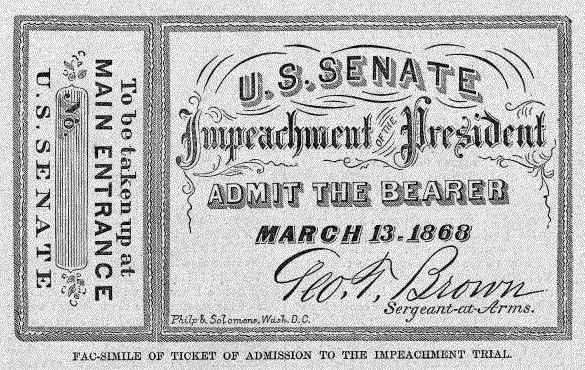
A ticket to the Impeachment Trial of President Andrew Johnson in the Senate in 1868.


Lyndon B. Johnson. 36th POTUS. 37th VPOTUS. Texas. Democrat.

The punchline of the fact sheet from the pre-Internet days ends with Lincoln being in Monroe, Maryland a week before his assassination setting up Kennedy to be in Marilyn Monroe a week before his. There is no Monroe, Maryland and Marilyn Monroe died in 1962...all according to Google.

All of this is nothing but historical coincidences. Nothing more. These comparisons between the two American presidents has been going on since the mid-1960s, more than likely.

Monday, April 15, 2013

Pointless Presidential Pfacts #34 - "The Last Time Lincoln Was in a Theater"

On April 14, 1865, Abraham Lincoln and Mary Todd Lincoln went to Ford's Theater to watch "Our American Cousin". Now while the 16th President of the United States wanted to relax at the theater as the Civil War came to an end, an individual with so much opposition to the central government's involvement in freeing the enslaved black man wanted nothing more than to topple the U.S. government on the night of the 14th. John Wilkes Booth and his conspirators planned to kill Lincoln, the loyal Southern Democrat from Tennessee and the recently sworn-in vice president, Andrew Johnson, and the Secretary of State, William Seward. Lincoln and Johnson ran on the Union Party ticket, dumping his vice president Hannibal Hamlin for the loyal southerner of the opposition party. Seward had been the nation's chief diplomat since the start of Lincoln's first term and prior to that had challenged Lincoln for the Republican nomination in 1860 and was expected to win it. Booth was a southern sympathizer from a famous family of actors, he was not unknown like his future fellow presidential assassins like Charles Guiteau, Leon Czolgosz, or Lee Harvey Oswald (and his conspirators???).


Abraham Lincoln, 16th President of the United States. Republican from Illinois.

The guy that was to kill Vice President Johnson chickened out and Johnson had no clue about an attempt. Although Booth did try to make a connection between himself and the vice president, but nothing came of it.

Lewis Powell, one of Booth's co-conspirators, had the responsibility of killing Secretary Seward. Powell made it into the secretary's home and fought off his son before stabbing him. What saved Seward was a neck-brace he wore after being in a carriage accident. Powell fled the scene and was later caught.


Lewis Powell

The only one successful that night was Booth. He had scoped out Ford's Theater and planned out his moves. He knew the play's funniest line, "Don't know the manners of good society, eh? Well, I guess I know enough to turn you inside out, old gal — you sockdologizing old man-trap." And that was when he was going to strike. Booth shot Lincoln with a derringer. After he shot Lincoln in the back of the head, Booth fought off Major Henry Rathbone, he and his wife shared the theater box with the First Couple, after bigger names like Grant and Sherman turned the play down. Booth slashed away at Rathbone, but the attack threw Booth off his game. Booth jumped from the box to the stage and his spur got caught in the flag. He broke his leg but before rushing off the stage yelled something to the audience. Two things were reported said, "Sic semper tyrannis!" which is the motto of Virginia and translates to "Thus always to tyrants." The line heard was "The South is avenged!"


Booth got on a horse, which he asked someone to hold, although they didn't know why, and he rode out of town. The Secretary of War, Edwin Stanton, issued a manhunt for Booth and his accomplices. Booth sought help for his leg and eventually made his way to Garrett's farm and stayed in the barn until Federal troops circled the barn with fire. A soldier shot Booth and he died shortly afterward. His conspirators were tried and hung for the crime. Among those executed on July 7, 1865, was the first female, Mary Surratt.


John Wilkes Booth

But on the night of April 14th, doctors in Ford's Theater tried to save the president's life. Fearful that President Lincoln would not survive the bumpy road back to the Executive Mansion, they moved the president across the street. Lincoln died the next morning. It is said that Stanton said, "now he belongs to the angels" and later he changed his quote to "now he belongs to the ages."


Johnson was sworn-in as the 17th president of the United States. Lincoln's plans for Reconstruction of the South would never come to light and a political power struggle between President Johnson and the Radical Republicans would harm Reconstruction and Civil Rights for about 100 years until after another assassinated president is succeeded by another Vice President Johnson.


Andrew Johnson, 17th President of the United States. Democrat from Tennessee.

Friday, April 12, 2013

Pointless Presidential Pfacts #33 - "The 33rd President follows the 32nd"

On April 12, 1945, Franklin D. Roosevelt, the 32nd President of the United States, died. When news of the U.S. president's death reached Adolf Hitler in Germany, it was already Friday the 13th and his death was taken as a good sign for the Axis Powers. But of course he was wrong, since the war in Europe would end the next month. The Allied Powers would move on and the U.S. would too with Harry S. Truman as the new and 33rd president of the United States.

In 1944 FDR was reelected to an unprecedented 4th term as POTUS. The inauguration for the 4th term was less grand this time around. Instead of at the Capitol, the ceremony was held on the South Portico of the White House. The reason for the difference in ceremonies was because the U.S. was at war and it was Roosevelt's 4th time. Business as usual. In that 1944 election, Truman was elected to the vice presidency. He was FDR's third vice president. John Nance Garner, a conservative Democrat from Texas, was elected and reelected with FDR in 1932 and 1936 and for FDR's 3rd term he had liberal Democrat Henry A. Wallace from Iowa as his running-mate. Wallace was so liberal in the minds of Democrats in 1944 that if he remained on the ticket it would harm FDR's chances of reelection. His 4th election was the closest of his four but he still pulled in over 50% of the popular vote. He ran against the young and popular New York Governor Thomas Dewey, who would run an even closer race four years later against President Truman. Had FDR passed away before January 20, 1945, Wallace would've been POTUS. In 1940, Wallace went from the head of the Agriculture Department to the vice presidency. After his term as vice president, he would return to FDR's (and remain with President Truman's) cabinet as the Secretary of Commerce. Wallace would eventually leave the cabinet and in the 1948 election run against Truman and Republican Dewey as the Progressive Party's candidate. He would come in fourth and with no Electoral Votes against third place finisher (and winner of some Electoral Votes) Dixiecrat Strom Thurmond. At the 1945 inauguration, Wallace swore-in the vice president-elect just as Garner had done for Wallace at the 1941 inauguration. Truman would be the vice president for only 82 days, before taking the Oath of Office.

Upon arriving at the White House and learning of the FDR's passing, Truman asked First Lady Eleanor Roosevelt "Is there anything I can do for you?" to which she replied "Is there anything we can do for you? For you are the one in trouble now." After he took the oath, he said of his new responsibility, "I don't know if any of you have had a bale of hay fall on you. Well, I feel like the sun, the stars and all the planets just fell on me."

Tuesday, February 12, 2013

Pointless Presidential Pfacts #32 - "Give it a Name"

Franklin Roosevelt was the first to call his annual message to Congress a "State of the Union" address in 1934. It wasn't until 1947 when Harry Truman was president and the first to be broadcast on television did the address' name enter common usage.

Sunday, February 10, 2013

Pointless Presidential Pfacts #31 - "Let's Clear Things Up with the Vice Presidency"

The following words were added to the Constitution with the 25th Amendment after its ratification on February 10, 1967:

In case of the removal of the President from office or of his death or resignation, the Vice President shall become President.

Before that it was unclear if the vice president of the United States became the president or an acting president. After the first death of a president in office, William Henry Harrison, on April 4, 1841, John Tyler stepped up and took the oath of office. The Tyler Precedent was followed by Millard Fillmore, Andrew Johnson, Chester Arthur, Theodore Roosevelt, Calvin Coolidge, Harry Truman, and Lyndon Johnson.

The amendment's second section clarified what to do if there is a vacancy in the vice presidency. Whenever a vice president became president, like those listed above, or died in office or resigned, the vice presidency remained unoccupied. Six years after the passage of the amendment, Spiro Agnew became the second vice president to resign from office and Richard Nixon used the new amendment to fill the office. Gerald Ford became the first vice president appointed to the office, after approval by both Houses of Congress. Less than a year into the office, Nixon became the first president to resign the presidency making Ford the first president of the United States never elected to either office. Once president, Ford appointed Nelson Rockefeller to the vacant office of the vice presidency. So from 1974-1977, the POTUS and VPOTUS were appointed office holders.

The third section of the amendment also allows the president to transfer power to the vice president, if the president is unable to perform the duties of the office. President Ronald Reagan did so with Vice President George Bush and President George W. Bush did it twice with Vice President Richard Cheney. Previously this should've happened with Presidents James Garfield, Grover Cleveland, William McKinley, Woodrow Wilson, and Dwight D. Eisenhower, but there was no amendment then, of course. To transfer power, the president must write a declaration of of the transfer to the President Pro Tempore of the Senate and the Speaker of the House of Representatives, both relinquishing the powers of the office to the vice president and then resuming the duties of the office.

The final section of the amendment has never been put in to effect. President George H.W. Bush calls it a legal coup since it requires the vice president and a majority of the cabinet to declare the president unfit for office. The movie Air Force One shows the vice president and cabinet with section 4 of the amendment as a backup plan while the president is held hostage by terrorists, but the plan is never used.